Top Attractions on Portugal’s Silver Coast: Our Journey

We were sorry to say goodbye to Lisbon but after picking up a hire car we were keen to explore another area of Portugal – the ‘Silver Coast’, or Costa de Prata This runs along the central-western Portuguese coastline and is known for its beautiful beaches, historic towns and is generally less crowded than the Algarve. We had booked in at Casa Sobreiro, a holiday let just outside the village of Salir de Matos and a short drive from the coast. The owners made us feel very welcome and we were thrilled both with the accommodation and the quiet location.

Casa Sobreiro’ also pictures taken on a walk in the neighbouring countryside.

One of the attractions in the area is the medieval walled town of Óbidos. It’s very picturesque and therefore can get quite busy but it’s well worth a visit. We parked for free down at the bottom and walked into the village up through one of the Moorish gates. Bougainvilleas are in flower everywhere in summer and the views from the walls are breathtaking but unless you’re in to all the tourist shops, there’s not a lot to do. The colourful houses add to the charm of the place but it’s the medieval walls which encircle the village that are the most spectacular. The Moorish castle at the top is now a pousada (a chain of luxury, traditional hotels in Portugal), but all the walls are accessible.
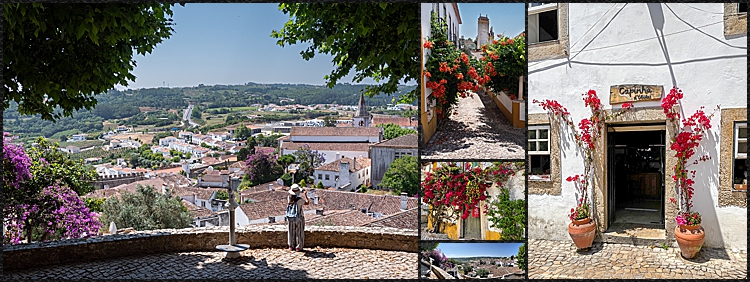
Óbidos village.

After leaving Óbidos we escaped the dust and heat of the day and drove to the coastal village of Foz do Arelho There are actually two beaches created by a saltwater lagoon. We chose to go to the main beach where there are long stretches of white sand, the other is more for paddle-boarding or kite-surfing on a windy day. There are lots of cafes along the promenade all selling fresh seafood We chose one and had a beer and then checked out another which had a very good write-up so decided that was the place to go later in the week – Cabana do Pescador didn’t disappoint. Foz de Arelho is also famous as a great place to watch the sun slowly going down. All ways round, as a seaside resort it’s an idyllic summer destination.

Foz de Arelho by day and in the evening.

We do love visiting one or two historical monuments when we’re on holiday so we were keen to visit the 900 year old Monastery of Alobaća which has all of its original buildings preserved and is one of the finest examples of Cistercian architecture in Europe. Inside the medieval buildings is the Refectory, the Chapter Room and the magnificent cloister. The Nave is impressive too, in fact it’s all very impressive and great place to take photographs too.

Monastery of Alcobaća

It’s not unusual when we’re away to come across a wedding and sure enough waiting outside the church was a bridal group. What you can’t see in the picture is the crate of beer in a wheelbarrow with lots of ice just by the front steps ready for the lads to enjoy, presumbly after the Ceremony. All must have gone well becasue the wedding cars certainly woke up the town of Alcobaća as the wedding cars drove round and round the square beeping their horns.
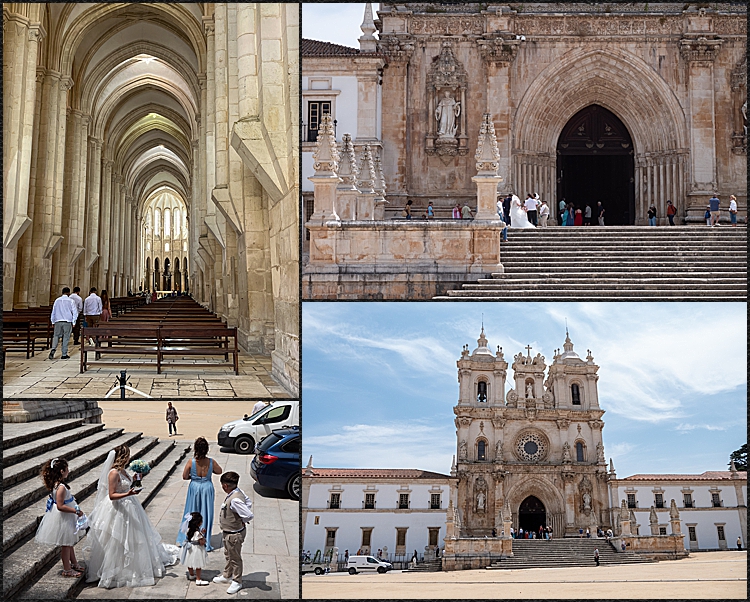
The Gothic church, adjoining the Monastery was built in the Middle Ages.

After lunch in the town we headed for the Castle of Porto de Mós which has undergone several changes since it was bult in 1200. It was an interesting drive over there with some lovely views of the countryside. The castle really stands out even from a few miles away especially two of the towers which are topped with green ceramic cones. When you see them close to it’s a bit of a ‘marmite moment’ … you either like them or you don’t. Parking is free and the admission charge is just 92 cents (half price for people like us). The castle is now a cultural centre and hosts exhibitions and conferences and also hosts plays – a perfect backdrop for an historical enactment! It seemed to us that the castle wasn’t on the tourist route and we liked that about it.

The Castle of Porto de Mós.

If there’s one place to visit in this region it has to be Coimbra. If you click on this link to the website you’ll see there is a host of things to do in this World Heritage City …and now …confession time, we didn’t do it justice. We wandered around the city including part of the medieval old town, visited the Cathedral and had a splendid lunch but we didn’t go into the famous University. Tiredeness and the heat that day was just too much and we had 120km drive back to the Casa. I’m looking now at the information on this Seat of Learning which is one of the oldest in the world and regret that we weren’t up to visiting it. If we go back to that area we will definitely make it a priority. The Throne Room; the Chapel; the Bookstore for starters plus the many more interesting rooms and buildings of this University don’t deserve to be missed.
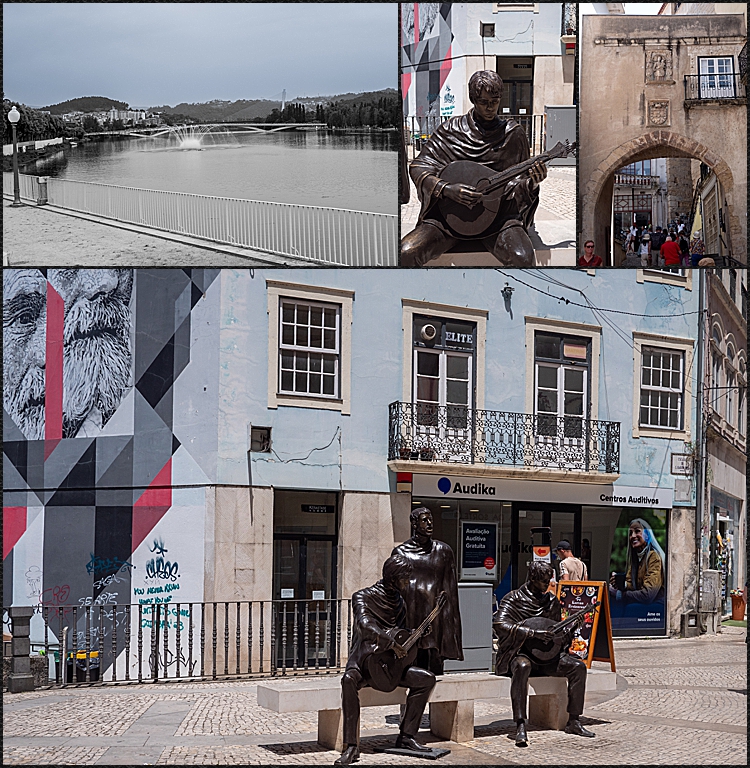
The start of our visit to the city

We parked for free in a large multi-storey car park this side of the Mondego river and walked across the bridge into the city. Loved these ‘musicians’. Very good sorveteria (ice cream shop) opposite.
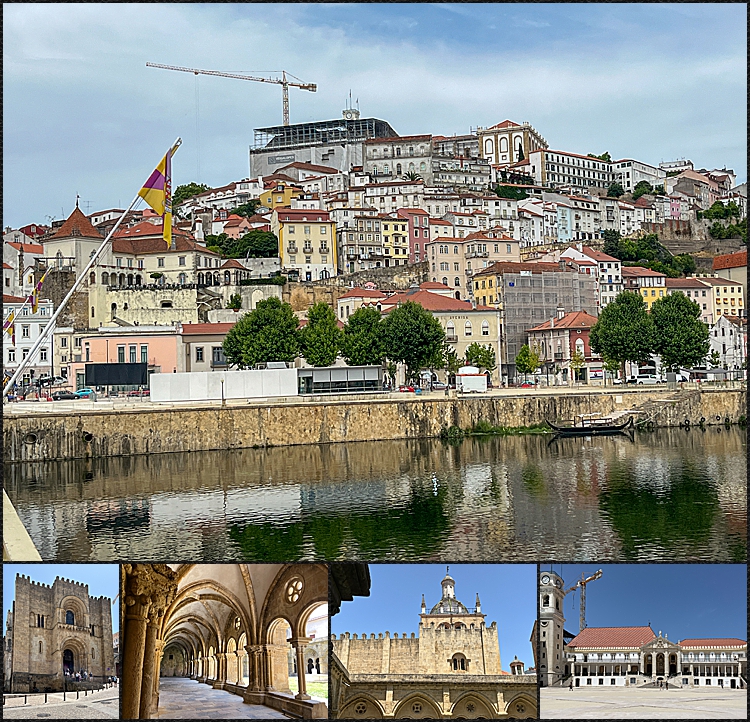
Main picture – View from the bridge. Bottom right is the front of one of the University buildings and the other three pictures are of the old Cathedral.

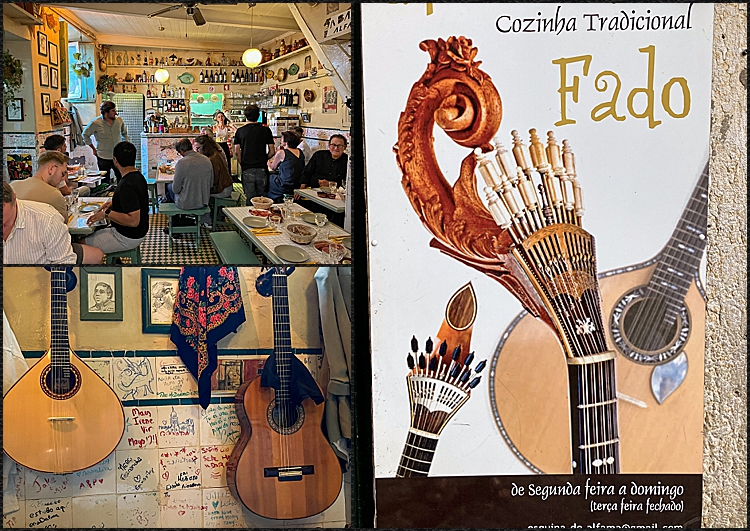
Main picture is of a window advertising Fado, a Portuguese music genre now only sung in Coimbra and Lisbon. The top four pictures show the quaintness of the city.

As I mentioned before, the Casa where we were staying was only a short drive from the coast. Foz do Arelho was one of the towns but we also drove to two more. The first was São Martinho do Porto which was incredibly busy with a very noisy fun fair surrounded by pop-up food stalls so there was a strong smell of chips together with petrol fumes from cars navigating the narrow streets looking for a parking space. We parked up on the hill overlooking the bay and walked down. We weren’t very impressed with the place but we will never forget the glass of rosé we were served – it was the worst rosé wine ever! To be fair, the cafe manager did admit that it had gone off …(in the box!) and gave us a glass of white wine instead. So sorry, São Martinho do Porto – we weren’t impressed with the place, maybe on another day …Nazaré however was very different.

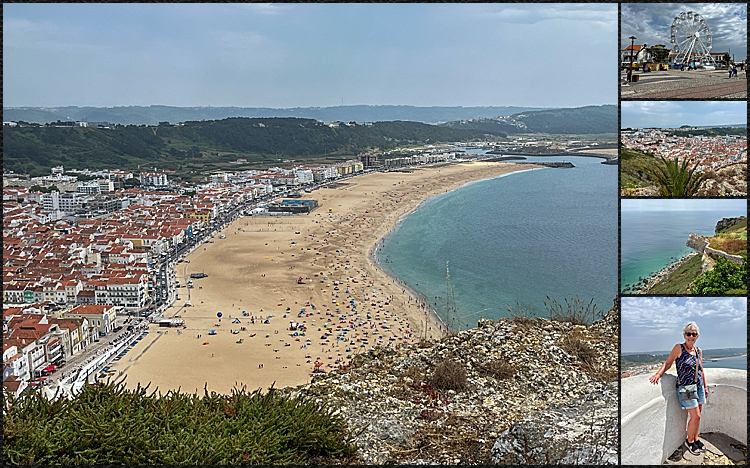
We parked in Sitio which is a district of Nazaré. This fishing village is perched on top of the craggy headland where you get a fabulous view of the bay and Norte Beach. We visited the impressive church of The Sanctuary of our Lady of Nazareth and the nearby chapel and then went by funicular down to the town. The funicular leaves every fifteen minutes and if you can get a clear view as it goes down, its worth it. Built in 1889 it was modernised in 2002 and is used by both tourists and locals. A return ticket is €4.00.

The view from Sitio.

It was a public holiday the day we went, so the seafront was very lively. Having just sat down with a cold beer in front of us we heard music getting gradually louder, sure enough it was a procession. Naturally I couldn’t resit taking a few pictures.

Celebrating Corpus Christ – a national holiday in Portugal.

Nazaré is known for its beautiful crescent-shaped beach; its cobbled streets and big waves. The bay was very calm when we were there but in the winter, if the conditions are right, waves occur which dramatically increase in height and grow to become some of the world’s largest ‘surfable’ waves. The biggest wave ever measured was 28 metres (93 feet). Surfers closely study the forecast and a hint that powerful waves are expected results in thousands flocking to the resort. I think I’ll watch the spectacle from one of the three Nazaré Webcams. The best time to see the giant waves is between October and March.

Before I write about our last day of the holiday I must mention two restaurants local to the Casa. Lagar da Suzi in the village of Salir de Matos serves traditional Portuguese food. I had the best gravy ever to go with my steak. It was a very friendly atmosphere and Suzi was extremely helpful. Take euros with you as they don’t accept cards.

Solar dos Amigos in Guisado is quite some place and attracts people from far and wide. All the accolades it gets on social media etc are well-deserved. Inside there are five rooms including one with an enormous log-fired barbeque along one wall where delicious meats and fish are grilled to perfection. The portions are big; the staff are very attentive and the food is excellent. It was so good, we went back again on our last evening.

Jardin Oriental Bacalhoa Buddha Eden.

Our flight from Lisbon wasn’t until early evening and as we had to leave the Casa by 10.00am, we needed to find something to do. Our hosts suggested ‘a quirky’ place full of statues and only a short drive away so we thought why not? Honestly we were amazed by Jardin Oriental Bacalhoa Buddha Eden. With its 35 hectares, Buddha Eden Garden is the largest oriental, sculpture park in Portugal. As well as statues of Buddha (one is the largest in Europe), the park reflects a multi-faith philosophy. Several cultures and countries are represented including Buddhism, African art, replicas of the Chinese terracotta warriors and a unique collection of Asian plants and flowers. It’s a peaceful place, well laid out with paths leading you through different gardens, hidden corners and interesting viewpoints. It was quiet when we were there which made us think this ‘Eden’ is very underrated and overlooked by tourists. We stayed about three hours and enjoyed a simple lunch washed down with a glass of local wine whilst looking out on a bed of pale blue aliums intersperced with heads of Buddhas. Yes it’s different, yes it’s off the beaten track, yes it’s completely different to any other attraction in Portugal and yes you will be wowed by it.

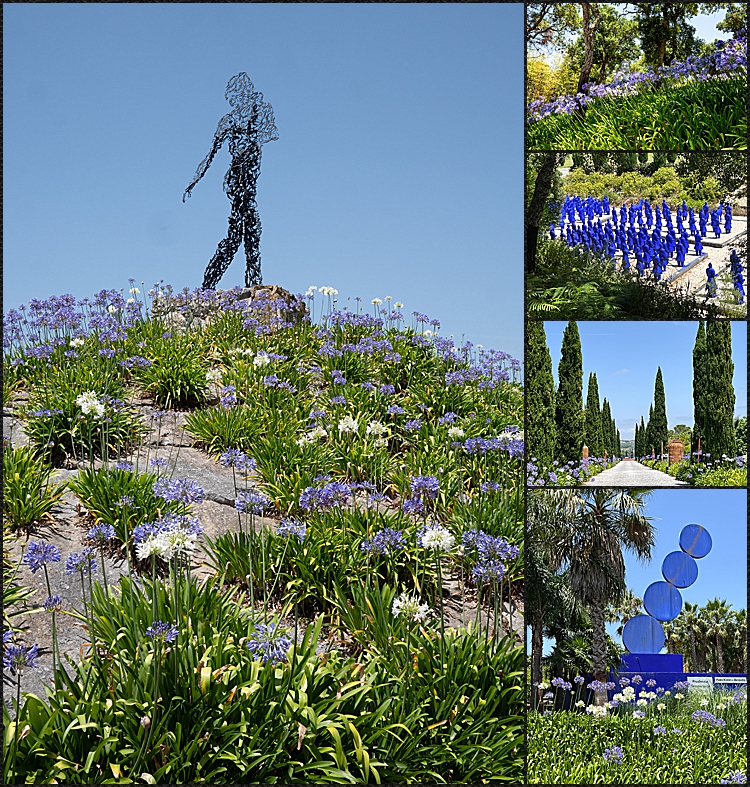
Jardin Oriental Bacalhoa Buddha Eden.

Jardin Oriental Bacalhoa Buddha Eden.

We couldn’t have found a better place to end our holiday in Portugal and for someone who loves art, photography and gardens it was perfect.

We rounded off our journey back to the airport by stopping off in Mafra, just a few kilometres from the outskirts of Lisbon. We had planned to visit the palace there but we were running out of time so we settled for a tasty Portuguese pastry each and a tea and coffee from the patisserie opposite. The Palácio National is an impressive building but by then we were happy to sit in the square, enjoy the sunshine and our afternoon tea before flying home.

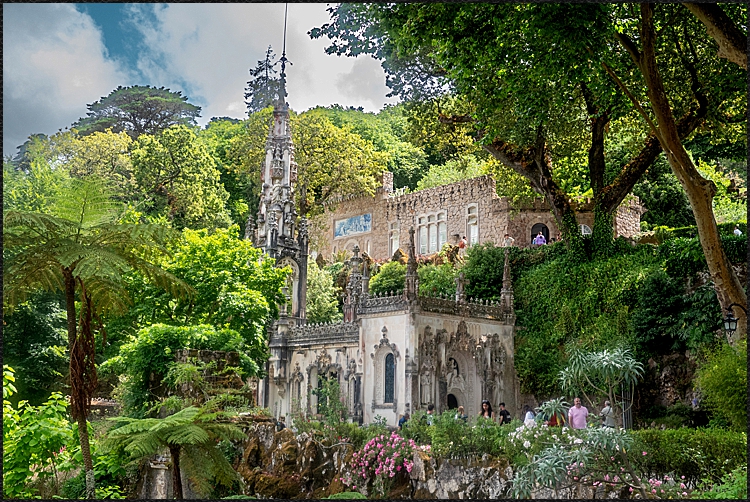
Palácio National do Mafra

Uncovering the Charm of Lisbon and Sintra.

The Portuguese guitar and the acoustic guitar.

When we booked our apartment in the Alfama district of Lisbon we hadn’t realised it was Festival season. This runs during June and July with the two important days being 12th and 13th June, Saint Anthony’s Day and yes, we were there then and our apartment was right in the middle of it. Huge street parties take place from late afternoon until the early hours. Stalls sell all different kinds of food, especially the locals favourite, grilled sardines washed down with beer which is also on sale everywhere. It’s one big pop up street market set up along the narrow cobbled streets of this historic area. I must mention too that the PA system belts out contemporary music from around 17.00hrs but to hear the authentic fado music you need to eat in one of the restaurants which has fado singers performing …which we did.

A typical evening during the Festival. Picture top left is the morning after when the street has been cleaned ready for that night’s celebrations to start all over againx

We really liked our apartment Alfama 44 even though we could hear the music through the double-glazed windows and by the third night we were looking forward to a peaceful sleep at the next place we were going to. If you prefer a quieter stay in the Alfama district, then avoid the Festival season other than that, soak up the atmosphere and enjoy this interesting area.

‘A Baiuca’ Taverna in Alfama.

As well as visiting the Museum of Fado we also wanted to hear a live performance. A little research was done and the restaurant that appealed to us was just up the street from our apartment. The taverna, A Baiuca was the perfect choice. It’s tiny inside with about eight tables and at the back, the smallest kitchen you could imagine producing delicious, traditional, fresh food. We had a fantastic night enjoying superb food and listening to authentic Fado performances. The main singer, Fernanda was accompanied by two traditional fado musicians and when Clara had chance in between serving everyone she also sang for us. We would thoroughly recommend A Baiuca for a dining experience like no other. We are hooked on Fado. It is melancholoic and mournful in many ways but incredibly powerful and romantic and rooted in Portuguese culture. It’s usually performed by a soloist and talking during the performance is very much frowned upon. By the way, you must book beforehand to get a table at this taverna.

Quinta de Regaleria part of the UNESCO World Heritage Site in Sintra.

The majority of tourists visiting Lisbon will head off to Sintra for the day. The easiest way to get there unless you have a car or you are on a coach tour is to go by train which is only a 40 minute journey from Lisbon. The last time we came we visited the 8th Century stone Castle of the Moors and Pena National Palace both up in the hills and a bus ride away from the station. Both are worth a visit and do-able in a day. This time we were heading for Quinta de Regaleria which is short walk although we stopped along the way to have a cold drink and a pastel del nata before starting the climb up to la Quinta de Regaleira.

Some accounts describe the estate as ‘mysterious’, others as ‘enchanting’, I would say it’s quirky and interesting with a fairy-tale persona with delightful gardens too. According to the website for Quinta de Regaleira it was built at the end of the 19th century by a millionaire who was a Freemason. This probably explains why there are several cryptic symbols on the walls, mysterious caves to walk along and an Initiation Well. To save queuing it’s best to buy a timed entry ticket (as at 2025), adults 15€, seniors over 65, 10€.

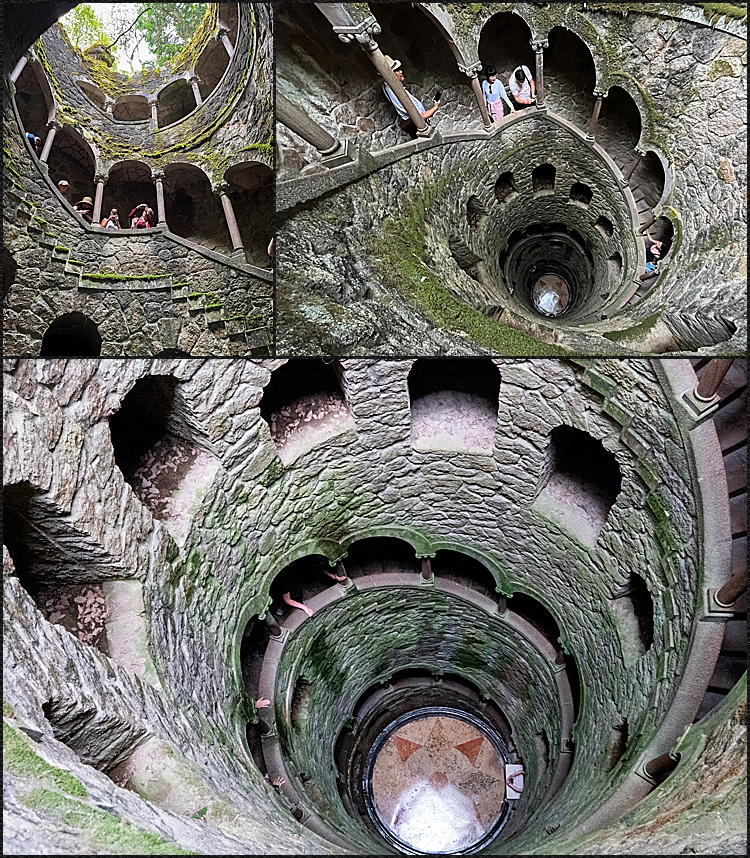
Once we were in …and it was quite a wait until our time slot we realised you can wander wherever you wanted. Because the estate is so large it didn’t seem very busy until we arrived at the queue for the Initiation Well … it was long, very long. Not surprisingly all visitors want to see the well and it is worth the wait which was only about twenty minutes. Apparently it was built for clandestine rituals although there are several theories about its purpose. There are nine levels which is great fun to walk down although I’ve since read each platform is thought to represent the nine circles of hell! The circular floor at the bottom which doesn’t show fully in my picture has The Knights Templar cross and the symbol of a compass. There’s a network of tunnels which takes the visitor to an underground lake, waterfalls and outside into the gardens.

Initiation Well

Visiting the well gave us an appetite for lunch so we headed through the grounds and up to the cafe which is by the Regaleira Chapel which we popped into. The cafe is the only place to eat within the grounds and although it was busy we managed to get a table. We had a very pleasant lunch washed down with a glass of wine, enjoying the sight of the rather bizarre buildings.

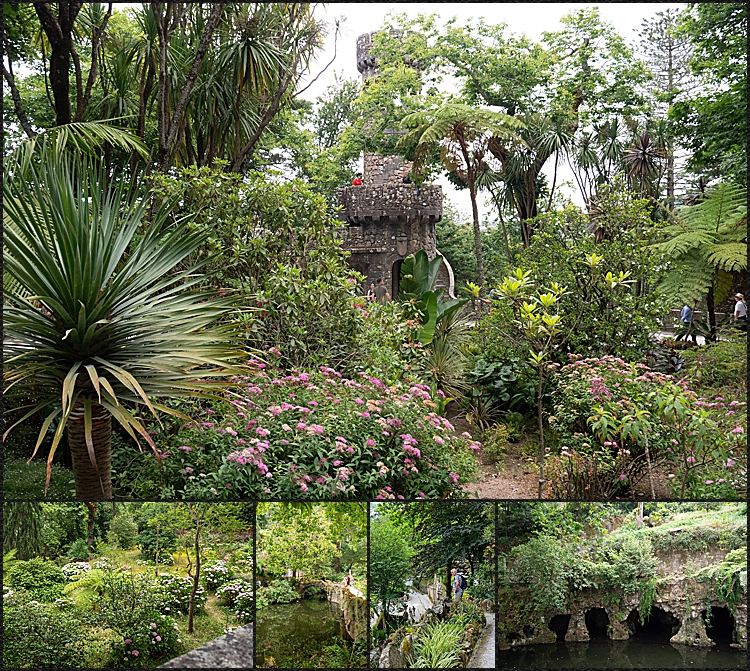
General views of the grounds.

Unless you’re in a hurry, visiting Quinta de Regaleira including the walk to and from the railway station takes up most of the day. We thoroughly enjoyed our visit to this very individual site and thought it was good value.

One of the many delightful areas of the garden at Quinta da Regaleira and my favourite.

Our last day in Lisbon was spent wandering around the city. We didn’t manage to get on one of the iconic trams as the whole central network was jammed due to crowds of people and much activity at the Cathedral. It was June 12th and what we hadn’t realised was that on this day 16 couples get married in the Cathedral and the iconic #28 tram goes right by the Cathedral. It’s part of the Saint Anthony tradition which started in 1958. There was a ‘gap’ betwen 1974 and 2019 but now this Festival has been reinstated and these weddings have become an important day, not just for those couples but for the whole city. We didn’t wait for the couples to be paraded down the street after the Ceremony as it would have meant a couple of hours hanging around with all the crowds but I’m sure it’s an amazing spectacle.

The city of Lisbon.
A favourite viewpoint looking over the sea in Lisbon.

Lisbon is a great city which is why we decided to go back a third time. There’s lots to do; it’s easy to walk round and if it’s not the ‘Wedding Day’ you can also take a tram to explore the different areas. We enjoyed staying in the historic Alfama area even though it was pretty manic at night but it all added to our holiday. There is a lot more to do than I’ve written about here but maybe this Blog has inspired you to go and see for yourself. We were sorry to leave after being there just three days however we were heading off north, to discover another area of Portugal.

Three go to Lisbon (Final Part)

Visiting a cemetery may not be on everyone’s holiday itinerary but I find them fascinating. So much scope for taking pictures and I don’t mean in a morbid way. There’s usually some beautiful statues and often on gravestones in Europe is a picture of the deceased person. Makes it somehow more personal. In this cemetery in Lisbon we came across a memorial to the firemen who had died in an incident in the city. (The memorial is the small picture below the statue).

Cemetery of Pleasures in Lisbon

At the far end of the cemetery is a separate area of graves dedicated to the men who gave their lives to the fire service. It was a peaceful spot, beautifully maintained with a superb view of the Tagus river with the 25th April Bridge bridge across. The cemetery is called Cemiterio dos Prazeres which bizarrely translates as the Cemetery of Pleasures. This would you believe, has become a popular tourist place to visit.

The website says …”When you walk through the large entrance gates and enter the central square, you don’t really notice how big this 20 hectare cemetery is. The paths along the graves are symmetrical, making Cemitério dos Prazeres look like a miniature city for the dead”. If you look at the picture (above), bottom right you can see what they mean. There are lots of avenues with small houses on either side which are the family mausoleums. They have little ‘front doors’ with glass windows which you can peer through and see the caskets …should you wish. Walking along this avenue felt a little weird so we decided to head out and find a beer. Fortunately as the cemetery is just by the terminus to the no 28 tram line, there was plenty of places to get a drink.

I should mention that if you do visit the cemetery there are famous Portuguese personalities buried there including actors, singers, writers and painters. Open every day of the week 0900-17.00.

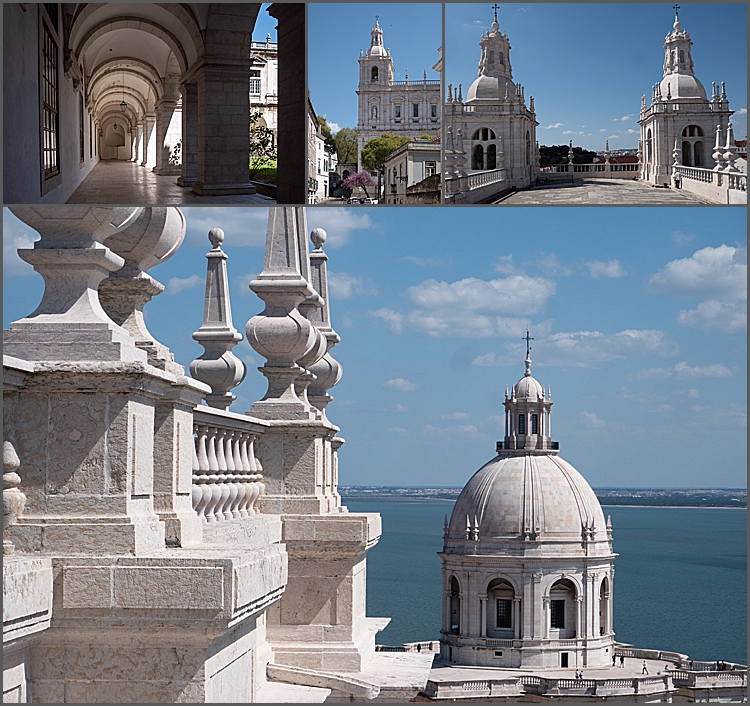
And now it was our final day. We decided to walk first of all to the St Vincent Monastery to see if we could get in the church to look round. This imposing building dominates the skyline and is huge! Its name in Portuguese is ‘Mosteiro de Sao Vincente de Fora‘ which means ‘Monastery of St Vincent Outside the walls.’

Church of St Vicente

If you go there don’t be put off by thinking it’s closed; walk through the archway on the right which takes you into the walled garden and the entrance is opposite. For a mere €5 you can wander round and enjoy the church, the collection of paintings, sculptures, the museum, an impressive gallery and from the top of the roof of the monastery you get amazing views. I’ve already mentioned that our friend doesn’t like heights so my man and I went up to to check it out. You can just make it out from the picture above that the rooftop has a balustrade and this runs all the way round. I’m so pleased I went down to tell Liz that it was really safe up there – she came up to the top and loved the all-round views.

The convent and church of 16th century St Vincent
The monastery and church of 16th century St Vincent

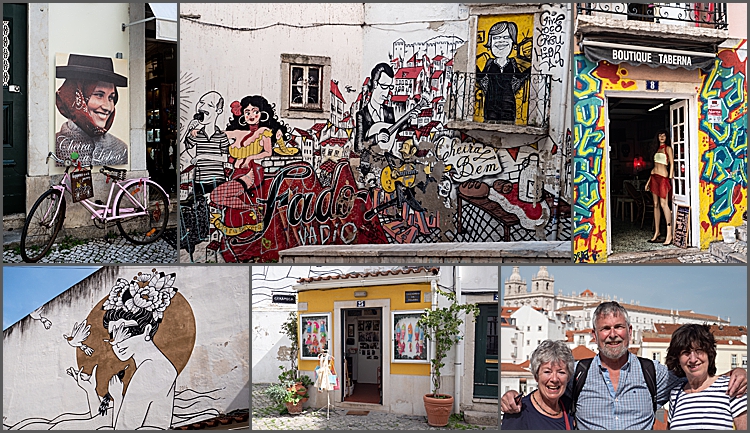
This beautiful church is in the heart of the Alfama district. Historically this area was associated with poverty, prostitution and squalor where once the poor and disadvantaged lived. Walking through the narrow cobbled streets with its ancient houses, fashionable shops and trendy cafes you could hardly believe it now. It’s a really interesting area with some very steep stone staircases where you can take in the view at the top before descending down to the maze of alley ways lined with tiny independent shops and bars.

We had a simple but delicious lunch at a cafe perched on the corner of one of the streets. We wobbled on our chairs a bit but there’s hardly any streets in the Alfama District which are flat. The fish was fresh, the beer quenched our thirst and if there were fumes from the cars passing close to our table, we didn’t mind. We had time to chat about our fab week in Lisbon; all the things we’d done and how we’ll definitely come back one day. The Alfama District is where Fado is said to have been born. It’s a melancholic style of singing said to be a deep expression of the Portuguese soul and originally associated with sailors and prostitution. This link will take you to five restaurant in Alfama where Fado is sung. uhttps://www.lisbonguru.com/5-best-fado-restaurants-alfama/ There are lots more restaurants and bars so you need to do your research as meals vary in price. To discover more about this traditional music there’s the Museum of Fado but sadly we just couldn’t fit that in before heading home.
The pictures below were all taken in the Alfama district

My favourite picture from our trip to Lisbon.

I hope you’ve enjoyed reading about our week in Lisbon. I felt I need to split the Blog into three parts otherwise it would have been too l-o-n-g! Thanks for sticking with it.

Three go to Lisbon.

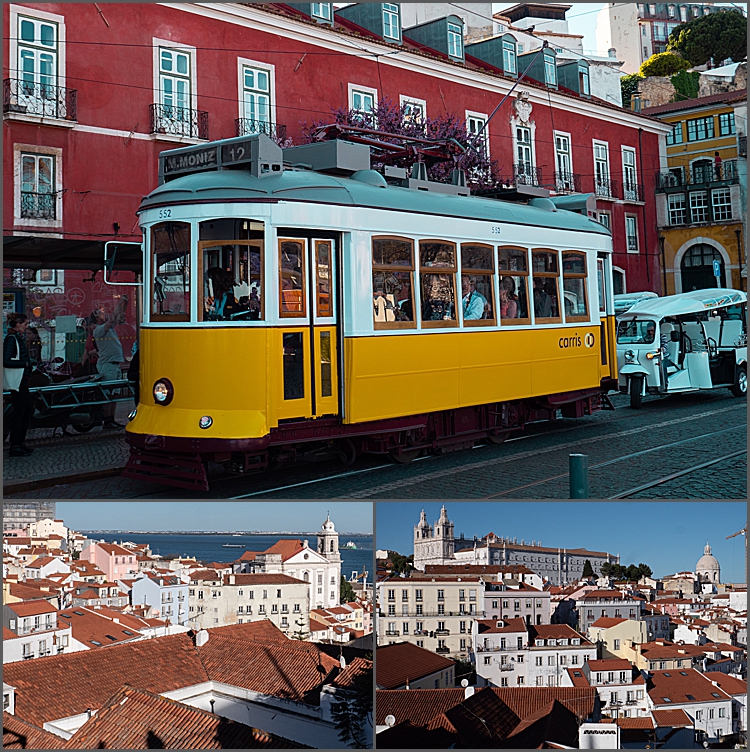
One of the iconic yellow trams which transport locals and tourists across the city. Cheap, clean and reliable and a great way to see this wonderful city. Take the number 28 tram for the classic Lisbon tram journey which screeches and rattles its way through the popular tourist districts. In this picture is also one of the hundreds of tuk-tuks ready to take tourists on a tour, costing rather more than the tram.

There’s no doubt that Lisbon is very hilly and our apartment was right on the top of one of the hills by the Sao Jorge Castle. We loved this area. In the day it teems with tourists rolling through the many souvenir shops or queuing to go into the castle and at night you’re transported back in time as you walk along the quiet, dimly lit cobbled streets. There was a full moon the night we arrived.

A full moon on our first night in the city.

Day one. First objective …to find a bakers for croissant and bread and a little grocers for fruit and yogurt. No problem at all. Our little apartment had a terrace which was one of the reasons we chose it. Perfect for eating breakfast al fresco or enjoying a glass of wine later. The terrace backed onto the wall of the castle which has several very noisy residents. It wasn’t unusual to see a peacock looking down on us from the wall or an adjacent tree, fortunately they couldn’t get out of the grounds! The thing about peacocks is that they are very noisy. I always thought that at night time birds go to roost and sleep. These delightful creatures sqwark all the time …morning, noon and night. No we didn’t get used to it! Our friend had the bedroom at the front of the building so she couldn’t hear them – we could!

Enough about peacocks, we had a city to explore. First stop was to walk down the hill to the the cathedral known locally as the Se de Lisboa. This Roman Catholic church is the oldest in the city and has an impressive Gothic cloister.

Not the prettiest church I’ve ever been in but the cloister is impressive.

Tour of the cathedral done, it was time for a sandwich and a beer before walking down to the waterside and the impressive Commerce Square.

Praca de Comericio (Commerce Square) by the Tagus river and the 25th of April suspension bridge.

This area is buzzing with tourists and locals. We thoroughly enjoyed just sitting by the river Tagus soaking in the atmosphere watching the boats go by and the antics of the seagulls. After half an hour or so we decided it was time for a little retail therapy …at least that’s what we girls thought.

You just walk through The Rua Augusta Arch and you’re into the main shopping centre. One of the most interesting shops was the window of a traditional bakers which was full of those delicious Portuguese custard tarts, Pasteis de Nata. More about these later. Having checked out the many shoes shops and making a mental note to come back to several we carried on walking to the ruins of the Carmo Convent.

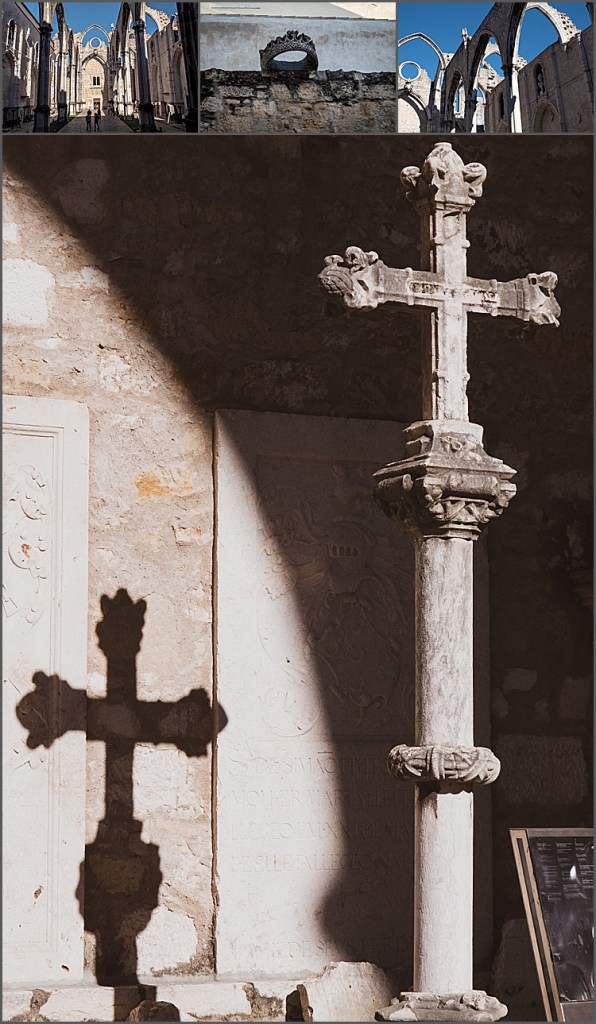
You walk through a little door by the cash desk and suddenly there’s the impressive ruins of the convent in front of you. This ruin was one of the many victims of a devastating earthquake which hit Lisbon in 1755. As well as the ruins which in themselves are fascinating there is a museum housed in the apse and nave of the convent which still have a roof over them. The museum is full of an eclectic mix of objects, tombs and tiles. The party of school children in there found some of the objects very amusing … This ruined convent is well worth a visit and a great place to take pictures.

Carmo Convent, Lisbon
The roofless Carmo Convent and Church
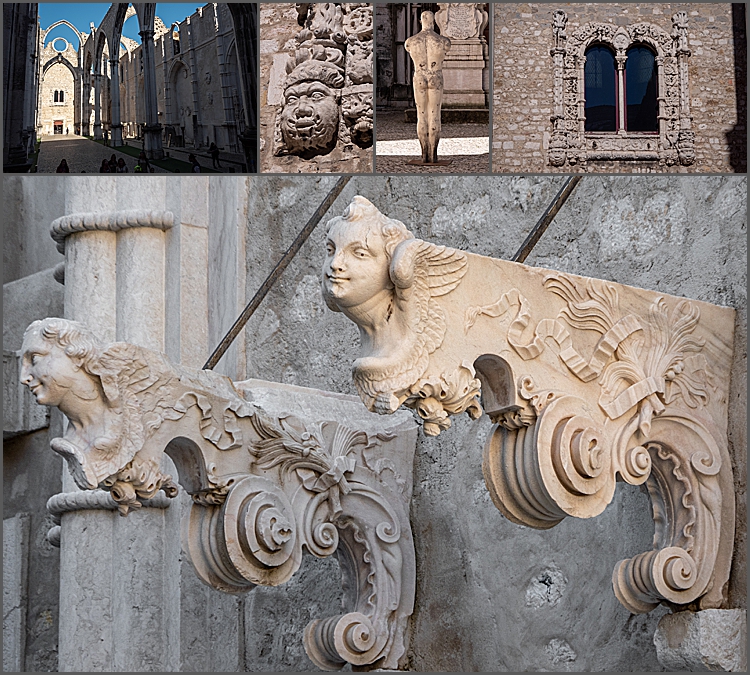
Picking out the details.
To think that some of this stone work dates back to the 15th century.

After all the walking we’d done it was time to catch a tram back up the hill. Arriving at our stop we were definitely flagging and needed to re-charge our batteries. One last thing we wanted to do though before heading back to our apartment was to walk across the road to look at the view over the city. It was spectacular in the evening sunshine.

Stunning views wherever you look.

Even though we knew there was lots more to see in Lisbon we decided on our second day to catch a train to Cascais which is on the coast just west of Lisbon. It takes about forty minutes, mostly whizzing through the suburbs with almost every wall covered in graffiti. In our carriage we were serenaded by a group of students singing Queen songs – they were really good. Couldn’t help wishing that we get this at home on our trains sometimes!

Cascais (apologies for the slightly wonky middle picture)!

We expected the town to be touristy, what we hadn’t expected was all the tacky shops and oh my goodness, the buskers! A mixed lot! The tourist information website describes Cascais as … ‘an elegant fusion of decorative 19th century architecture and modern tourist facilities’. Yes there is some interesting houses especially away from the main street but overall we weren’t that impressed. We hadn’t gone to flake on the beach and we didn’t go into The Castro Guklmaraes Museum or walk far along the coast so we didn’t really do the place justice. Don’t be put off by my lack enthusiasm though.

Back on the train and this time we got off at the station nearest to the Belem Monument. An iconic structure built in 1940 celebrating the achievements of Portuguese explorers, it’s truly magnificent. There is a lift which takes you to the top for a modest price.

Bele
The work that went into these sculptures is incredible.

Just a stone throws away from the monument is the home of the iconic and delicious Pasteis de Nata. Pasteis de Belem is the place to go for Portugal’s famous custard tart. Flaky pastry and unctuous custard is a winning combination. This bakery and cafe have been making the Pasteis since 1837 and it appears the interior dates back from that time too. We may have missed out on a visit to the nearby Monastery on account of the huge numbers of tourists outside but we weren’t going to visit Belem and not buy Pasteis de Nata.

Clutching our delightfully package treats we caught a bus back into the city and then took a cable car up to the castle and our apartment.

Time to relax on the terrace with a Pasteis de Nata washed down with a glass of rose.

After all that it was time for a siesta. We needed to charge our batteries once again before before going out that evening to a famous fish restaurant down near the sea front. Should we have booked a table …yes of course we should.

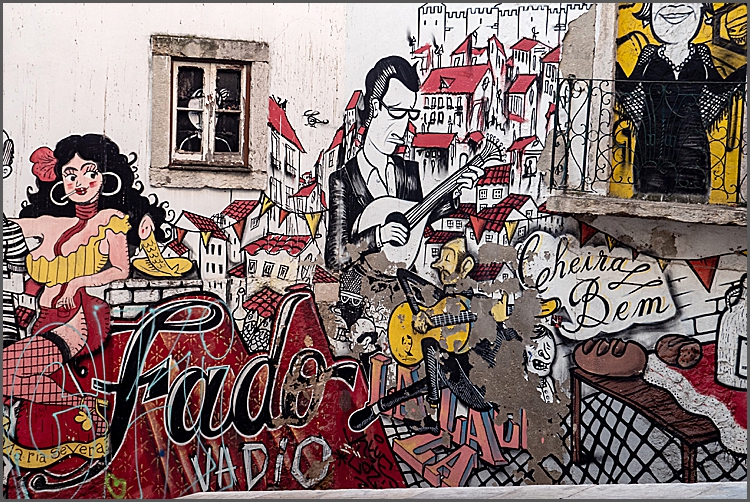
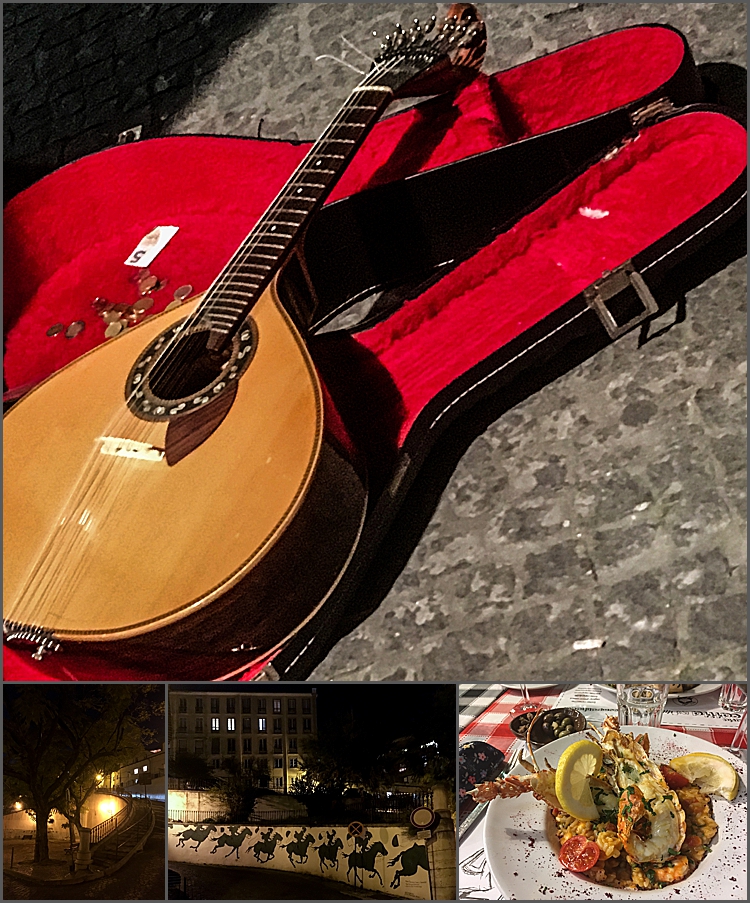
Love this picture, top left of a traditional Portuguese twelve stringed guitar. It’s associated with the music genre, Fado. I took it whilst the street busker was chatting to someone. The guitar was just lying on the ground so I quickly took a picture with my phone. Fado is a form of singing which is very expressive and mournful and I would add, haunting. The music is often associated with pubs and cafes and originated in Portugal in the 1820’s. We noticed that restaurants advertising Fado singing were quite expensive which did put us off. I wish now we had tried one but as we will definitely be going back to Lisbon we’ll not miss out on this again. There’s also a whole museum devoted to Fado.

Walking the back streets of Lisbon at night is so enjoyable and feels safe. There’s lots of atmosphere, graffiti and interesting murals. It was a shame we had to wait outside Maria Catita restaurant for almost an hour for a table but we were given a drink along with all the other tourists waiting. Quite a party really except the wine was terrible! My lobster dish, pictured bottom right was delicious and well worth waiting for. This popular restaurant fully deserves its reputation but if you go, book a table!

Well we’re halfway through our week in Lisbon so I think it’s a good time to finish the first half of this Blog. Lots more pictures to come including what we got up to in Sintra and our visit to the Lisbon Oceanarium. I hope you’ll stick around to read the final part!