


It’s never easy leaving the beautiful scenery of Switzerland but as we were heading for our favourite area of France, it wasn’t too much of a wrench.
Our first stop was Montreux in the heart of the ‘Swiss Riviera’ on the shores of Lake Geneva. Already the weather was improving as we walked a little way around the lake in the welcome sunshine. It wasn’t long before we spotted what we were looking for …the statue celebrating a rock legend, Freddie Mercury. Not surprisingly there were a number of people wanting to have a picture with the great man, I wasn’t going to miss the opportunity either.

I’m sure Freddie would have approved of both the statue and the location and the dedication on the plinth. What a great tribute.
Grabbing a quick lunch and raising a glass to the man himself we then drove to another famous landmark, Le Chateau Chillon. The word ‘Chillon’ means rocky platform and that’s exactly what this castle sits on, its part and parcel of the rock itself. It’s surrounded by a natural moat and can be accessed from all sides but visitors these days take the easy route along the bridge.

There is evidence everywhere that the castle was hewn out of the rock. The stony floor and vaulted Gothic ceilings are superb but the rooms underground hold a dark history. As well as storing wine and beer barrels, much of the space was used to house prisoners. ‘Offenders’ were chained to the stone pillars and fed meagre rations. The most famous prisoner, was Bonivard, a priest who converted from Catholicism and became a Protestant. Centuries later, the poet Byron was so inspired by the story that he wrote the now famous poem, ‘The Prisoner of Chillon’.
It’s an extensive fortress and has many rooms; the cellars and dungeons being the most interesting. Chateau Chinon has lots of architectural details; paintings, murals and furniture and because of its shape there are several courtyards and interconnecting walkways. If you’re in the area this castle is well worth a visit, not just for its historical significance but for it’s location right on stunning Lake Geneva. After we came out we walked in the garden, bought an ice cream from the shop and sat on the castle wall enjoying the view.
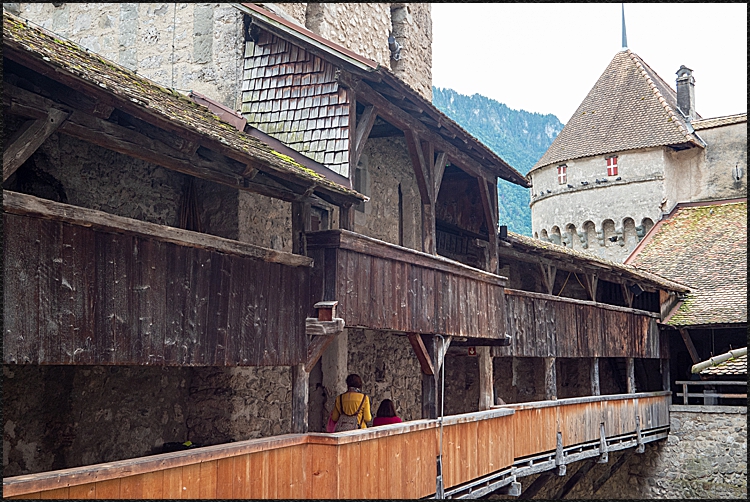
One of the covered walkways.
It’s just twenty minutes to the French border following around the lake. Our hotel that night was excellent and the staff were great. Happy to recommend Hotel le Leman at Saint Gingolph and the lakeside resturant, Restaurant du Port À Meillerie where we ate that evening.

Wow what a superb breakfast! Ready to face the day we set off in the direction of the medieval city of Annecy. It took us a while to get to the lake which was annoying as we had quite a drive ahead of us from there. Thankfully we managed to find an underground car park just by the historic centre although we didn’t have lot of time to explore or see the old gates which are preserved in what was a fortified town. After stretching our legs walking along the lakeside we turned towards the old town and of course I had to take a picture of the iconic ‘Palais de l’Ile’. It’s built on a rocky island and looks a little like a boat marooned on the river. This town is as you would expect very touristy so after grabbing a baguette for lunch we got on our way again. It was easier to find the road out to the motorway than it had been coming in.

And now we were heading to Provence and our gîte for the week in the village of Lagnes. We’d stayed in this charming Provencal village the year before and it had suited us so well that we decided to go back again. Aurelie and Fabien, the owners are very welcoming and the rooms in the gîte are quite spacious. Although it’s part of the house, the accommodation is self-contained with a private patio leading off from the bedroom. Another reason that we like this gîte is we can use the pool at any time and bbq when we like and there’s no problem with parking.
Lagnes is very unspoilt and has many narrow paths and covered walkways between the old houses. The XIIIth century chateau which is perched on the rock overlooks the village. We walked up there one evening as you get a magnificent panoramic view from the top. The bakery is a short walk from the gîte as is the pub but nearer still is the excellent pizza place. Just one meal there is not enough, le Monde à Sa Porte does great pizzas. We went twice and had a thoroughly good meal on both occasions.
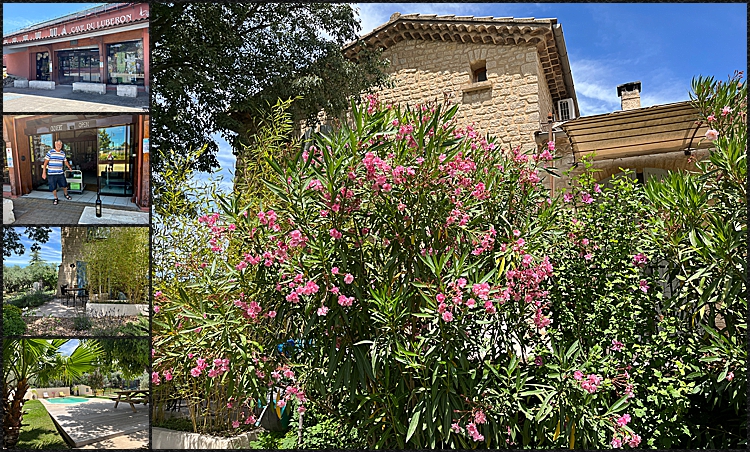
The gite at Lagnes, also the Cave du Luberon which we visit (note the trolley). It’s a necessary part of the holiday.
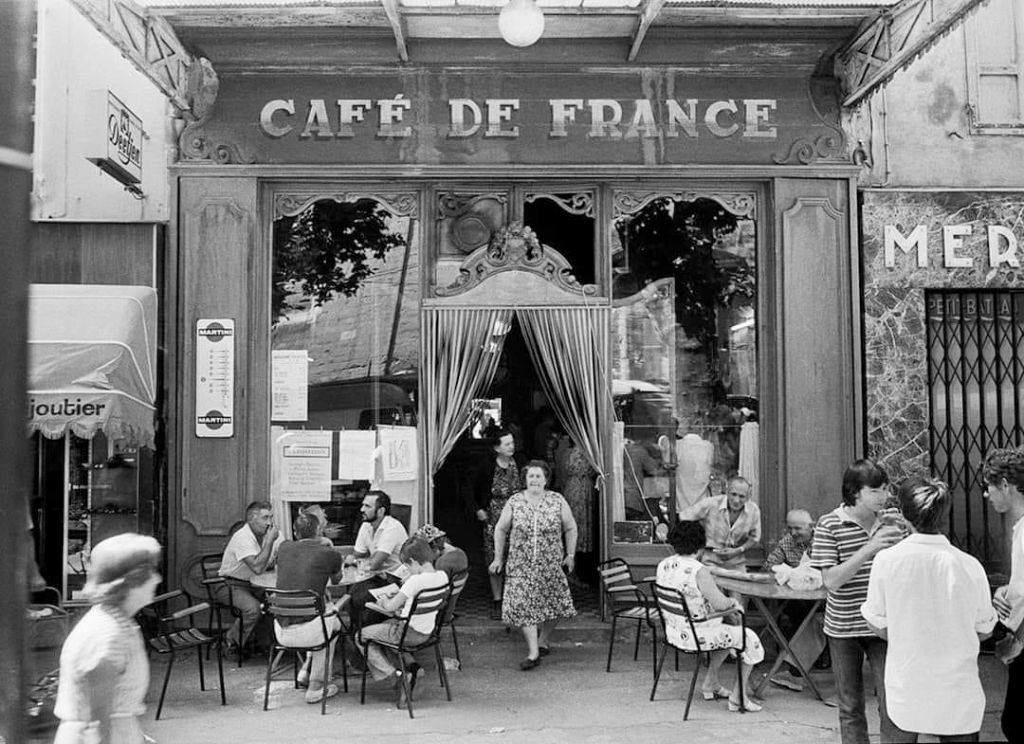
I can’t speak highly enough of Provence and particularly the south east of the region. It’s our favourite part of France and because we’ve been going there for many years we know the area pretty well. We always go into L’Isle-sur-la-Sorgue which is the nearest main town to where we stay but avoid Sundays when the Brocante (Bric & Brac) market is on. It’s impossible to park that day and where once it was somewhere you could pick up a reasonably priced antique and wander easily around the stalls, it’s not like that anymore. We like to go into the town mid-week on a Thursday to the locals’ market and sit in the square outside the Cafe de France with a beer and watch the world go by. I’ve copied this picture from their website. Not sure how long ago it was taken but the cafe itself has been going since 1903. Incidentally, this is not me in the picture!
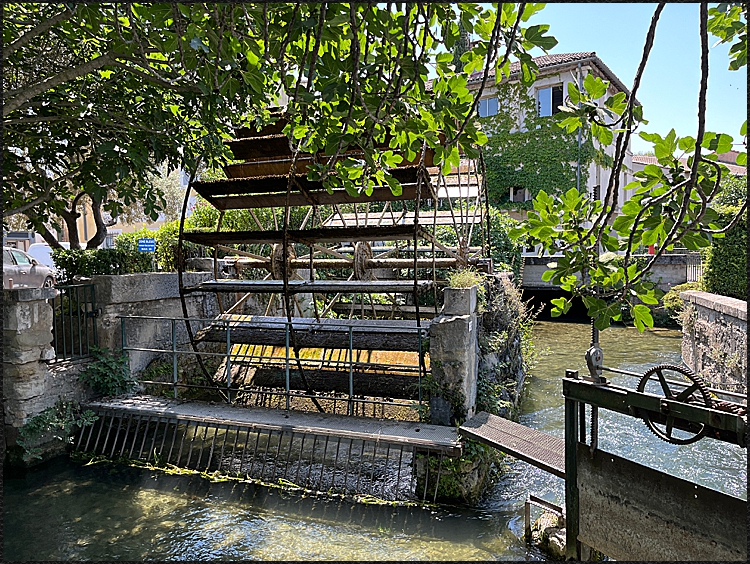
We have the TV chef Keith Floyd to thank for introducing us to this part of France and to L’Isle (as the locals call it). We watched a programme, probably thirty-five years ago now, where the chef had set up his grill on a bridge and was cooking, glass of wine in hand of course. He was waxing lyrical about the town and when the camera swung round you could see why. This ‘Island city’ is very picturesque with its canals of clear, blue water, little bridges, flowers spilling over the tops of the railings and giant waterwheels turning in the Sorgue river. Fortunately although the town is much busier than it used to be it still has lots of charm and we always enjoy walking around and popping into some of the more bohemian, independent shops.

Whilst we’re in Provence we travel around enjoying the countryside, the villages and soaking up the history and the atmosphere. It’s only recently that we’ve discovered the village of Oppéde-le-Vieux. This medieval village is off the main tourist route and is quite remote. You can park a little way outside and pay a small amount or there’s free parking in Oppéde village and enjoy the 30-minute walk to the old village. There’s a well laid out botanic garden at the start to the village which is full of plants and shrubs including ‘garrigue’, which enjoys this dry, Mediterranean climate. Further along the path towards the village is the graveyard which we had a wander round before arriving at the cobblestoned ‘Place de la Croix’, the centre of the village. We were tempted to get a drink at one of the two cafes in the square but decided to wait as we wanted to head up to the Chapel. It’s quite a climb but worth it.
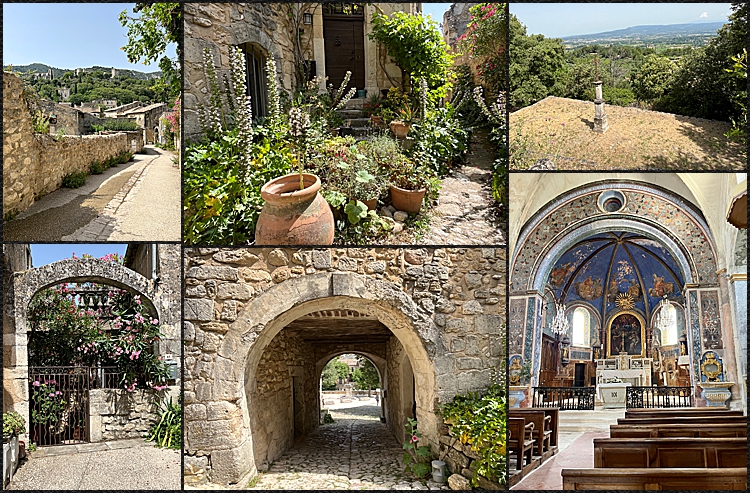
At the start of WWII there were around ten people living there. After the war, the interesting ruins attracted artists and students studying architecture and gradually a community grew. Thanks to them the houses, churches and castle ruins were protected and today the village is well preserved. I imagine it’s a heritage site since grants have been procured enabling the ruined castle to be saved from further decay.
The beauty of this village is that it is remote and is more or less unchanged from medieval times. There’s a tea shop in the Place de la Croix where you can sit in the small courtyard and enjoy one of the owner’s refreshing drinks. Perfect to revive you after a steep climb up to the church and a scramble over cobbles on the way down. It’s worth having a look in the boutique shop there where I always find something to buy.
During our week this time we went to several places and rather than a blow-by-blow account I’ll finish this Blog by mentioning a few towns and villages and add a couple more pictures.
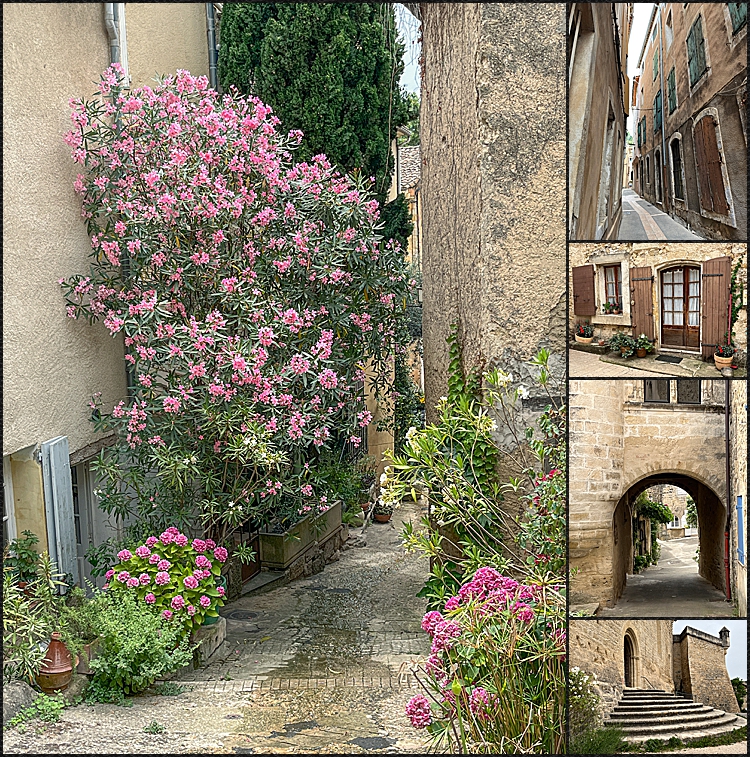
We’d spent a pleasant morning wandering around Apt which is the main town of the Luberon. It has a distinct Arabic feel to part of it with several spice stalls and Moroccan carpets on sale in the Saturday morning market. We found a good wine shop where we bought a couple of bottles of wine to take to our friends who live near L’Isle-sur-la-Sorgue. It was important to buy ‘good’ wine from a vintner rather than a supermarket for this special lunch. On the way back from Apt we meandered over the Luberon Hills and explored the medieval villages of Cucuron & Ansouis. In the latter, we came across a cafe and had a very reasonably-priced lunch sat under a large Plane tree. The castle is well preserved but then it is privately owned. There’s also a beautiful little church in the village with a wonderful set of steps in the shape of a fan.

I want to mention the village of Châteauneuf du Pape which is, like many settlements in the area, perched on top of a hill surrounded by fields of grapevines, (you have probably heard of this famous, full, red-bodies wine). At its summit is the ruined castle which was built in the 14th century by the popes as a summer residence. There’s not much left of the castle so it’s easy to walk round. The adjacent car park is free too. It was quite a drive there but we like the restaurant which is just a few steps down from the car park. The food at Le Verger des Papes is excellent but not cheap. Sitting in the garden you look across the Rhone valley to Avignon which on a clear day you can see the famous Palais des Papes.
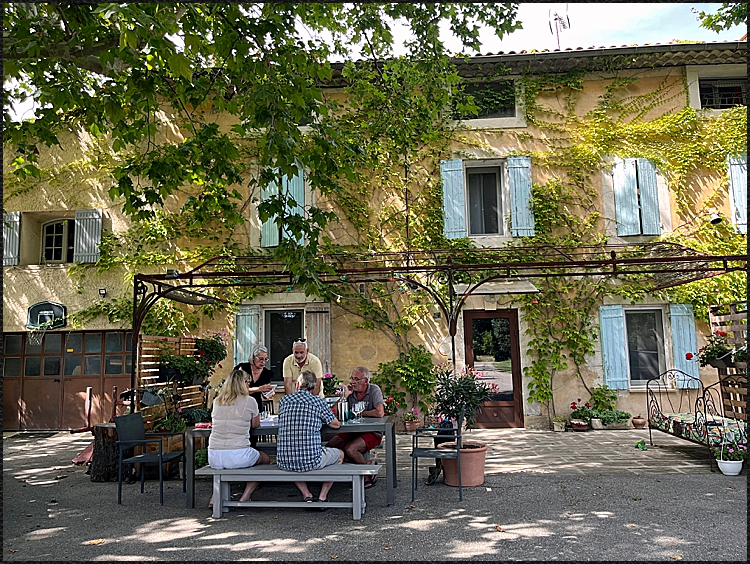
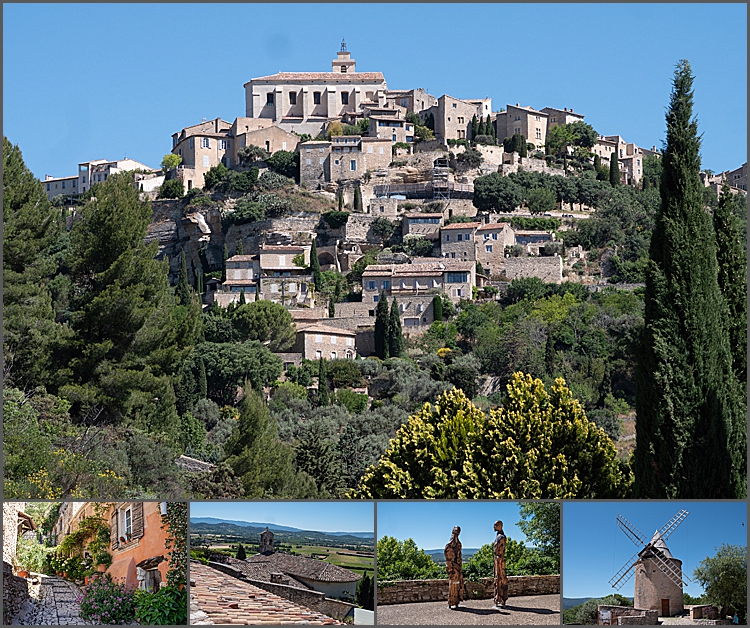
Just a couple more places to mention which we always make time to visit. Venasque is one, famous for its cherries also the lovely little chapel there and wonderful views from the ramparts and St Didier, where you must head for the nougaterie shop run by familie Silvain. Oh and I almost forgot Lacoste which is one of our favourite villages. There are so many worth visiting.
I hope my tale of our week in Provence has inspired you to travel that way and explore the countryside and the villages and the markets and all the thing that make this such a wonderful area. Thank you for reading this rather lengthy account. I could have written more …





 Travels with the Booths.blog