
We were sorry to say goodbye to Lisbon but after picking up a hire car we were keen to explore another area of Portugal – the ‘Silver Coast’, or Costa de Prata This runs along the central-western Portuguese coastline and is known for its beautiful beaches, historic towns and is generally less crowded than the Algarve. We had booked in at Casa Sobreiro, a holiday let just outside the village of Salir de Matos and a short drive from the coast. The owners made us feel very welcome and we were thrilled both with the accommodation and the quiet location.

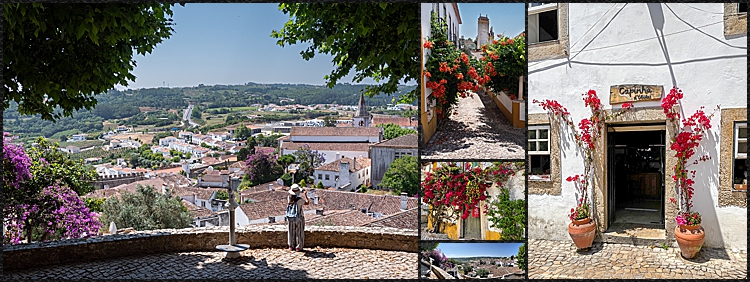
One of the attractions in the area is the medieval walled town of Óbidos. It’s very picturesque and therefore can get quite busy but it’s well worth a visit. We parked for free down at the bottom and walked into the village up through one of the Moorish gates. Bougainvilleas are in flower everywhere in summer and the views from the walls are breathtaking but unless you’re in to all the tourist shops, there’s not a lot to do. The colourful houses add to the charm of the place but it’s the medieval walls which encircle the village that are the most spectacular. The Moorish castle at the top is now a pousada (a chain of luxury, traditional hotels in Portugal), but all the walls are accessible.
After leaving Óbidos we escaped the dust and heat of the day and drove to the coastal village of Foz do Arelho There are actually two beaches created by a saltwater lagoon. We chose to go to the main beach where there are long stretches of white sand, the other is more for paddle-boarding or kite-surfing on a windy day. There are lots of cafes along the promenade all selling fresh seafood We chose one and had a beer and then checked out another which had a very good write-up so decided that was the place to go later in the week – Cabana do Pescador didn’t disappoint. Foz de Arelho is also famous as a great place to watch the sun slowly going down. All ways round, as a seaside resort it’s an idyllic summer destination.

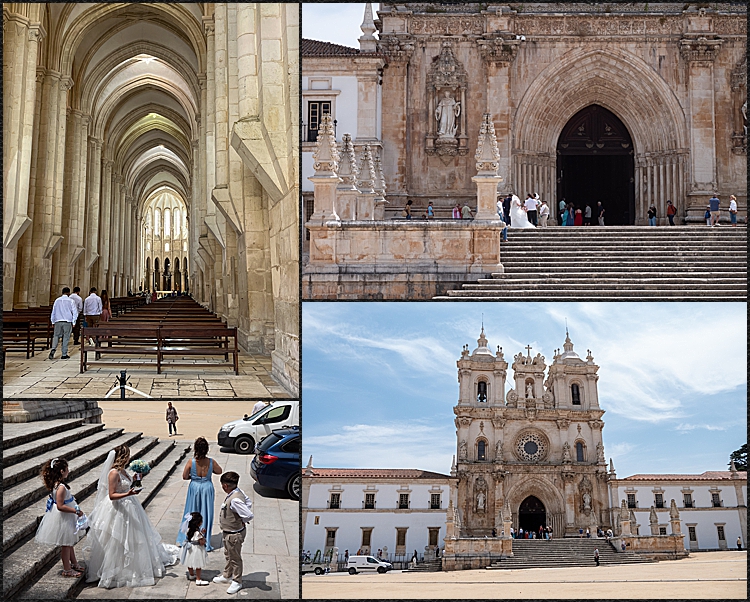
We do love visiting one or two historical monuments when we’re on holiday so we were keen to visit the 900 year old Monastery of Alobaća which has all of its original buildings preserved and is one of the finest examples of Cistercian architecture in Europe. Inside the medieval buildings is the Refectory, the Chapter Room and the magnificent cloister. The Nave is impressive too, in fact it’s all very impressive and great place to take photographs too.

It’s not unusual when we’re away to come across a wedding and sure enough waiting outside the church was a bridal group. What you can’t see in the picture is the crate of beer in a wheelbarrow with lots of ice just by the front steps ready for the lads to enjoy, presumbly after the Ceremony. All must have gone well becasue the wedding cars certainly woke up the town of Alcobaća as the wedding cars drove round and round the square beeping their horns.
After lunch in the town we headed for the Castle of Porto de Mós which has undergone several changes since it was bult in 1200. It was an interesting drive over there with some lovely views of the countryside. The castle really stands out even from a few miles away especially two of the towers which are topped with green ceramic cones. When you see them close to it’s a bit of a ‘marmite moment’ … you either like them or you don’t. Parking is free and the admission charge is just 92 cents (half price for people like us). The castle is now a cultural centre and hosts exhibitions and conferences and also hosts plays – a perfect backdrop for an historical enactment! It seemed to us that the castle wasn’t on the tourist route and we liked that about it.

If there’s one place to visit in this region it has to be Coimbra. If you click on this link to the website you’ll see there is a host of things to do in this World Heritage City …and now …confession time, we didn’t do it justice. We wandered around the city including part of the medieval old town, visited the Cathedral and had a splendid lunch but we didn’t go into the famous University. Tiredeness and the heat that day was just too much and we had 120km drive back to the Casa. I’m looking now at the information on this Seat of Learning which is one of the oldest in the world and regret that we weren’t up to visiting it. If we go back to that area we will definitely make it a priority. The Throne Room; the Chapel; the Bookstore for starters plus the many more interesting rooms and buildings of this University don’t deserve to be missed.
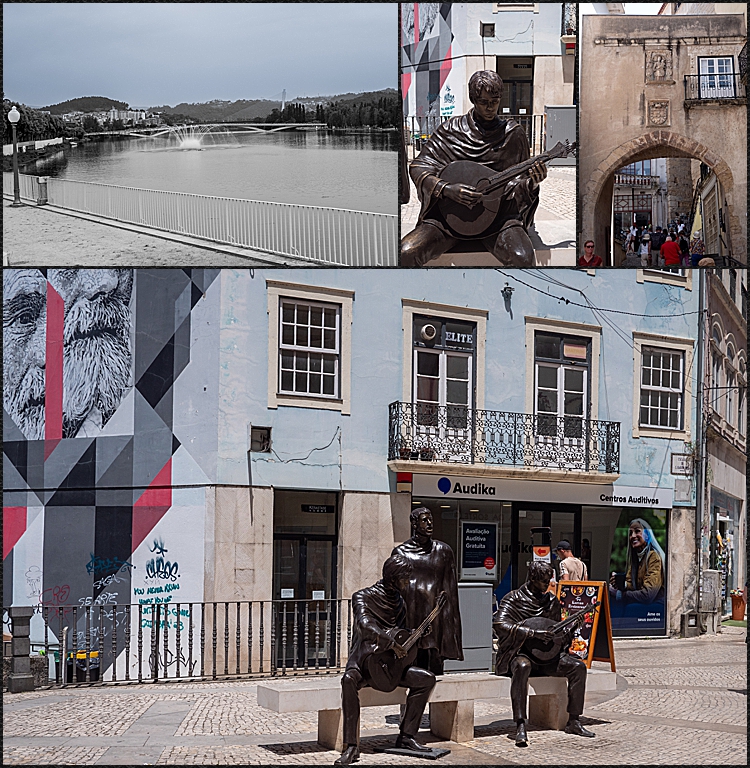
The start of our visit to the city
We parked for free in a large multi-storey car park this side of the Mondego river and walked across the bridge into the city. Loved these ‘musicians’. Very good sorveteria (ice cream shop) opposite.
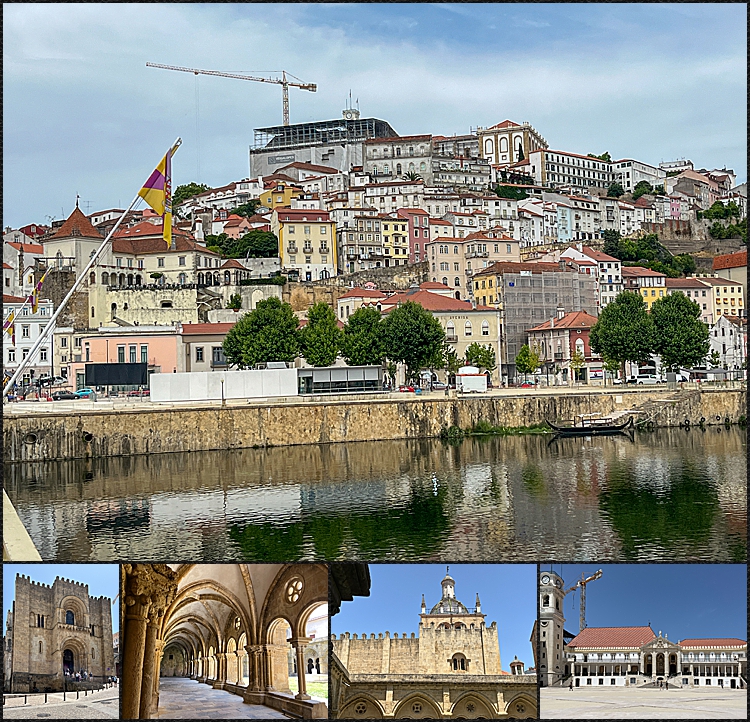
Main picture – View from the bridge. Bottom right is the front of one of the University buildings and the other three pictures are of the old Cathedral.

As I mentioned before, the Casa where we were staying was only a short drive from the coast. Foz do Arelho was one of the towns but we also drove to two more. The first was São Martinho do Porto which was incredibly busy with a very noisy fun fair surrounded by pop-up food stalls so there was a strong smell of chips together with petrol fumes from cars navigating the narrow streets looking for a parking space. We parked up on the hill overlooking the bay and walked down. We weren’t very impressed with the place but we will never forget the glass of rosé we were served – it was the worst rosé wine ever! To be fair, the cafe manager did admit that it had gone off …(in the box!) and gave us a glass of white wine instead. So sorry, São Martinho do Porto – we weren’t impressed with the place, maybe on another day …Nazaré however was very different.
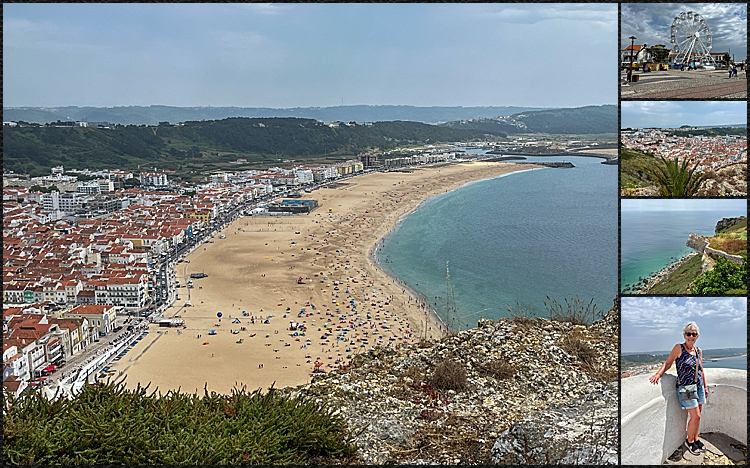
We parked in Sitio which is a district of Nazaré. This fishing village is perched on top of the craggy headland where you get a fabulous view of the bay and Norte Beach. We visited the impressive church of The Sanctuary of our Lady of Nazareth and the nearby chapel and then went by funicular down to the town. The funicular leaves every fifteen minutes and if you can get a clear view as it goes down, its worth it. Built in 1889 it was modernised in 2002 and is used by both tourists and locals. A return ticket is €4.00.

The view from Sitio.
It was a public holiday the day we went, so the seafront was very lively. Having just sat down with a cold beer in front of us we heard music getting gradually louder, sure enough it was a procession. Naturally I couldn’t resit taking a few pictures.

Nazaré is known for its beautiful crescent-shaped beach; its cobbled streets and big waves. The bay was very calm when we were there but in the winter, if the conditions are right, waves occur which dramatically increase in height and grow to become some of the world’s largest ‘surfable’ waves. The biggest wave ever measured was 28 metres (93 feet). Surfers closely study the forecast and a hint that powerful waves are expected results in thousands flocking to the resort. I think I’ll watch the spectacle from one of the three Nazaré Webcams. The best time to see the giant waves is between October and March.
Before I write about our last day of the holiday I must mention two restaurants local to the Casa. Lagar da Suzi in the village of Salir de Matos serves traditional Portuguese food. I had the best gravy ever to go with my steak. It was a very friendly atmosphere and Suzi was extremely helpful. Take euros with you as they don’t accept cards.
Solar dos Amigos in Guisado is quite some place and attracts people from far and wide. All the accolades it gets on social media etc are well-deserved. Inside there are five rooms including one with an enormous log-fired barbeque along one wall where delicious meats and fish are grilled to perfection. The portions are big; the staff are very attentive and the food is excellent. It was so good, we went back again on our last evening.

Our flight from Lisbon wasn’t until early evening and as we had to leave the Casa by 10.00am, we needed to find something to do. Our hosts suggested ‘a quirky’ place full of statues and only a short drive away so we thought why not? Honestly we were amazed by Jardin Oriental Bacalhoa Buddha Eden. With its 35 hectares, Buddha Eden Garden is the largest oriental, sculpture park in Portugal. As well as statues of Buddha (one is the largest in Europe), the park reflects a multi-faith philosophy. Several cultures and countries are represented including Buddhism, African art, replicas of the Chinese terracotta warriors and a unique collection of Asian plants and flowers. It’s a peaceful place, well laid out with paths leading you through different gardens, hidden corners and interesting viewpoints. It was quiet when we were there which made us think this ‘Eden’ is very underrated and overlooked by tourists. We stayed about three hours and enjoyed a simple lunch washed down with a glass of local wine whilst looking out on a bed of pale blue aliums intersperced with heads of Buddhas. Yes it’s different, yes it’s off the beaten track, yes it’s completely different to any other attraction in Portugal and yes you will be wowed by it.

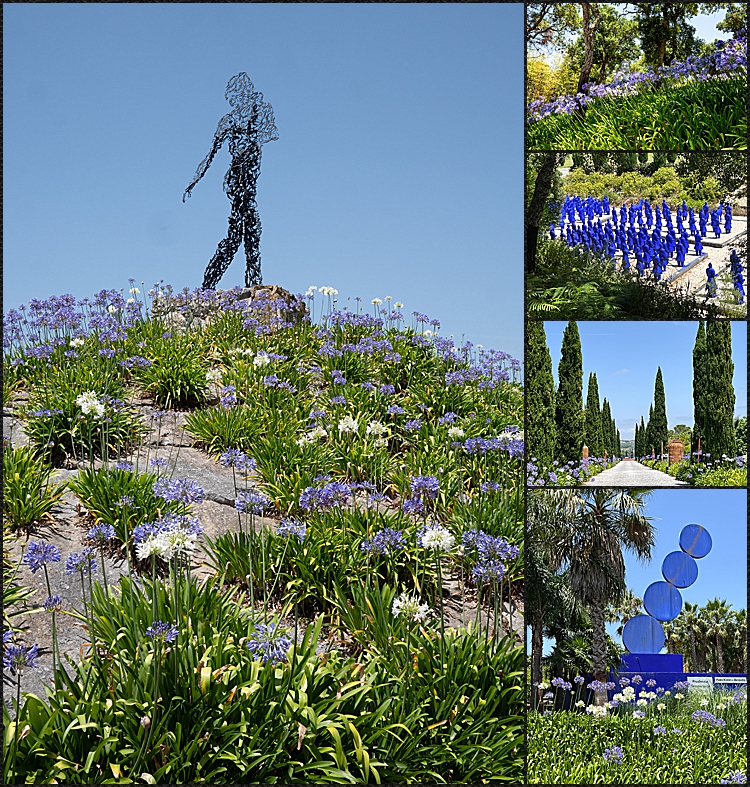

Jardin Oriental Bacalhoa Buddha Eden.
We couldn’t have found a better place to end our holiday in Portugal and for someone who loves art, photography and gardens it was perfect.
We rounded off our journey back to the airport by stopping off in Mafra, just a few kilometres from the outskirts of Lisbon. We had planned to visit the palace there but we were running out of time so we settled for a tasty Portuguese pastry each and a tea and coffee from the patisserie opposite. The Palácio National is an impressive building but by then we were happy to sit in the square, enjoy the sunshine and our afternoon tea before flying home.






 Travels with the Booths.blog