
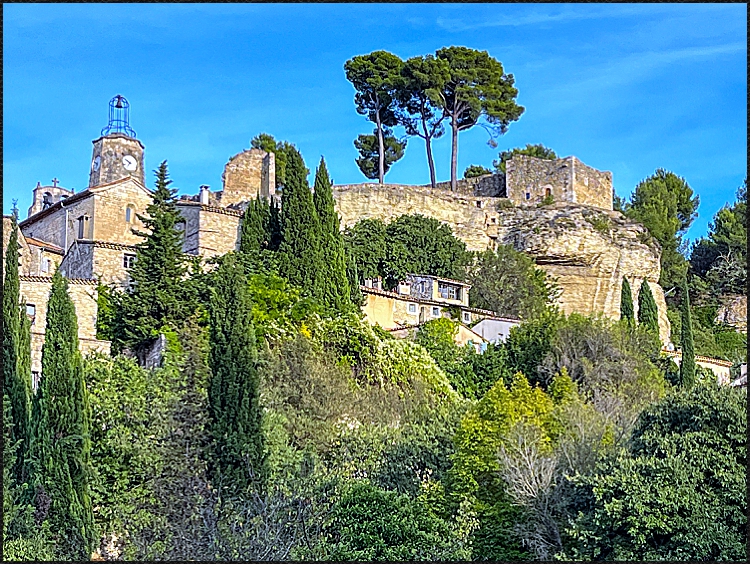
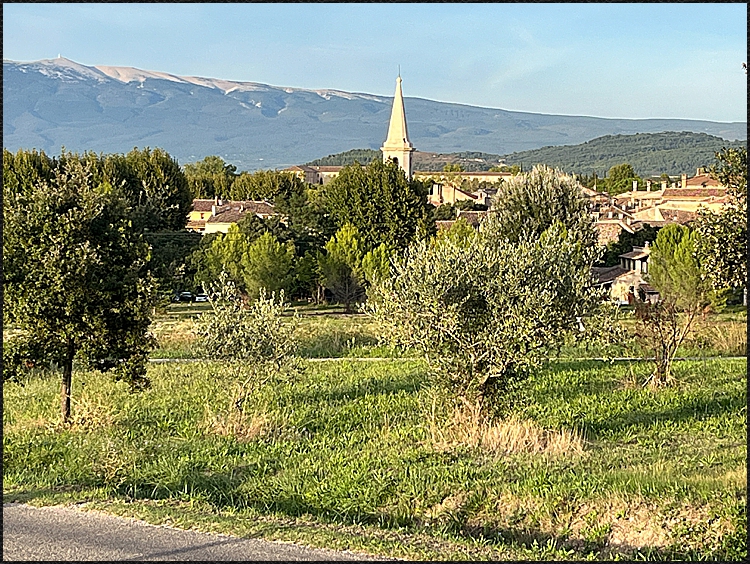
Staying near St Didier – at 305 Chemin des Tourrasses
Travelling to Provence:– Paris to Avignon by the TGV takes around two hours forty minutes. We were greeted by a beautiful blue sky and a temperature of 30 degrees as we piled off the train. It wasn’t long before we’d picked up the hire car and were heading towards the gîte which was just outside the village of St Didier in the Vaucluse Department.
The Gîte: – Gilles and his wife, Celine, made us feel very welcome, explained a few things about the gîte and then left us to sort ourselves out. They didn’t have to tell us much about the area or St. Didier as we’ve been to Provence many times and we also knew the village. We were so impressed with the view of Mont Ventoux from the gîte also pleased with the quiet location and the delightful swimming pool. We knew we had chosen a good spot for our week in Provence.

Mont Ventoux is the only mountain in Provence and dominates the Vaucluse landscape from miles around. It has gentle slopes, a ‘bald’ summit revealing white rock and is a UNESCO Biosphere reserve due to its diverse flora & fauna. It’s also famous from the Tour de France with three classic ascents and attracts ameteur cyclists, hikers and nature lovers alike. We drove up there several years ago and obviously chose the wrong day. The mist was very thick at the summit so the breathtaking, panoramic views were lost on us and the wind was so strong that we didn’t linger too long outside the car. It wasn’t a day for spotting chamois, stags, roe deer, wild boars or anything else. We must try again.
Our week.
A Provençal village: – As I’ve already mentioned, we know the area well however there are places we always want to go back to as we can never get enough of the villages in Provence. One such village is Venasque, famous for its cherries. They hold a cherry fesival in June where not only do many of the 110 growers sell mountains of cherries from their stall, they also dress in regional costume and on a certain day the whole town turns out to celebrate and venerate the humble cherry. We went once and because this is a famous festival and people come from miles around we had to park at the bottom of the cliff and walk up. The website describes Venasque as a medieval town, perched on a steep cliff …a very accurate description.
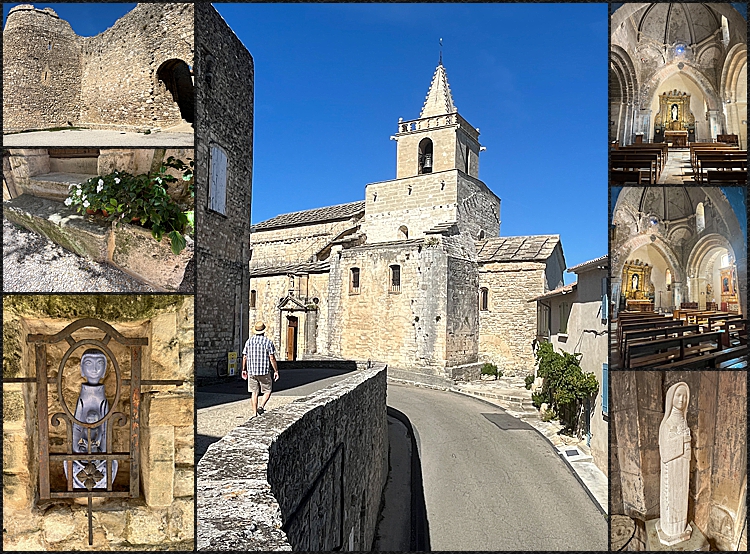
The village of Venasque.
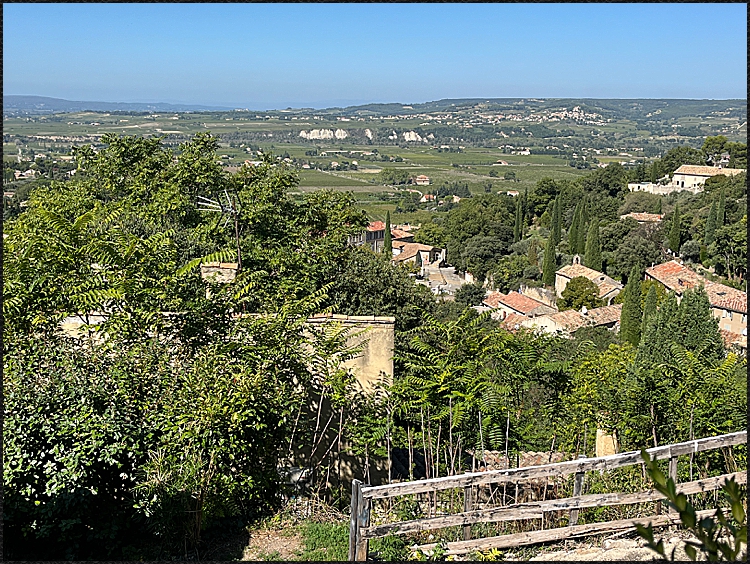
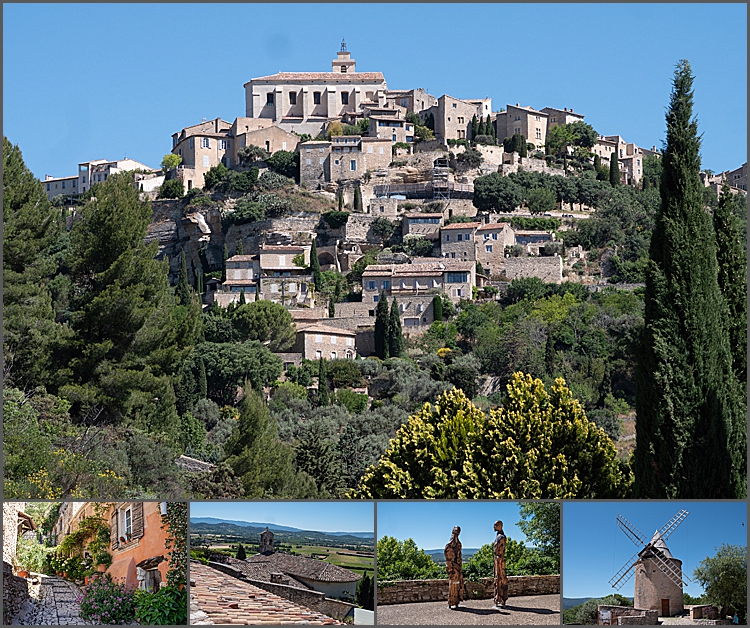
At other times Venasque is a quiet place to visit. You walk through the arch of the ramparts with its Roman towers and walk over to the Esplanade where there’s a fabulous view. From there we walk along the narrow paths to the Romanesque church of Notre Dame which (to me) has a special atmosphere and in there is one of my favourite statues. There’s also a Baptistery with the entrance around the back of the church which is apparently one of the oldest religious sites in France. The villagers obviously take pride in their village; there are flowers everywhere and interesting statues to spot as you walk along and in the little courtyard gardens too. We used to sit by the fountain and have a drink but this time we were told we would have to order a meal. We were a bit surprised as there was hardly anyone around however we walked across the road to Le Petit Chose and enjoyed a glass of wine and the view from the terrace there.
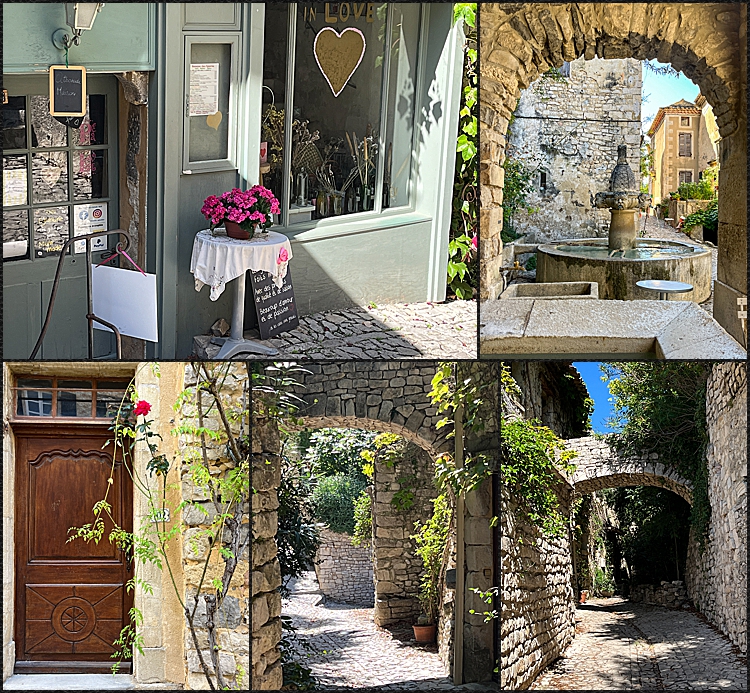
Séguret is another village which we often visit. It’s ranked as one of the ‘Most Beautiful Villages in France’ although I’m sure there are many on that list. Like Venasque it’s generally very quiet later in the year although in the ‘High Season’ it does get crowded. There are no cars driving through the narrow, cobbled streets of this medieval village which definitely adds to its charm. There are several artist’s workshops and galleries as well as artisan jeweller’s shops to wander into and a couple of tourist shops but that’s it, however the Séguret wine cellar is worth a visit. We parked at the bottom of the village where there was plenty of spaces and walked up through the Reynier Gate and along the Rue des Poternes lined with well-maintained medieval Provencal houses. We stopped a couple of times, firstly to look around a gallery where a sculptor was working on one of her pieces and then to go inside a jewellery shop. I was tempted to buy one of the beautiful pieces but the prices were a little too high for my pocket. We walked up and along to the path that takes you up to the ruined castle but one look at the state of the path was enough for us to to give the castle ruins a miss. We did enjoy the panoramic view though from the top road.
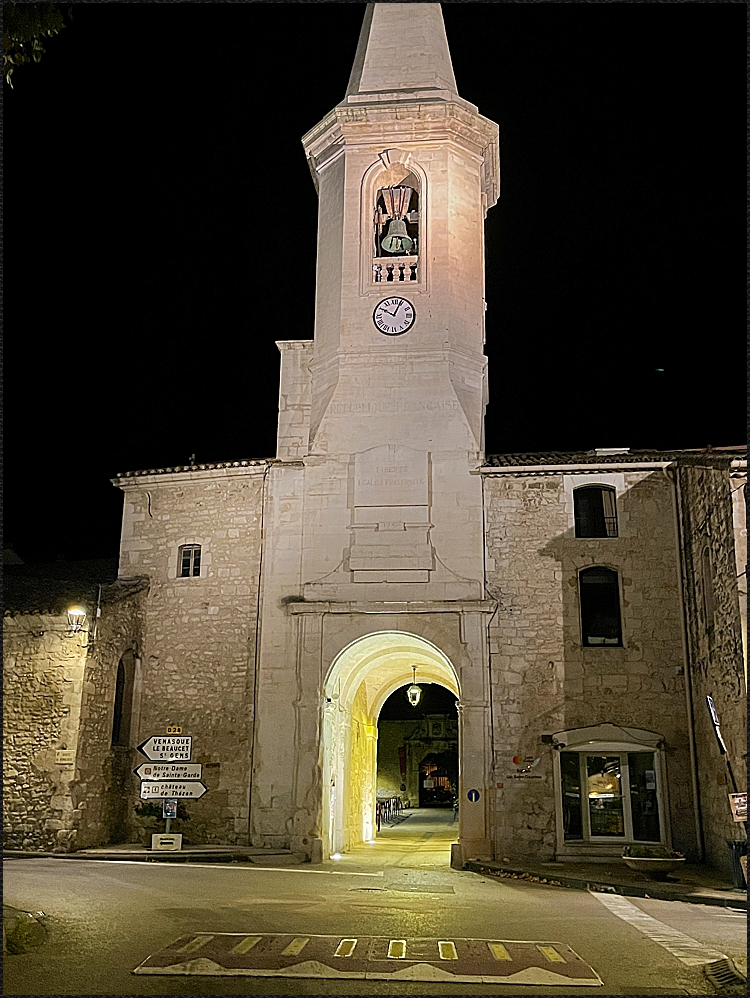
We were very happy with the location of our gîte which was only a kilometre outside the village of St Didier. There is a superb avenue in the town lined with ancient plane trees. Here are lots of restaurants, a well-supported local bar which serves good food too; a couple of grocery shops and at one end of the street there is a splendid stone archway with a clock tower you can see from miles around. Through the arch is the Chateau de Thézan which is now open again to the public. Unfortunately we missed the weekly market as we had to leave that morning but by all accounts the town is buzzing then.
Another attraction which draws people to St Didier is the artisan shop, Silvain This is a company famous for the manufacture of nougat. If you are a lover of nougat, this is the place to be. The shop has an excellent display of all their products and this is a wide range of delightful things to tempt you. This in our opinion and that of many others is the best home-made nougat produced anywhere. We haven’t done the workshop visit but that is also highly rcommmended. You are guaranteed to walk out the shop having bought more than you intended!
The town of Carpentras:
When we were in Provence a couple of years ago we tried to book a visit to the synagogue in Carpentras but the guided tour was fully booked. This year we phoned and managed to get on the tour …more about that shortly.
Carpentras is famous for its black truffle market which is held between mid November – mid February. Restauranteurs, traders and brokers come to buy the famous ‘black diamond’, the market is recognised as the place in Europe as it sets the market price for this famous black truffle. The town is also famous for its strawberries when in May the Strawberry Festival takes place. And the third claim to fame is a factory which produces Berlingots de Carpentras, nougats, Provencal biscuits, lollipops and pralines. I have to confess we didn’t buy any truffles, strawberries or visit the Confierie du Mont Ventoux, but there’s always another year …
The Synagogue of Carpentras is the oldest synagogue still in operation in France. A large Jewish community had settled in the town at that time and was placed under the security of the Pope following the persecutions carried out by the ‘Kingdom’ of France against the Israelite people. Restored in the eighteenth century, the synagogue was updated with baroque elements, including a monumental stairway that contrasts with its modest façade. Notable features include the ritual baths (mikveh), two bakeries dating back to its origins, and a dedicated room for Jerusalem within the prayer space. These elements make the synagogue a profound reflection of the Jewish community’s enduring cultural and spiritual heritage.
I can’t remember what we paid for the tour but it wasn’t much. It would have been much more interesting for us if there was some English thrown in as we walked around but unfortunately although the guide spoke good English, because everyone else in the group was French apart from two people and us, she told the history of the synagogue almsot entirely in French. We found it very challenging and after the first hour we did switch off. I asked at the end if they had a leaflet in English that we could take away, but they didn’t.
I’m glad we went as it is an interesting building and we did pick up some history. With hindsight maybe we should have asked the guide to explain a few things in English but we didn’t.

The town of L’Isle-sur-la-Sorgue:
Towards the end of our holiday we arranged to meet a friend in the nearby town of L’Isle sur la Sorgue. The town is famous for the many canals that weave through the centre, some with waterwheels and little bridges going across. The town is known as ‘Little Venice’ and you can see why. The clear waters of the Sorgue with the ferns gently swaying with the current is wonderful to watch and memerising when you look down from one of the many bridges. We always walk up to the end of the main street to see how much water is flowing into ‘Le Basin’. Along that street are many cafes with tables set out along the frontage and alongside the river. It’s a popular tourist area and is always busy. If you visit the town on a Sunday however it is packed with people who have come, not just to go to the market but also to browse the many stalls selling bric-a-brac. In the height of the summer it’s difficult to park and hard to see anything at all for the crowds. There may be bargains to be had in this ‘flea market’ but for anyone looking for an antique you do have lots of choice as there are nearly 300 antique dealers in the town!

Our friend’s choice of ice cream parlour was spot-on. The ice creams at Ravi are delicious. We sat outside along the terrace by the river and had a great catch-up. As we were leaving she told us about an old church and another building open in the town as part of the Heritage Week and suggested we take the opportunity to visit them. She remembered holding her 18th birthday in the church, so has fond memories of it (must have been quite some location for a special birthday as it had quite a Gothic feel about it!). The second building was La Tour d’Argent which dates back to the 12th century where we could climb to the top and get a good view of the main square in the town.

The church is now de-commissioned and has a rather dodgy floor and was being used as an exhibition space for the week displaying ‘wacky’ artwork and sculptures. La Tour d’Argent also had some unusual creative artwork and had just for this week opened the stairs to the roof. The uneven stone steps spiralling up to the top were a little tricky to negotiate but it was well worth it. It was a different way to see the impressive Collegiate Church of Notre-Dame-des-Anges. which is the main church in the town and quite some monument.
By the end of our holiday we had done a few walks in the area near to the gîte; we also explored the wonderful Provençal countryside in the car, visited towns and villages, drank lots of very reasonably priced wine and had some excellent meals. We made full use of the pool at the gîte and were very pleased with everything there including the quiet location. A week in Provence isn’t long enough to explore this area unless you have been lots of times before. We will be going back before long as it is one of our favourite places and it doesn’t matter how many times we go ,there’s always lots to do and see and soak up that unique Provençal ‘feel’. I hope this Blog has given you a flavour of the area and perhaps it’s tempted you to visit and explore for yourself?





 Travels with the Booths.blog