Visiting Chang Mai …and then onto ‘our’ elephants.

It’s a long time since we visited Chang Mai so we were looking forward to going back there again, The flight from Bangkok is just over an hour which was quite long enough having sat for eleven hours on the first plane. The airport in Chiang Mai is in the middle of the city so it didn’t take long for our taxi driver to drop us off at The Twenty Lodge, a small guest house, along a quiet back street just off one of the main roads. After a couple of hours sleep we had a wander round to get the lay of the land. Walking just a short way we passed several temples which as there are hundreds within the ancient walls of the city, wasn’t surprising. We decided however that sightseeing would have to wait as we were quite content to slowly acclimatise to the heat in an attempt to keep awake.

The delightful boutique hotel ‘The Twenty Lodge.’

John had researched and found what appeared to be a good place to eat on our first evening. The description of the restaurant was spot-on. The owner greeted us and after being served with a welcome glass of cool Chang beer we were shown to our table in the delightful outside garden. It was an excellent outdoor space to sit in this bustling city and the food was excellent too. Before we’d even finished our meal we’d decided to go back to ‘Link Cuisine’ a second night …which we did.

Looking at the website for The Twenty Lodge Hotel there’s one big omission …it doesn’t say what a fabulous choice there is in the buffet-style breakfast. I’m not sure what some of the dishes were but I tried most of them during the four days we were there. I gave the green curry a miss although I’m sure it was delicious but even for a curry lover like me, it was just a tad too early. The croissant and home-made jams were instant hits, also the variety of fresh fruit on offer The staff there were so helpful particulary the people on reception. Having caught up on sleep and eaten a huge breakfast we were ready to explore this ancient city.

The Buddhist temple of Wat Phra Singh was just around the corner from where we were staying. It’s one of the most revered temples in the city and houses a stunning 15th century statue of Buddha made of copper and gold. There is a lot to like about Buddhist temples. The atmosphere is very relaxed and it’s only one or two that charge an entrance fee to tourists and even then it’s only a few Baht. I always have a scarf with me as shoulders should be covered and flip flops are a good idea as they can be slipped off easily before going inside a temple. Very short, shorts are also frowned on.
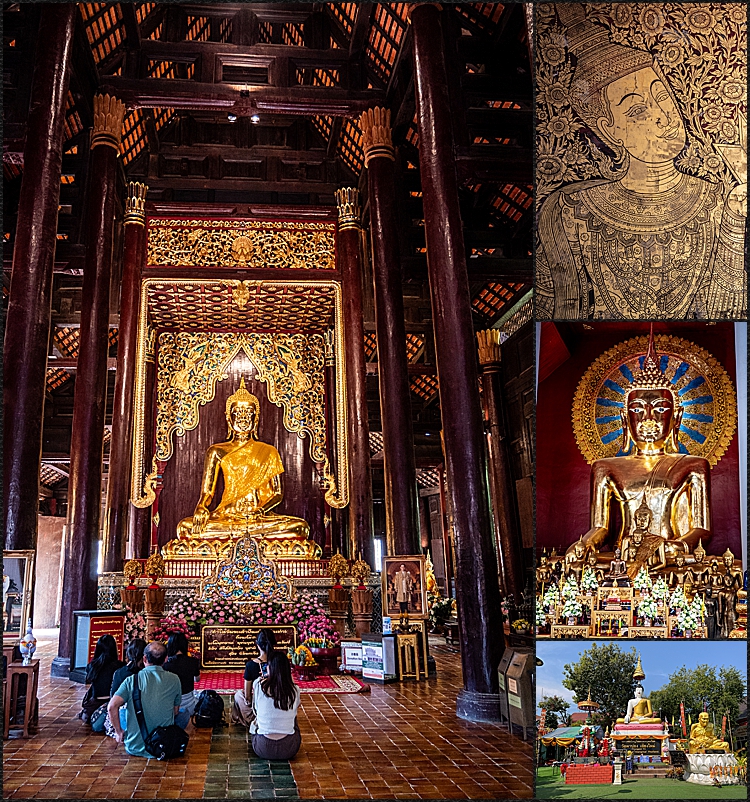
15th century Buddha resplendent in copper and gold.
The beautiful gardens at Wat Pra Singh.

Moving on further down the road and already feeling the heat, quite literally, we arrived at another must-see Temple, Wat Chedi Luang.

Wat Chedi Luang is an enormous ‘Chedi’ like a stoopa, 282 feet high and 144 feet wide. The structure was damaged by an earthquake in 1545 and as it’s not structually sound it’s not possible to go inside. Having said that, it is very impressive. The stone elephants remaining on the other side of the building were a nice surprise. We thought how impressive it would have been if all the elephant scuptures had survived the earthquake. Imagine on each side the elephants looking down on you! As you can see, there are still some impressive features remaining of this ancient temple, especially the Nagas defending what would have been the main entrance. The painted warriors are probably 20th century.

Wat Chedi Luang

There is a lot to see in the grounds including these two big ‘gongs’. The wooden ‘striker’ is as heavy as it looks but keeping with Buddhist tradition we hit the gong three times.

Hitting the right note.

After sitting in the shade for a while we carried on exploring. We stopped for lunch just by the city wall before walking through into the ‘newer’ part of Chiang Mai. By the wall were quite a few of what appeared to be mostly Japanese tourists having their picture taken with hordes of pigeons flying around them. There’s certainly no shortage of these birds roosting in and on the walls but why people want to annoy them so they flap around in their pictures, I don’t know. Thankfully when you looked the other way you could enjoy the picturesque moat which runs all around the city.

There’s always something to see as you wander around Chiang Mai.
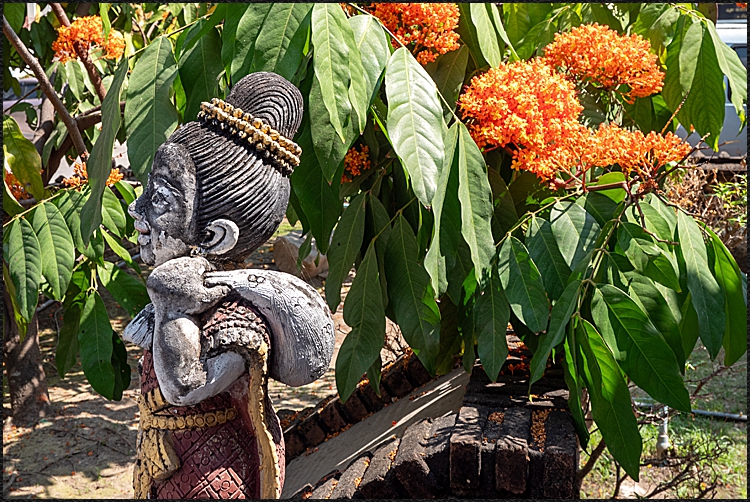
Interesting statue spotted in a temple garden.

I haven’t mentioned the variety of shops in the city as well as there is lots of choice when it comes to places to eat. This is authentic Thai food so it’s hard to make a bad choice as there’s loads of places to eat. Chiang Mai is also known for its local handicrafts and although there’s plenty of ‘tacky’ things on sale I did find a wonderful shop full of good-quality handicrafts, some locally made, and spent time and money in there although the prices were reasonable. We did walk around a couple more Wats before feeling ‘templed-out’ and going back to our hotel to relax by the pool.

The next day we were picked up from The Twenty Lodge by a minibus from Asia Scenic, a Thai Cooking School. There are a number of these schools but this one was recommended by the hotel. We picked up several other people on the way to downtown Chiang Mai where we met the rest of our group who like us had chosen to do a half day at their organic farm. They were a lovely, lively group, all ready to learn more about the real Thai cuisine and cook it too. After intros and instruction from our guide we walked to the market where she explained about the herbs, vegetables and spices we were going to cook with and showed us examples displayed on a variety of the stalls.
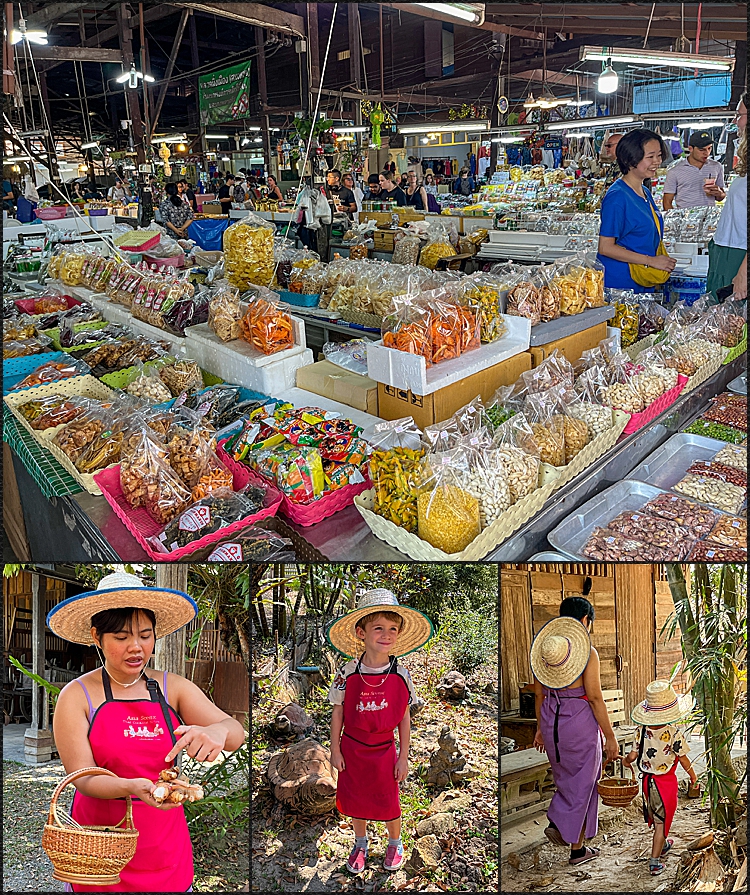
The fascinating market in Chiang Mai followed by our tour of the organic garden.

This company offers a variety of classes, whole or half day, in the town or on the farm. That’s the class we chose as it was a chance to get out of the city and see an organic Thai farm and learn more about the herbs and vegetables they grow there. After touring around the market we were taken by mini bus to the farm where we would be cooking in the open-air kitchen. There were twelve of us in the group; a mix of nationalities and ages. The youngest in our group was five, we were the oldest …so there was a good mix of ages, all full of enthusiasm and ready to cook. Walking around the gardens was very interesting and we learnt a lot about the plants etc. grown there. As for cooking the dishes we had each chosen, well that was great fun especially using the unfamiliar turbo gas. Before getting onto the mini bus to head back to the city we were given a recipe book so we could (in theory) produce the same dishes at home.

The organic kitchen garden and the open air kitchen.

That evening, which was a Sunday, we walked to the (almost) one kilometer long Rachadamnoen Road where the famous Sunday Night Market is set up. The market starts at 4.00pm until midnight and hundreds incuding locals and of course us tourists are drawn to it. The place was packed! Squeezing between all the stalls became a challenge so you just have to push your way through. I didn’t spot too many things to buy but it wasn’t for the variety of things on sale, I just felt it was too much of a hassle to stop at the stalls. It was less crowded when we walked back up the road so I did by a couple of things before diving into one of the cafes along the street. That was the best bit; sitting there drinking a beer, eating a curry and just watching the people walk by.

It’s Monday morning, our fifth day in Thailand and we’re picking up a hire car from the airport and then heading off to spend a few hours with elephants. Just typing that reminds me of the wonderful time we spent at the Thai Elephant Conservation Centre Tecc at Hang Chat, Lampang. We were last there in 2006 and now we were back again to see ‘our’ elephants. More about that in my next Blog.

A perfect sight.

Ten days in Thailand

Yes we were lucky to go on holiday before Lockdown. Having flown in from Paxi in Laos to Bangkok we got a taxi straightaway after getting off the Airport Rail Link. Before now we’ve had to wait quite a while. Thankfully this driver didn’t keep falling asleep every time we stopped at traffic lights! A bit scary as the traffic in the city is quite manic.

We have stayed in Baan Manusarn, which is a small guest house a couple of times before. As Bangkok goes it’s a fairly quiet area. The pier for the ferry is at the end of the road and there’s quite a few good restaurants nearby. Once we’d dumped our bags we had an afternoon to spare so we headed for the iconic temple of Wat Arun. Last time we were there we had horrendous jet lag and just about managed to drag ourselves around. This time we didn’t pay to go into the main temple as there’s plenty of other buildings you could go in for free. I’m saying ‘could’ as now you have to pay to go into the temple complex. Can’t imagine there’s many tourists visiting there currently or anywhere else for that matter – Thailand isn’t letting tourists in at the moment. Seems to be working as since the pandemic hit the country they’ve recorded just one death. That’s the official figure …

Wat Arun by the Chao Phraya River

It was a fairly early start the next day as the train to Kanchanaburi leaves Thonburi station at around 8.00. There are just two services each day. You have to allow plenty of time to get to the station as Bangkok wakes up at 4.30am every day and the roads are busy. The huge market by the station teems with life and is where the taxi drops you off. You have to have your wits about you wheeling you case through to the station. The train journey takes about three hours and is an interesting trip but the exciting part for us is arriving! A quick call to our resort and a taxi is organised and we’re on our way heading out of town.

Just a quick journey from Kanchanaburi station to Oriental Kwai Resort – heaven!

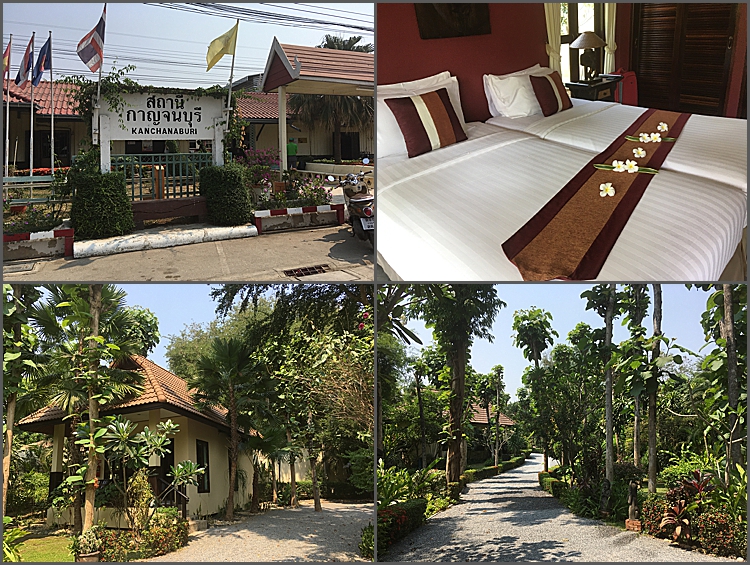
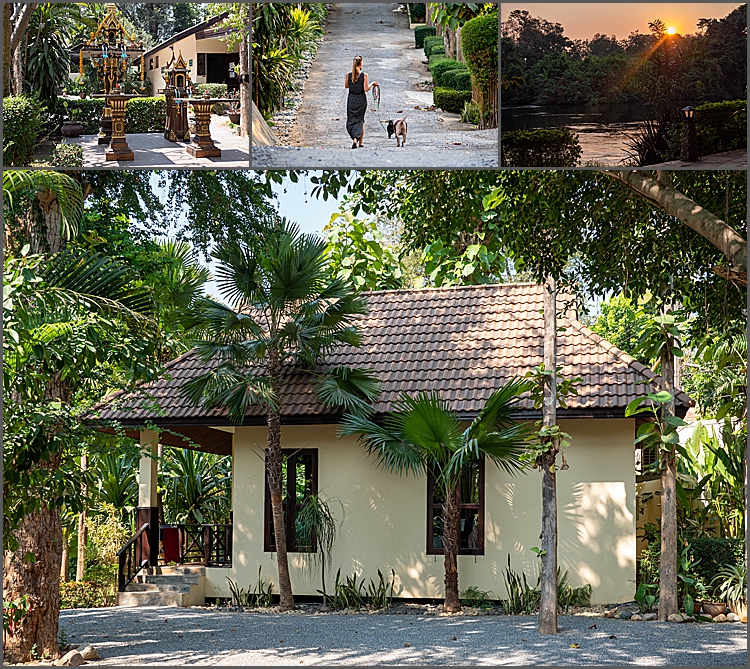
This for us is the most perfect place to stay. We love it here at Oriental Kwai. No wonder it’s Kanchanaburi’s number one hotel on Trip Adviser. It’s a 15 minute ride from the town and as soon as the taxi turns off the quiet lane into the drive, we feel at home, well our home in Asia. There are just twelve cottages and we like to stay in number 11. We enjoy the walk through the beautiful gardens, across the little bridge, past the immaculate swimming pool to the main reception area and restaurant. Late afternoon we like to sit by the river, have a drink and stay there until the sun goes down over the River Kwai.

Djo and Evelien who own and manage Oriental Kwai are lovely people and make you feel so welcome. They opened the hotel in 2007 after clearing quite literally a jungle! Together with help from their families they achieved their dream and their success story continues today. As I write this in the year of a pandemic my man and I are just hoping it won’t be long before we can go back again.

“Our’ cottage and the grounds at Orienal Kwai with the river running by.
It’s all there at Oriental Kwai

Although we know this area well we still like to do some sightseeing and lots of walking and John did a cycle ride whilst I stayed to take some pictures in the superb gardens. We’d also decided to hire a car this time and drive up to the lake town of Sangkhlaburi in the west of the province.

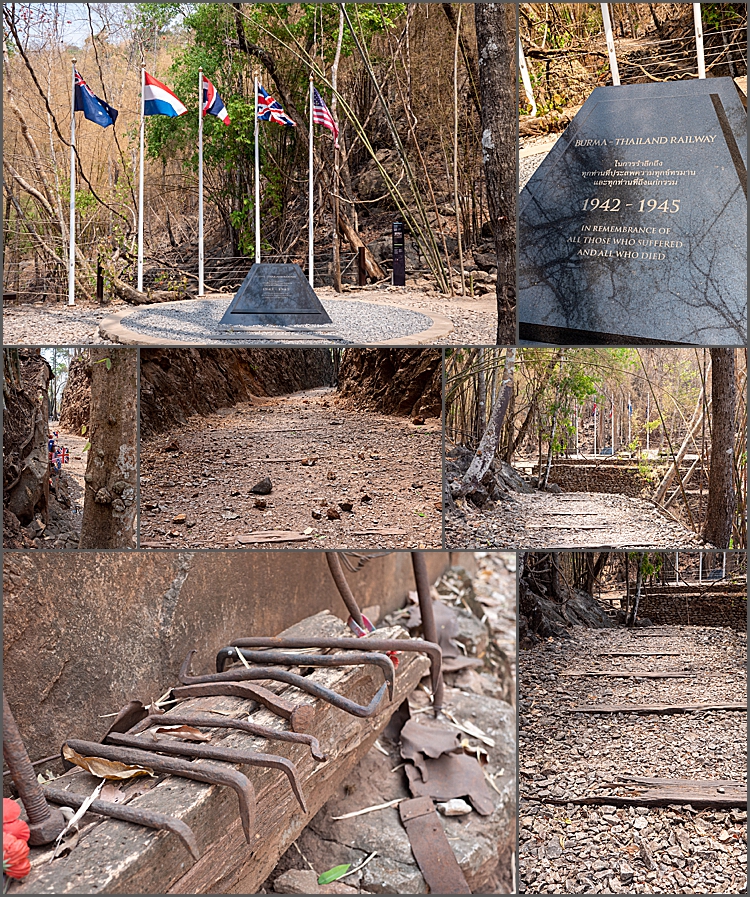
Picking up the hire car in the town was very straightforward, we’d booked it before we left home. Once you get out of the town the roads are very quiet although this route continues up to Three Pagodas Pass and the Burmese border. It also takes you past the entrance to the Visitor Centre and starting point for visiting The Hell Fire Pass, the name of the infamous railway cutting on the former Burma Railway. Although we have been before we wanted to see the changes they’d made to the exhibition centre.

The Visitors Centre and the Museum had been re-vamped however we both felt that the new layout of the exhibits didn’t have the impact we remembered from our last visit. It’s quite a steep walk down to the railway cutting itself but the impact of this area never changes. It is an emotional experience and the Memorial Walking Trail following the route of the ‘Death Railway’ is a sobering hike albeit with magnificent views over towards Burma. Don’t expect to hear any birds singing as you walk along – there are none. On this visit the walk was closed which was disappointing but we have walked it a couple of times before.

Back in the car and still heading North West we started looking for somewhere to eat. After an hour or so we were beginning to wonder if we’d have lunch at all when I spotted a cafe by the side of the road. No one spoke English – well why would they (?!) and the locals having lunch pretended we weren’t there. We hadn’t a clue what was going to be served up but the main thing was it was all going to be freshly cooked. I believe we had chicken, veg and rice but I honestly can’t remember, we enjoyed it with no ill affects so that was the main thing.

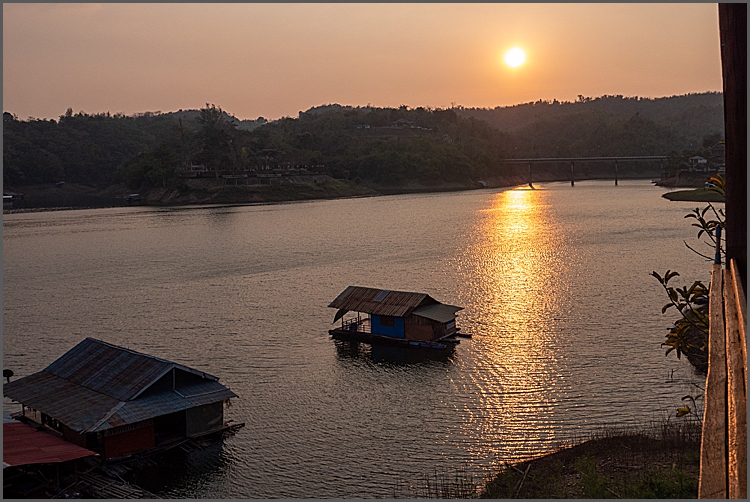
Floating raft houses on the Vajiralongkorn Lake.

The journey after our pit stop became more interesting as we drove up through the forest and then down to Vajiralongkorn Lake. It’s actually a reservoir that was created when a dam was built in 1982. It’s a huge expanse of water and very impressive. The other thing you notice about this area of Thailand is the diversity of the people. Sangkhlanburi is a small town, traditionally the Karen people lived there. Now there are Burmese people, many refugees having left Burma for the safety of Thailand and people from the Mon tribe and other minorities. Apparently they live together in perfect harmony although there are defined districts with some living in the hills or on floating raft houses and the Mon people who live across the other side of the lake which is spanned by a huge wooden bridge.

As usual once we’d arrived in Sangkhlanburi and found our hotel, Kingfisher House, we chilled out for a while over a well-earned beer – ‘Chang’ as it happens. Time then to walk down to the lake and check out this famous wooden bridge which is Thailand’s longest. It is quite a landmark and was built in 1986 although it looks much older. Unfortunately the bridge known as the Mon Bridge partially collapsed after bad weather in 2013. As the bridge links the main town of Sangkhlaburi with the Mon area of the town, the locals quickly got together and within weeks rebuilt it. How’s that for teamwork? Although it wasn’t late the bridge was deserted as you can see from this picture. This is a very sleepy non-touristy place.

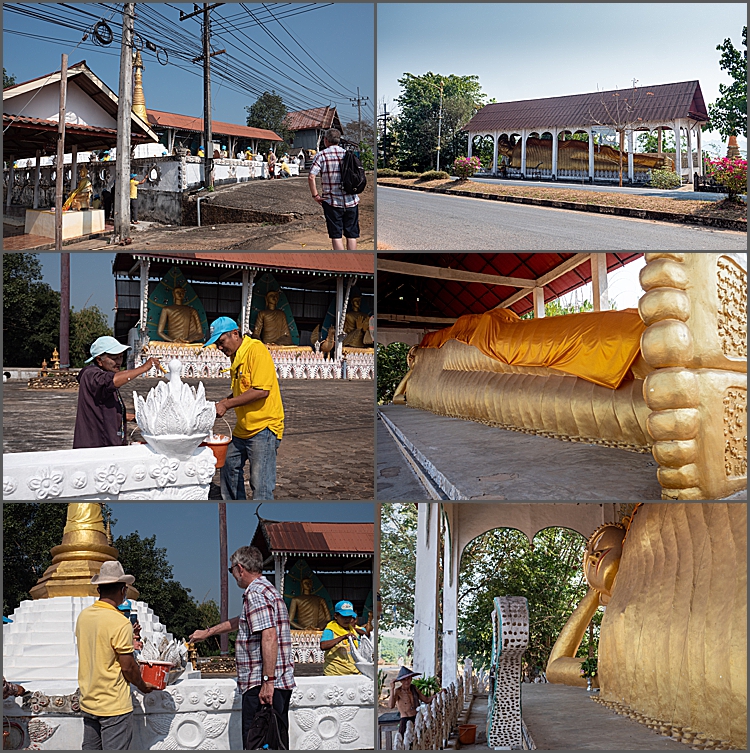
The next day we started off by exploring the town and headed up to see the reclining Buddha. Buddhists try to do a good turn every day, especially on Friday, to gain merit and that’s what a group of locals were doing outside a temple. There was a lot of painting and chattering going on and when they saw us we were invited to do some painting too!

Gaining Merit as in performing a good deed, act or thought is a fundamental concept in Buddhism.

There wasn’t much to see in the town itself and the market was pretty unexciting so we headed down to the bridge again. By now the temperature was in the high 30’s, very hot for walking across the bridge to the Mon village. Most of the shops were just closing but fortunately we found a cafe and I discovered the refreshing merits of Lipton’s iced tea! I managed to find one souvenir shop that was still open thinking there would be lovely Mon crafts to buy, sadly that wasn’t the case but I did manage to buy one or two little things.

Walking back over the bridge the heat was unbearable hence the rather natty headgear (bottom left picture). The little girl with the decorated face is Burmese. The yellow paste is called Thanaka made from ground bark . Its a traditional cosmetic often worn by Burmese people to protect the skin from the sun. The picture top right is of two local women laying out the freshly caught fish to dry.

Very few people in Sangkhlanburi speak any English so going into a cafe or anywhere is quite an experience. Once again we had no idea what we were going to get for lunch at this family-run cafe overlooking the bridge but the omelette and chicken was delicious. The cold drink which took quite a while to make was a real sugar rush job but we drank it of course. They were so kind to us, as though we were the first tourists they’d had there for a while.

After our lunch we drove up to see this rather splendid temple with the equally splendid name of Wat Wang Wiwekaram. The picture below is my favourite from our stay in Sangkhlanburi. It was a beautiful temple and although there would have been lots of monks we didn’t see any until we drove away. There was a group down the road sweeping the street …gaining that all important merit with Buddha.

Wat Wang Wiwekaram
A few more people on the bridge to watch the sun setting including two monks.

When we went back to the bridge in the evening to watch the sunset the family from the cafe where we’d had lunch came out onto the balcony to wave to us. We felt very honoured.

We enjoyed our couple of days in Sangkhlanburi but felt that was long enough although we would visit again. We’d seen most of the sights and enjoyed the peace of the place and marvelled at the Mon bridge and the beautiful lake but it was time to get back to Oriental Kwai!

On our journey to Kanchanaburi we stopped at this interesting temple which was clearly a mix of Buddhist temples and Hindu. Quite unusual I think. Amazing statues and once again, no-one around.

The last part of this Blog on Thailand will include pictures from the market we went to which was fascinating and there will also be some pictures of elephants (irresistible), as we spent a day at an Elephant Sanctuary. I thought I’d do this as a separate account otherwise the Blog becomes a bit too long. I suspect this one might be so if you’ve read this to the end – thank you!

First stop …Bangkok

A trip along the canal in a revamped boat used previously for collecting rubbish probably wouldn’t be near the top of the ‘must-do’ list for visitors but it’s a great free way to see the city. Yes there’s no charge and it’s good fun. We discovered it the first time we stayed at Baan Manusarn, an inexpensive family run B & B in a quiet part of Bangkok  down from Thewet Pier on the Chao Phraya river. There’s an interesting Thai market opposite the B & B(they are always worth a wander through) and a good cafe down the road  serving cold lager with entertainment from a very friendly cockatoo.

Bangkok_0007

The Chao Phraya river flows through the middle of Bangkok, it’s a river that never seems to sleep. Apart from the ferries which are cheap, full of locals and a good way to get around, there are numerous tourists boats, river taxis and longtail boats criss-crossing the river, like a constant armada. It’s the huge commercial barges that I find the most fascinating. These boats seem to  go on for ever and when full float silently along this huge river dragged by a tug boat. Mostly I think they are carrying sand or rice and once unloaded they seem to bounce back up river behind their little towboats.

Early evening is when the tourist cruise boats start. You can’t miss them with their garish lights and loud music. I shouldn’t knock them as I know friends who enjoyed their two-hour trip and the ‘international cuisine’, but it’s not for us. We’d rather go down to the pier, chat with the locals, share an offering to the fish and watch the sun go down.

Bangkok_0004

The nearest Buddhist temple (Wat Devaraj Kunchorn Warawihan) is quite near to our B & B and is a beautiful building, hidden down a narrow side street. On our second evening walking past we were drawn inside by the chanting of the monks. I love the sound but I’m always amazed at how the monks can sit that long without changing their position. Needless to say we eventually had to leave as we were both getting cramp!

012P1000214_Bangkok

There are of course lots of places to visit in Bangkok. Most tourists go to The Grand Palace and Wat Arun   also called The temple of Dawn. A word of warning about visiting The Grand Palace – check out the dress code, the guards are very strict. If you show up improperly dressed there is a booth near the entrance where for a deposit you are issued with a wrap round long skirt. No problem like that at Wat Arun, our only problem was that we were suffering from jet lag and the heat as we’d only arrived a few hours earlier. We found it hard to drag ourselves around.

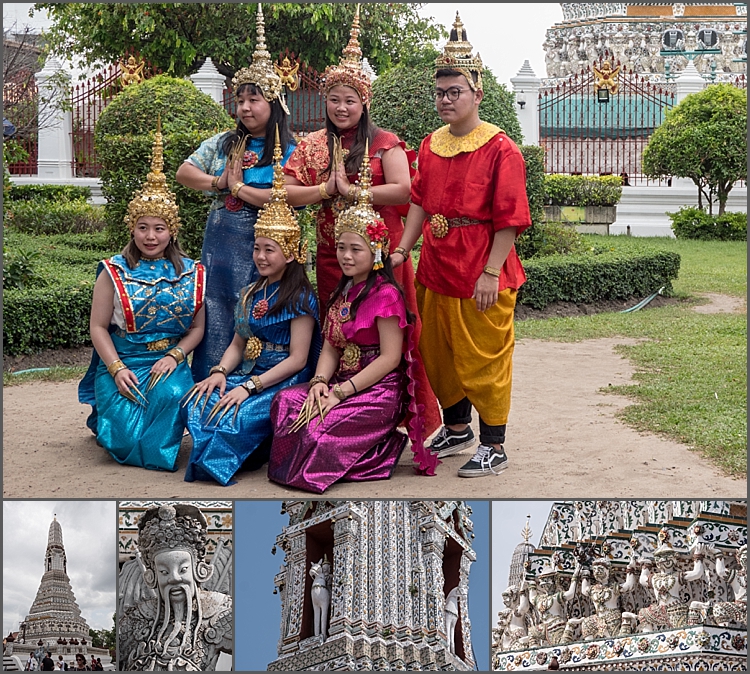
These people in the picture below at Wat Arun  have hired their costumes. You see groups like this dressed in national costume at all the main tourist places. Turns out they may not even be Thai! I have more pics like this which you’ll see in further Blogs. You’ll probably notice too that no-one takes the trouble to wear the ‘right’ shoes!

_Bangkok

Whether The Grand Palace is always crowded with tourists I don’t know. Looking at the number of coaches parked outside I think it’s pretty impossible to go there without having to jostle with everyone. I gave up trying to get some clear shots of the amazing architecture and instead did the same as everyone else, sharpened my elbows and darted in front of anyone with a camera who was taller than me!

We quickly worked out that The Grand Palace is divided into two main areas; the Temple of the Emerald Buddha and the Royal residence. The place is still used for hosting royal ceremonies and welcoming the king’s guests and other foreign dignitaries.

The elegant statues of Buddha are beautiful but there are so many features here it’s no wonder everyone is clicking away in every direction. It was a bit of a bun-fight and after a couple of days in Bangkok we were looking forward to escaping to the country.

Bangkok_0005

Reading this back it sounds as though we didn’t enjoy Bangkok but we did. We’ve been there a number of times now and have generally avoided the centre as we prefer just wandering around the streets to see what we come across. China town is fun though, you can buy lunch for a ridiculously cheap price. Travelling up and down the river on the ferries is what we enjoy doing and going into the Wat’s (Buddhist temples) which are everywhere. Bangkok is a buzzing, lively city and a real attack on the senses and apparently has more visitors than any other city. It’s not difficult to see why.