Exploring Montmartre and Notre Dame: A Paris Adventure

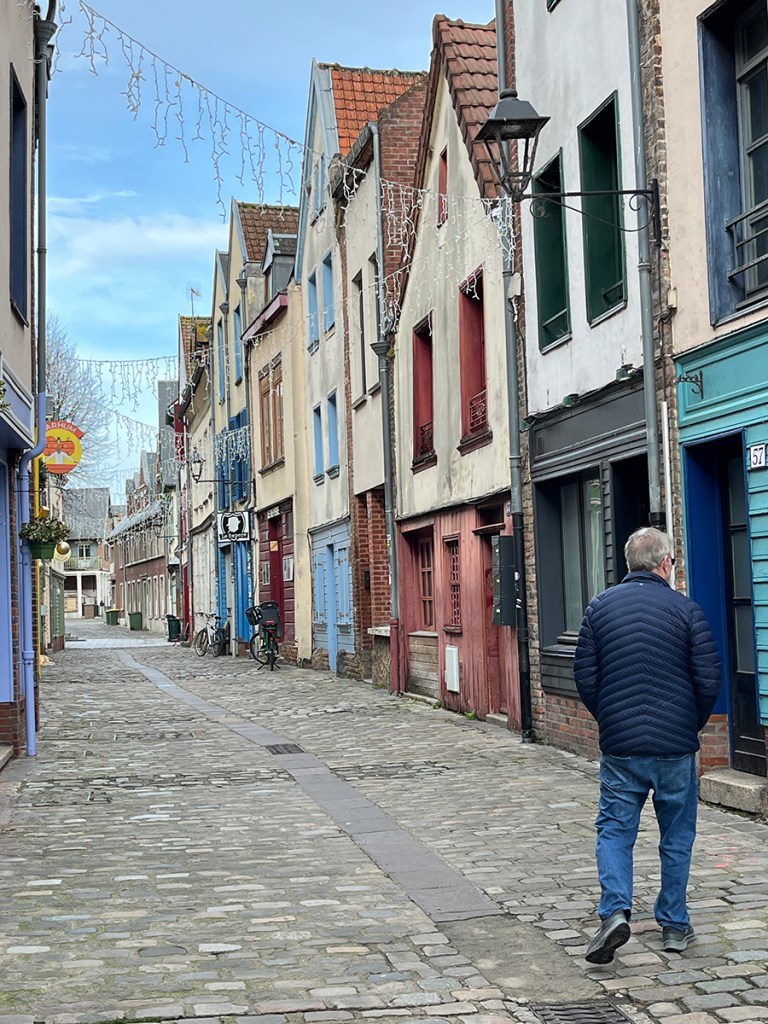
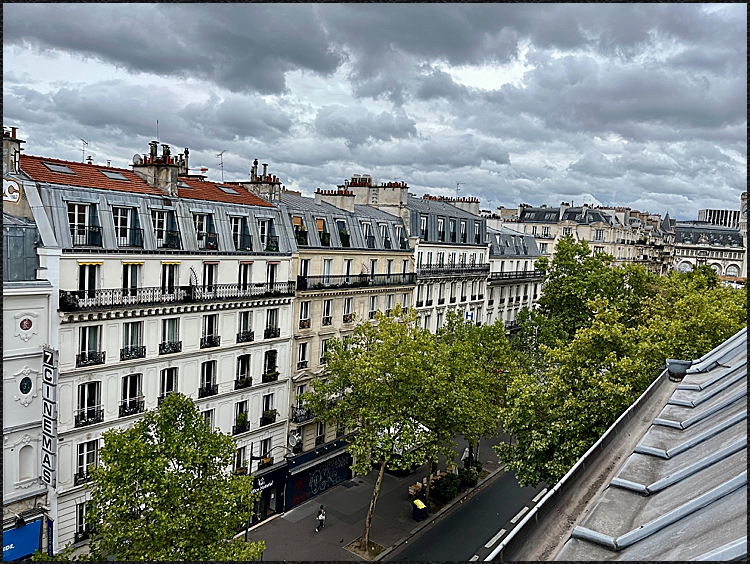
Looking down the Rue de Lyon.

Paris

It’s our wedding anniversary in September and what better place to celebrate but Paris? This city at any time of the year is superb but September is particularly magical. The trees are beginning to turn, the nights are still warm enough to sit out until the early evening with the sun snaking between those high Parisienne buildings bathing the streets in a warm amber glow.

We’d travelled by train from the Cotswolds where we live, to London and then caught the Eurostar where after less then three hours we had arrived at the Gare de Nord. It was just a short journey with suitcases on a very busy RER but after a couple of stops we’d arrived at the Gare de L’Est. Our hotel, 9Hotel Bastille-Lyon was a short trundle away and thankfully it had a lift as we were right on the top floor. Before long we’d wandered up the street to grab a beer at the L’Europeen It’s a typical Parisien Brasserie with an art deco interior and waiters in traditional ‘uniform’ looking immaculate in their white shirts, black waistcoats and trousers wrapped round with long white ‘aprons’. That evening we had an excellent meal at a small family-run restaurant, Les Affranchis which was only a short walk from our hotel.

Montmartre:

Sacré-Cœur Basilica

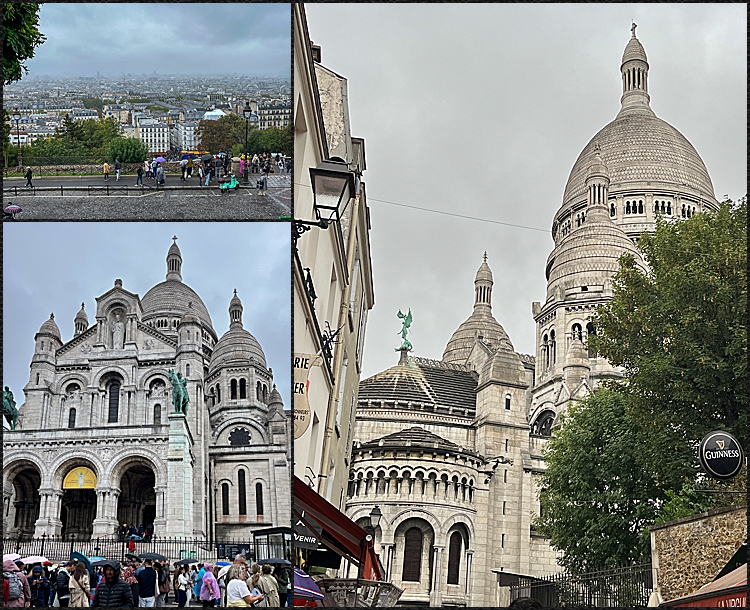
It’s Sunday and we’d woken up to cloudy skies and the ‘promise’ of rain. Our attempt to get tickets to Notre Dame had failed again so we decided to head up to Montmartre. It’s a steep walk up to the top and if it’s a clear day you’re rewarded with a great view – a panorama of Paris. No luck that day, it was hard to spot anything in the gloom. The queue to get into Sacre Cœur was long but we had an interesting chat with a lady who lived in Paris and then an American couple joined in so by the time the five of us had covered several topics focussing on world problems we were going into the Basilica. It’s free to go in and is open from 6.30-22.30. It’s well worth a visit and on a clear day if you want to get an even better view of the city, you can climb up to the Dome. (There is a charge).

Out and about in Montmartre.

After lunch at a cafe where we shared that classic ‘Croque Monsieur’, the rain had stopped which meant we could have a good walk round the area. The artists in Place du Tertre which is only a few streets away from the Basilica were quite busy. It’s fascinating to watch as they sketch portraits of their sitters – such talent. I wonder how much they charge? With that thought we wandered on to Au Lapin Agile where I wanted to take a picture. This famous bar which has a cabaret is famous worldwide and has been entertaining their customers since opening in 1860. These days there’s a flexible arrival time, check the website for opening times as it’s not open every evening. No credit cards accepted and the entrance price including a drink as at September 2025 is 40€.

No visit to Montmartre would be complete without saying ‘hello’ to Dalida. (Picture of this celebrated singer is top, middle above). Dalida, sometimes called “the queen of French chanson,” had a remarkably eclectic career. She was an international phenomenon, recording in at least seven languages and performing on stages around the world. Dalida will forever be associated with Montmartre, where she had a house at 118 Rue d’Orchampt in the 18th arrondissement. After her death in 1987 a square was named after her which has a bronze bust of the singer whose bosom has been rubbed to a glow by years of fondling from her fans. Her grave in Montmartre cemetry is also worth a visit.

This area of Paris is full of character and charm and feels very much like a village. We didn’t see any sun that day but that certainly didn’t dampen our spirits – there’s always a great amosphere in Montmartre.

Later that afternoon we went by Metro to Musée Malliol in the Rue de Grenelle to an exhibition of 350 photographs taken by the celebrated Fench photojournalist, Robert Doisneau – what a treat! Ordering tickets hadn’t been a problem and we were glad we did as there was a queue outside of people hoping to get in by just turning up. All of them were turned away … It was an excellent retrospective of Doisneau’s work in this excellent exhibition space. The Malliol Museum is currently closed preparing for their next exhibition.

Sadly our anniversary meal that evening was disappointing especially as we had eaten there on several occasions in the past, still the wine was good.

Notre Dame de Paris:

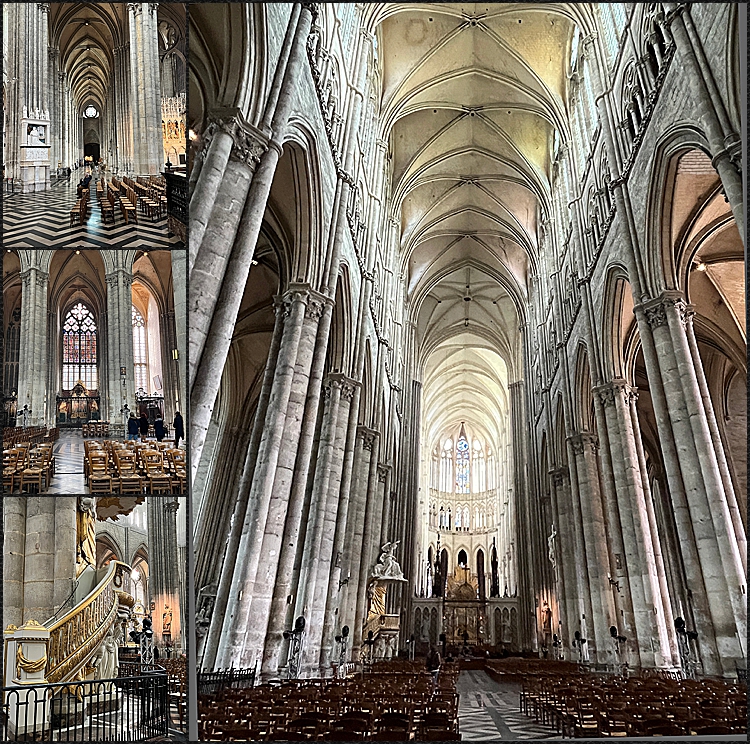
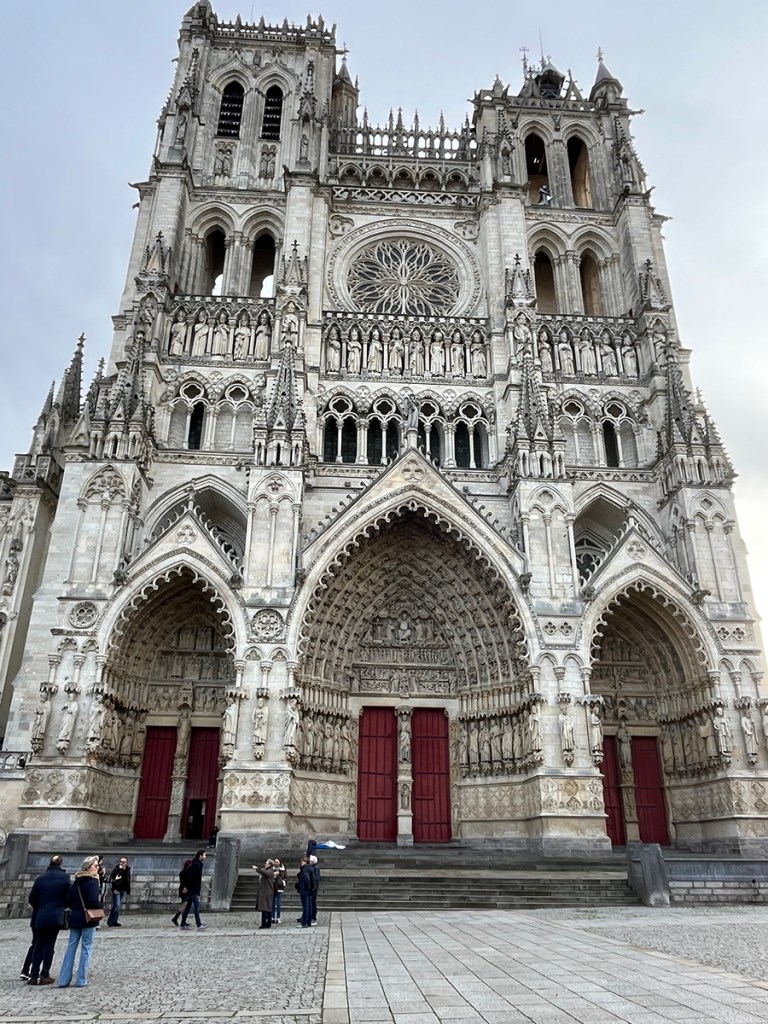
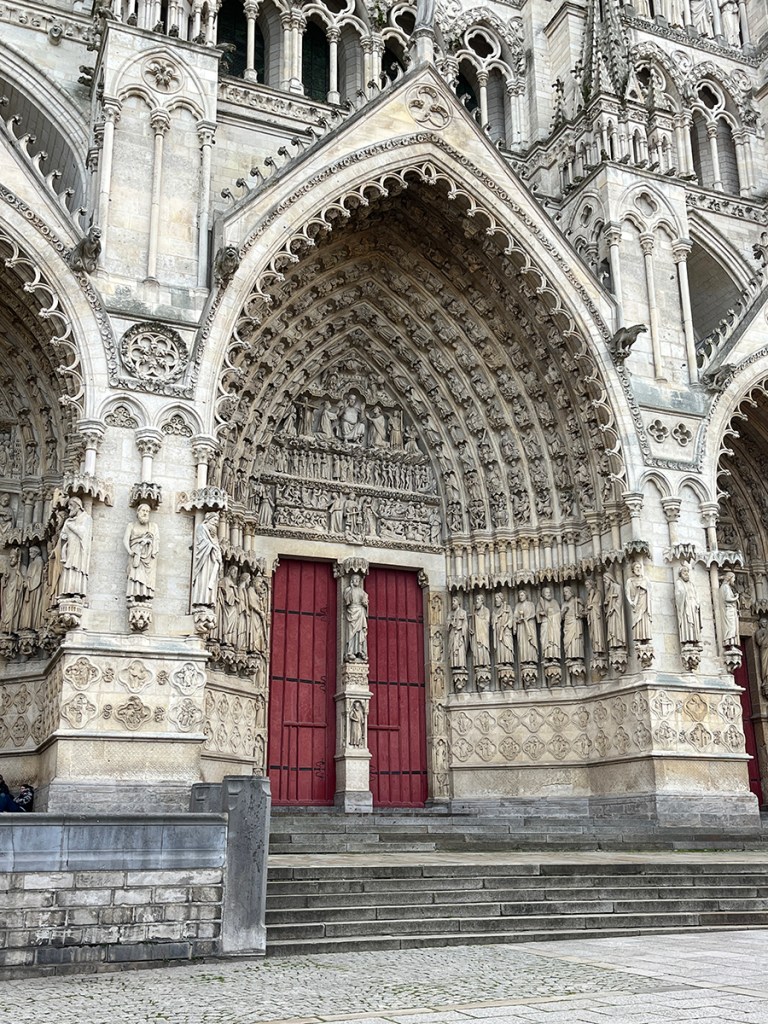
Top l.h.s: The Seine looking towards Pont Neuf. Remaining pictures: The frontage of Notre Dame and entering the Nave.

Perseverance paid off! After trying several times to book tickets on-line to go into Notre Dame …we made it! I should say it was down to my husband who got up extra early that morning to go onto the web site, seems it’s the only way to do it unless you want to queue for hours.

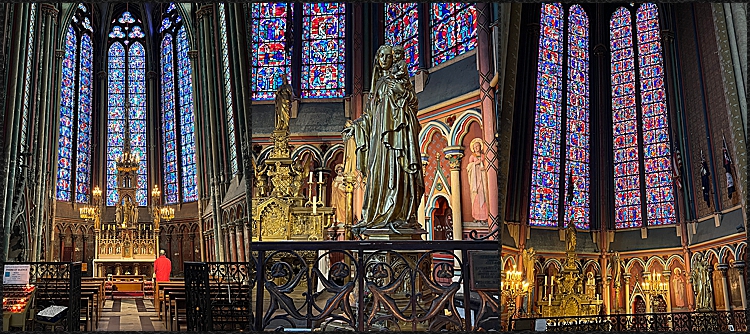
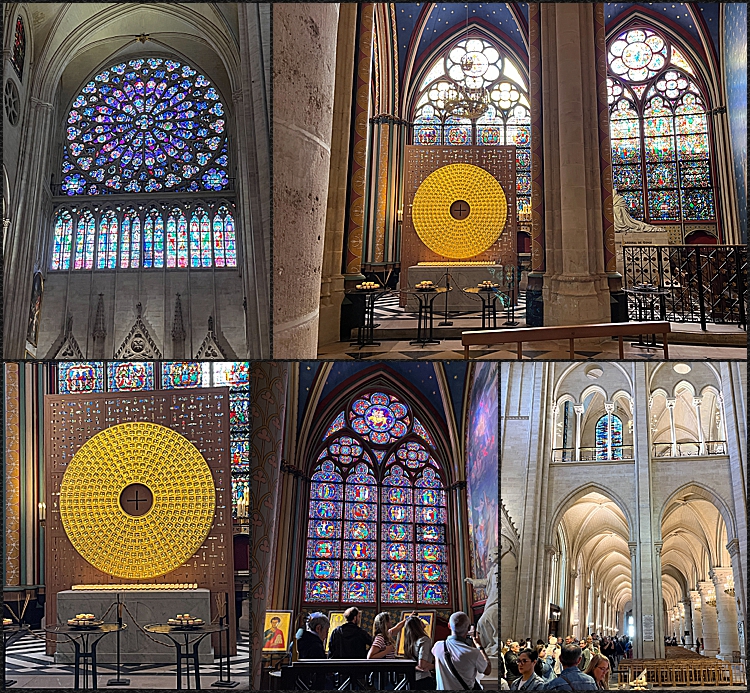
The wonders of the Cathedral. Blending in new artworks with (original?) stained glass windows.

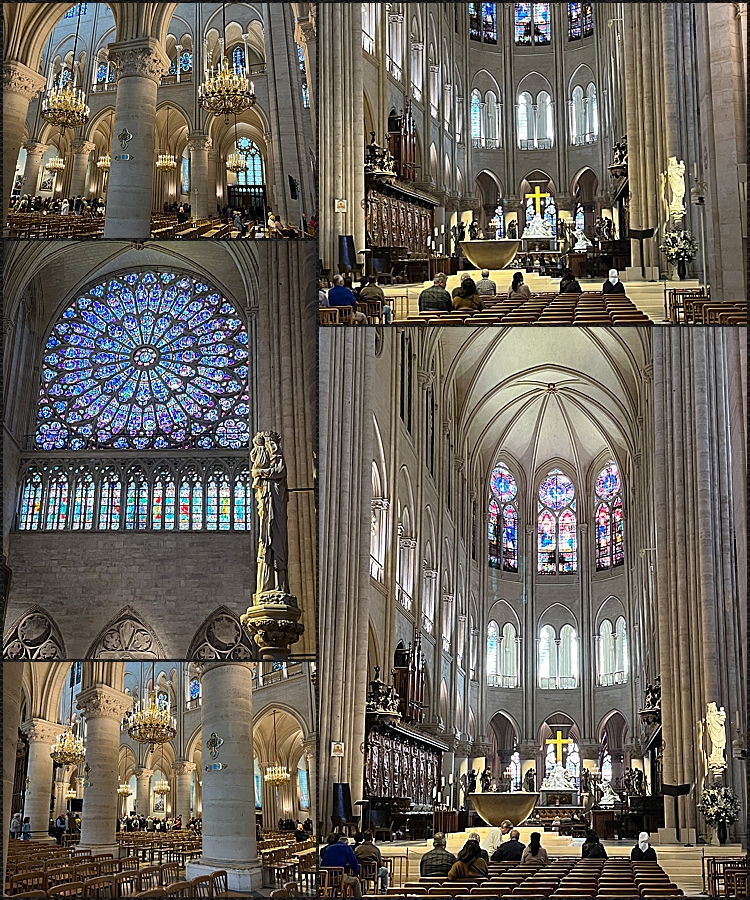
I’m so pleased we managed to go. What a wonderful place! It’s free admission, respectful silence is requested and it is very busy but my goodness it was worth it. Just wandering around this amazing building which has been a place of worship for 860 years is really quite moving. It’s history, which is fascinating is detailed on the Notre Dame de Paris website but I think it’s worth mentioning here that the fire of April 15th 2019 which destroyed the mediaeval framework and the spire was seen as a national disaster. Millions were raised for the restoration and now today, since re-opening on December 4th 2024 this Cathedral stands as a testament to the skills of all the crafts people who worked on this huge project. I hope that in time there will be an exhibition showcasing some of these artisans, general builders and the like who have achieved this restoration in record time.

The wonders achieved by the restoration of this famous Paris landmark.

We came away having thoroughly enjoyed our visit but also aware that we had a train to catch at midday, the TGV from the Gare de L’Est to take us down to Avignon for the next part of our trip. Provence here we come!

Walking back to the metro:- Sainte Chapelle on the left, Palais de Justice de Paris top right and the Conciergerie bottom right.

Top Attractions on Portugal’s Silver Coast: Our Journey

We were sorry to say goodbye to Lisbon but after picking up a hire car we were keen to explore another area of Portugal – the ‘Silver Coast’, or Costa de Prata This runs along the central-western Portuguese coastline and is known for its beautiful beaches, historic towns and is generally less crowded than the Algarve. We had booked in at Casa Sobreiro, a holiday let just outside the village of Salir de Matos and a short drive from the coast. The owners made us feel very welcome and we were thrilled both with the accommodation and the quiet location.

Casa Sobreiro’ also pictures taken on a walk in the neighbouring countryside.

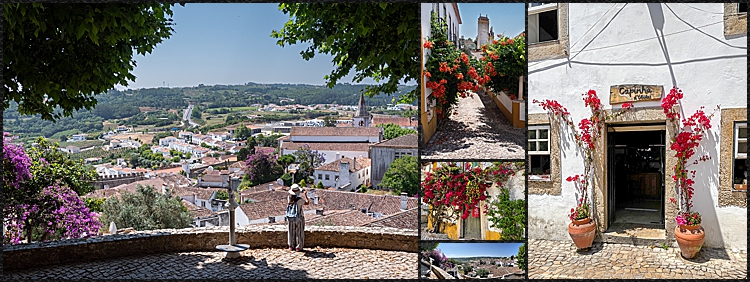
One of the attractions in the area is the medieval walled town of Óbidos. It’s very picturesque and therefore can get quite busy but it’s well worth a visit. We parked for free down at the bottom and walked into the village up through one of the Moorish gates. Bougainvilleas are in flower everywhere in summer and the views from the walls are breathtaking but unless you’re in to all the tourist shops, there’s not a lot to do. The colourful houses add to the charm of the place but it’s the medieval walls which encircle the village that are the most spectacular. The Moorish castle at the top is now a pousada (a chain of luxury, traditional hotels in Portugal), but all the walls are accessible.

Óbidos village.

After leaving Óbidos we escaped the dust and heat of the day and drove to the coastal village of Foz do Arelho There are actually two beaches created by a saltwater lagoon. We chose to go to the main beach where there are long stretches of white sand, the other is more for paddle-boarding or kite-surfing on a windy day. There are lots of cafes along the promenade all selling fresh seafood We chose one and had a beer and then checked out another which had a very good write-up so decided that was the place to go later in the week – Cabana do Pescador didn’t disappoint. Foz de Arelho is also famous as a great place to watch the sun slowly going down. All ways round, as a seaside resort it’s an idyllic summer destination.

Foz de Arelho by day and in the evening.

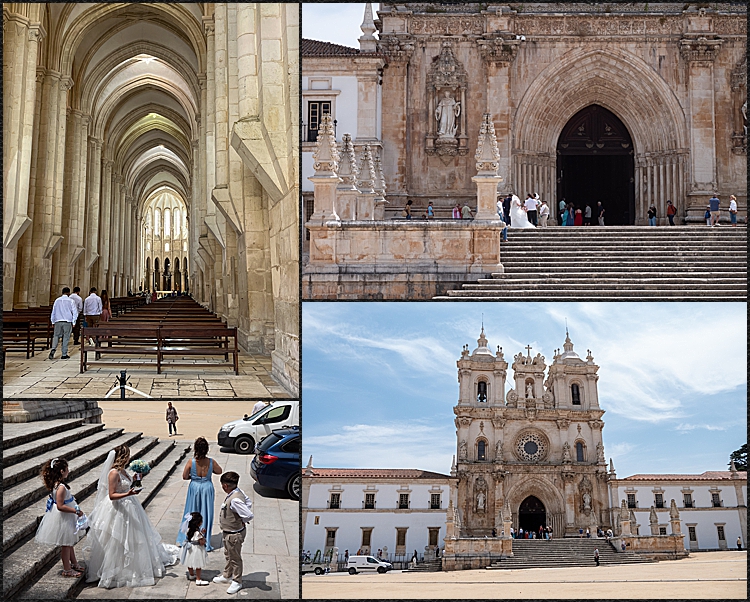
We do love visiting one or two historical monuments when we’re on holiday so we were keen to visit the 900 year old Monastery of Alobaća which has all of its original buildings preserved and is one of the finest examples of Cistercian architecture in Europe. Inside the medieval buildings is the Refectory, the Chapter Room and the magnificent cloister. The Nave is impressive too, in fact it’s all very impressive and great place to take photographs too.

Monastery of Alcobaća

It’s not unusual when we’re away to come across a wedding and sure enough waiting outside the church was a bridal group. What you can’t see in the picture is the crate of beer in a wheelbarrow with lots of ice just by the front steps ready for the lads to enjoy, presumbly after the Ceremony. All must have gone well becasue the wedding cars certainly woke up the town of Alcobaća as the wedding cars drove round and round the square beeping their horns.

The Gothic church, adjoining the Monastery was built in the Middle Ages.

After lunch in the town we headed for the Castle of Porto de Mós which has undergone several changes since it was bult in 1200. It was an interesting drive over there with some lovely views of the countryside. The castle really stands out even from a few miles away especially two of the towers which are topped with green ceramic cones. When you see them close to it’s a bit of a ‘marmite moment’ … you either like them or you don’t. Parking is free and the admission charge is just 92 cents (half price for people like us). The castle is now a cultural centre and hosts exhibitions and conferences and also hosts plays – a perfect backdrop for an historical enactment! It seemed to us that the castle wasn’t on the tourist route and we liked that about it.

The Castle of Porto de Mós.

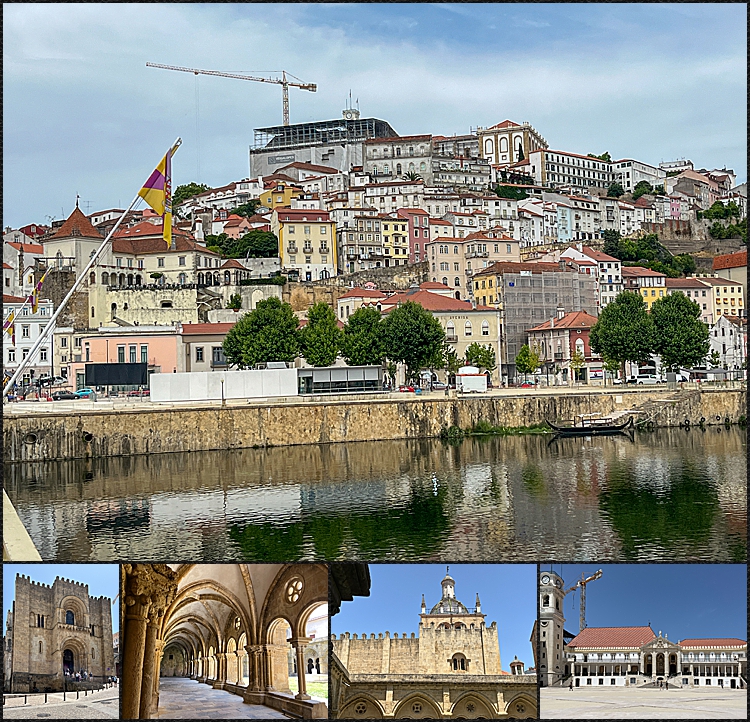
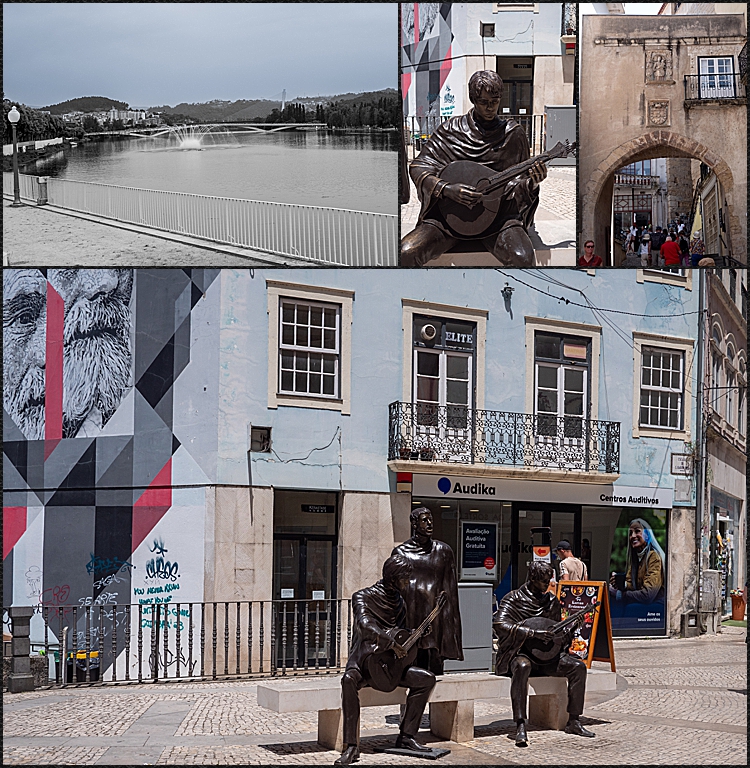
If there’s one place to visit in this region it has to be Coimbra. If you click on this link to the website you’ll see there is a host of things to do in this World Heritage City …and now …confession time, we didn’t do it justice. We wandered around the city including part of the medieval old town, visited the Cathedral and had a splendid lunch but we didn’t go into the famous University. Tiredeness and the heat that day was just too much and we had 120km drive back to the Casa. I’m looking now at the information on this Seat of Learning which is one of the oldest in the world and regret that we weren’t up to visiting it. If we go back to that area we will definitely make it a priority. The Throne Room; the Chapel; the Bookstore for starters plus the many more interesting rooms and buildings of this University don’t deserve to be missed.

The start of our visit to the city

We parked for free in a large multi-storey car park this side of the Mondego river and walked across the bridge into the city. Loved these ‘musicians’. Very good sorveteria (ice cream shop) opposite.

Main picture – View from the bridge. Bottom right is the front of one of the University buildings and the other three pictures are of the old Cathedral.

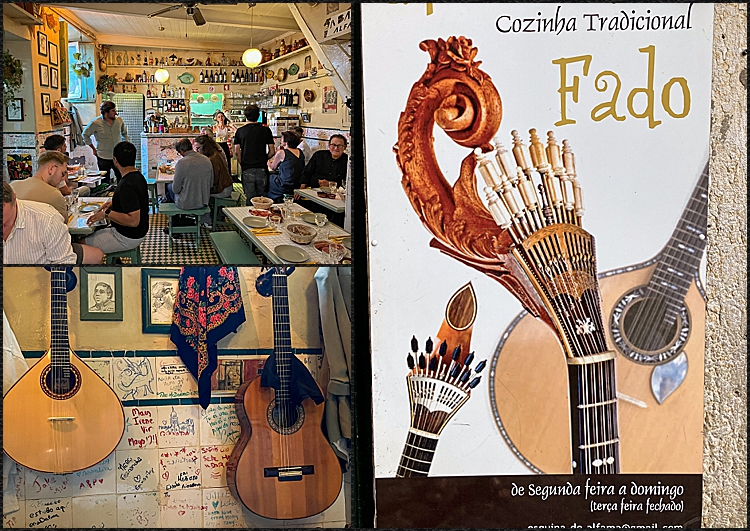
Main picture is of a window advertising Fado, a Portuguese music genre now only sung in Coimbra and Lisbon. The top four pictures show the quaintness of the city.

As I mentioned before, the Casa where we were staying was only a short drive from the coast. Foz do Arelho was one of the towns but we also drove to two more. The first was São Martinho do Porto which was incredibly busy with a very noisy fun fair surrounded by pop-up food stalls so there was a strong smell of chips together with petrol fumes from cars navigating the narrow streets looking for a parking space. We parked up on the hill overlooking the bay and walked down. We weren’t very impressed with the place but we will never forget the glass of rosé we were served – it was the worst rosé wine ever! To be fair, the cafe manager did admit that it had gone off …(in the box!) and gave us a glass of white wine instead. So sorry, São Martinho do Porto – we weren’t impressed with the place, maybe on another day …Nazaré however was very different.

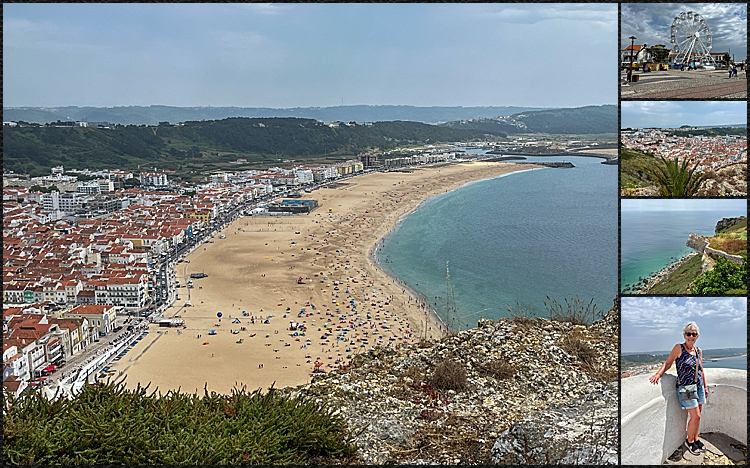
We parked in Sitio which is a district of Nazaré. This fishing village is perched on top of the craggy headland where you get a fabulous view of the bay and Norte Beach. We visited the impressive church of The Sanctuary of our Lady of Nazareth and the nearby chapel and then went by funicular down to the town. The funicular leaves every fifteen minutes and if you can get a clear view as it goes down, its worth it. Built in 1889 it was modernised in 2002 and is used by both tourists and locals. A return ticket is €4.00.

The view from Sitio.

It was a public holiday the day we went, so the seafront was very lively. Having just sat down with a cold beer in front of us we heard music getting gradually louder, sure enough it was a procession. Naturally I couldn’t resit taking a few pictures.

Celebrating Corpus Christ – a national holiday in Portugal.

Nazaré is known for its beautiful crescent-shaped beach; its cobbled streets and big waves. The bay was very calm when we were there but in the winter, if the conditions are right, waves occur which dramatically increase in height and grow to become some of the world’s largest ‘surfable’ waves. The biggest wave ever measured was 28 metres (93 feet). Surfers closely study the forecast and a hint that powerful waves are expected results in thousands flocking to the resort. I think I’ll watch the spectacle from one of the three Nazaré Webcams. The best time to see the giant waves is between October and March.

Before I write about our last day of the holiday I must mention two restaurants local to the Casa. Lagar da Suzi in the village of Salir de Matos serves traditional Portuguese food. I had the best gravy ever to go with my steak. It was a very friendly atmosphere and Suzi was extremely helpful. Take euros with you as they don’t accept cards.

Solar dos Amigos in Guisado is quite some place and attracts people from far and wide. All the accolades it gets on social media etc are well-deserved. Inside there are five rooms including one with an enormous log-fired barbeque along one wall where delicious meats and fish are grilled to perfection. The portions are big; the staff are very attentive and the food is excellent. It was so good, we went back again on our last evening.

Jardin Oriental Bacalhoa Buddha Eden.

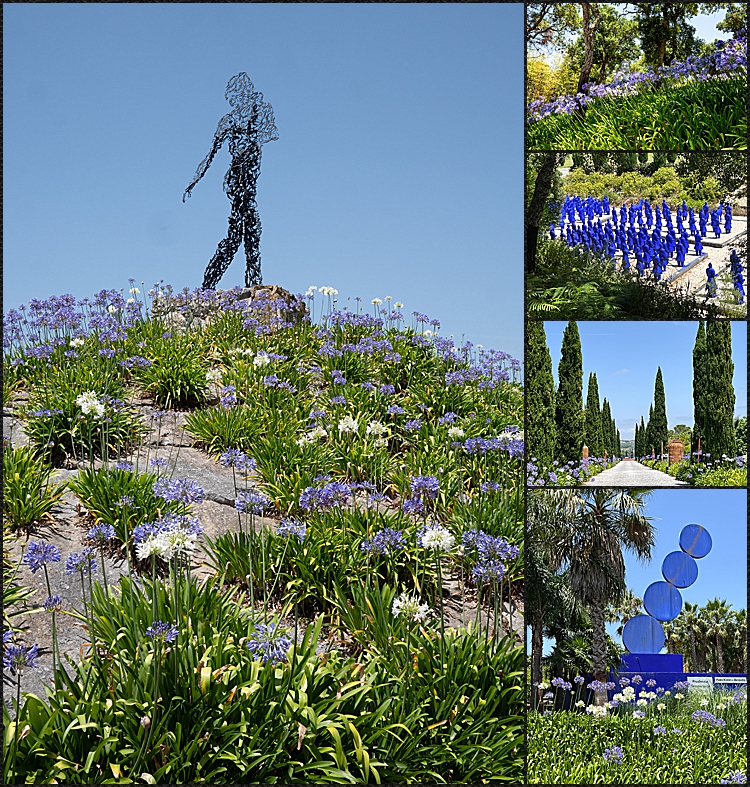
Our flight from Lisbon wasn’t until early evening and as we had to leave the Casa by 10.00am, we needed to find something to do. Our hosts suggested ‘a quirky’ place full of statues and only a short drive away so we thought why not? Honestly we were amazed by Jardin Oriental Bacalhoa Buddha Eden. With its 35 hectares, Buddha Eden Garden is the largest oriental, sculpture park in Portugal. As well as statues of Buddha (one is the largest in Europe), the park reflects a multi-faith philosophy. Several cultures and countries are represented including Buddhism, African art, replicas of the Chinese terracotta warriors and a unique collection of Asian plants and flowers. It’s a peaceful place, well laid out with paths leading you through different gardens, hidden corners and interesting viewpoints. It was quiet when we were there which made us think this ‘Eden’ is very underrated and overlooked by tourists. We stayed about three hours and enjoyed a simple lunch washed down with a glass of local wine whilst looking out on a bed of pale blue aliums intersperced with heads of Buddhas. Yes it’s different, yes it’s off the beaten track, yes it’s completely different to any other attraction in Portugal and yes you will be wowed by it.

Jardin Oriental Bacalhoa Buddha Eden.

Jardin Oriental Bacalhoa Buddha Eden.

We couldn’t have found a better place to end our holiday in Portugal and for someone who loves art, photography and gardens it was perfect.

We rounded off our journey back to the airport by stopping off in Mafra, just a few kilometres from the outskirts of Lisbon. We had planned to visit the palace there but we were running out of time so we settled for a tasty Portuguese pastry each and a tea and coffee from the patisserie opposite. The Palácio National is an impressive building but by then we were happy to sit in the square, enjoy the sunshine and our afternoon tea before flying home.

Palácio National do Mafra

Uncovering the Charm of Lisbon and Sintra.

The Portuguese guitar and the acoustic guitar.

When we booked our apartment in the Alfama district of Lisbon we hadn’t realised it was Festival season. This runs during June and July with the two important days being 12th and 13th June, Saint Anthony’s Day and yes, we were there then and our apartment was right in the middle of it. Huge street parties take place from late afternoon until the early hours. Stalls sell all different kinds of food, especially the locals favourite, grilled sardines washed down with beer which is also on sale everywhere. It’s one big pop up street market set up along the narrow cobbled streets of this historic area. I must mention too that the PA system belts out contemporary music from around 17.00hrs but to hear the authentic fado music you need to eat in one of the restaurants which has fado singers performing …which we did.

A typical evening during the Festival. Picture top left is the morning after when the street has been cleaned ready for that night’s celebrations to start all over againx

We really liked our apartment Alfama 44 even though we could hear the music through the double-glazed windows and by the third night we were looking forward to a peaceful sleep at the next place we were going to. If you prefer a quieter stay in the Alfama district, then avoid the Festival season other than that, soak up the atmosphere and enjoy this interesting area.

‘A Baiuca’ Taverna in Alfama.

As well as visiting the Museum of Fado we also wanted to hear a live performance. A little research was done and the restaurant that appealed to us was just up the street from our apartment. The taverna, A Baiuca was the perfect choice. It’s tiny inside with about eight tables and at the back, the smallest kitchen you could imagine producing delicious, traditional, fresh food. We had a fantastic night enjoying superb food and listening to authentic Fado performances. The main singer, Fernanda was accompanied by two traditional fado musicians and when Clara had chance in between serving everyone she also sang for us. We would thoroughly recommend A Baiuca for a dining experience like no other. We are hooked on Fado. It is melancholoic and mournful in many ways but incredibly powerful and romantic and rooted in Portuguese culture. It’s usually performed by a soloist and talking during the performance is very much frowned upon. By the way, you must book beforehand to get a table at this taverna.

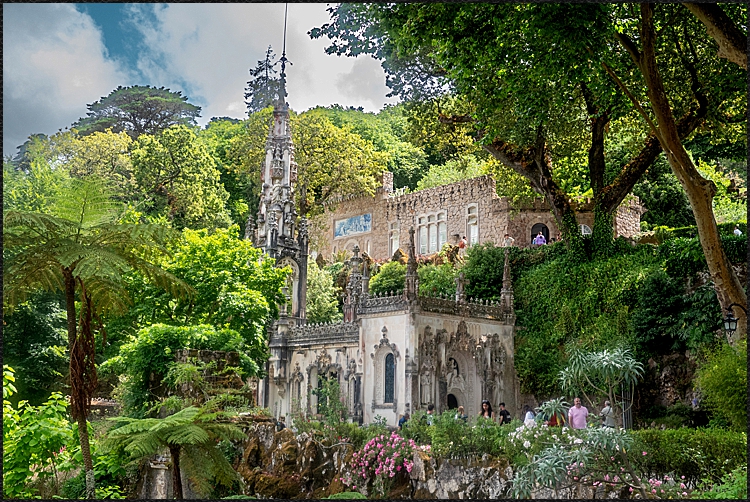
Quinta de Regaleria part of the UNESCO World Heritage Site in Sintra.

The majority of tourists visiting Lisbon will head off to Sintra for the day. The easiest way to get there unless you have a car or you are on a coach tour is to go by train which is only a 40 minute journey from Lisbon. The last time we came we visited the 8th Century stone Castle of the Moors and Pena National Palace both up in the hills and a bus ride away from the station. Both are worth a visit and do-able in a day. This time we were heading for Quinta de Regaleria which is short walk although we stopped along the way to have a cold drink and a pastel del nata before starting the climb up to la Quinta de Regaleira.

Some accounts describe the estate as ‘mysterious’, others as ‘enchanting’, I would say it’s quirky and interesting with a fairy-tale persona with delightful gardens too. According to the website for Quinta de Regaleira it was built at the end of the 19th century by a millionaire who was a Freemason. This probably explains why there are several cryptic symbols on the walls, mysterious caves to walk along and an Initiation Well. To save queuing it’s best to buy a timed entry ticket (as at 2025), adults 15€, seniors over 65, 10€.

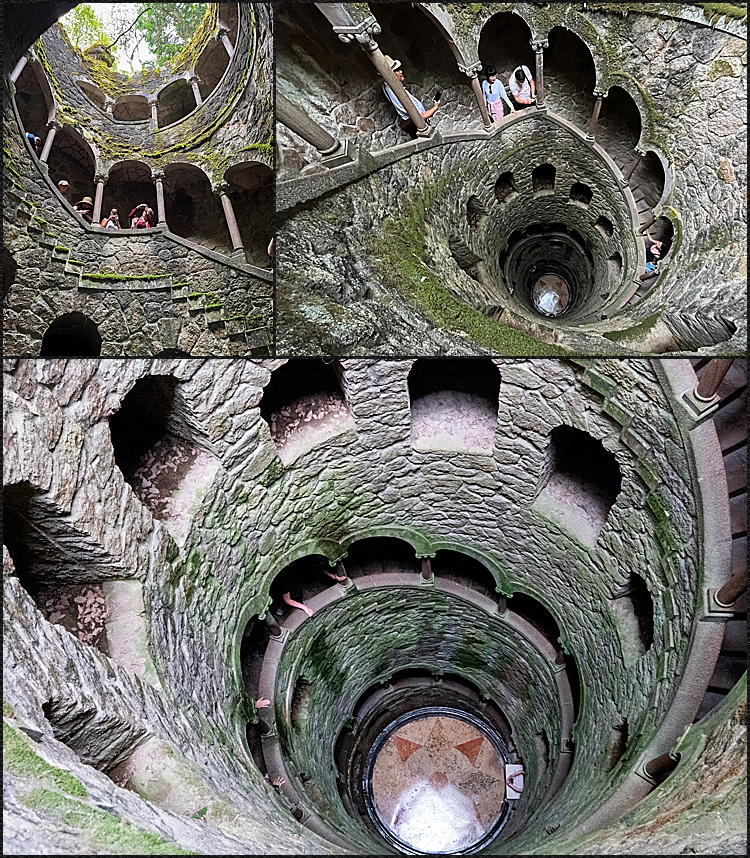
Once we were in …and it was quite a wait until our time slot we realised you can wander wherever you wanted. Because the estate is so large it didn’t seem very busy until we arrived at the queue for the Initiation Well … it was long, very long. Not surprisingly all visitors want to see the well and it is worth the wait which was only about twenty minutes. Apparently it was built for clandestine rituals although there are several theories about its purpose. There are nine levels which is great fun to walk down although I’ve since read each platform is thought to represent the nine circles of hell! The circular floor at the bottom which doesn’t show fully in my picture has The Knights Templar cross and the symbol of a compass. There’s a network of tunnels which takes the visitor to an underground lake, waterfalls and outside into the gardens.

Initiation Well

Visiting the well gave us an appetite for lunch so we headed through the grounds and up to the cafe which is by the Regaleira Chapel which we popped into. The cafe is the only place to eat within the grounds and although it was busy we managed to get a table. We had a very pleasant lunch washed down with a glass of wine, enjoying the sight of the rather bizarre buildings.

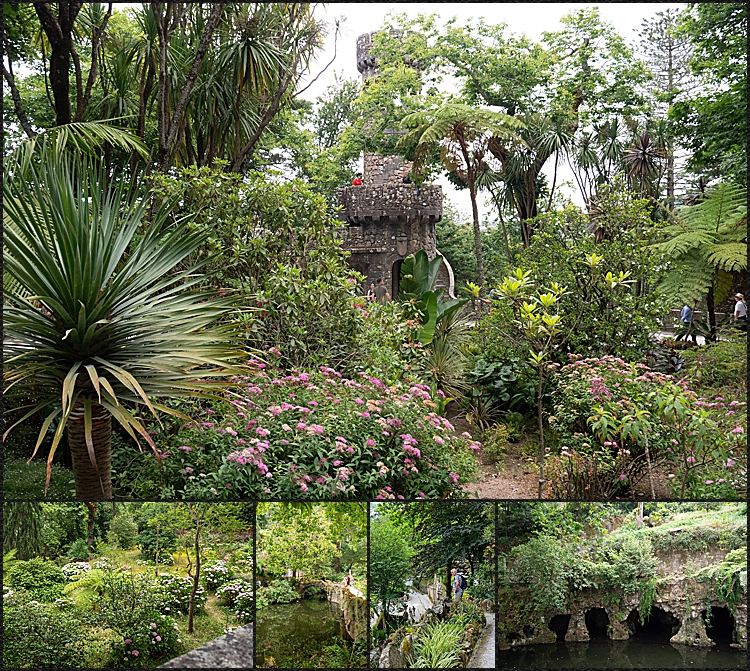
General views of the grounds.

Unless you’re in a hurry, visiting Quinta de Regaleira including the walk to and from the railway station takes up most of the day. We thoroughly enjoyed our visit to this very individual site and thought it was good value.

One of the many delightful areas of the garden at Quinta da Regaleira and my favourite.

Our last day in Lisbon was spent wandering around the city. We didn’t manage to get on one of the iconic trams as the whole central network was jammed due to crowds of people and much activity at the Cathedral. It was June 12th and what we hadn’t realised was that on this day 16 couples get married in the Cathedral and the iconic #28 tram goes right by the Cathedral. It’s part of the Saint Anthony tradition which started in 1958. There was a ‘gap’ betwen 1974 and 2019 but now this Festival has been reinstated and these weddings have become an important day, not just for those couples but for the whole city. We didn’t wait for the couples to be paraded down the street after the Ceremony as it would have meant a couple of hours hanging around with all the crowds but I’m sure it’s an amazing spectacle.

The city of Lisbon.
A favourite viewpoint looking over the sea in Lisbon.

Lisbon is a great city which is why we decided to go back a third time. There’s lots to do; it’s easy to walk round and if it’s not the ‘Wedding Day’ you can also take a tram to explore the different areas. We enjoyed staying in the historic Alfama area even though it was pretty manic at night but it all added to our holiday. There is a lot more to do than I’ve written about here but maybe this Blog has inspired you to go and see for yourself. We were sorry to leave after being there just three days however we were heading off north, to discover another area of Portugal.

Travelling from Switzerland to Provence.

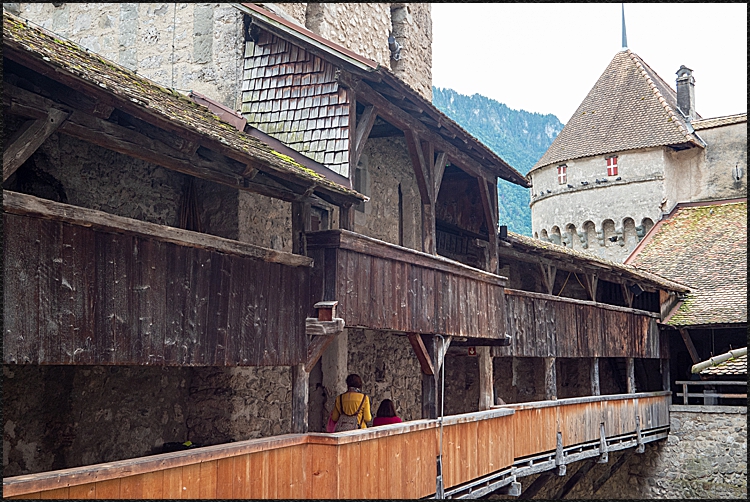
Chateau Chillon bordering Lake Geneva.

It’s never easy leaving the beautiful scenery of Switzerland but as we were heading for our favourite area of France, it wasn’t too much of a wrench.

Our first stop was Montreux in the heart of the ‘Swiss Riviera’ on the shores of Lake Geneva. Already the weather was improving as we walked a little way around the lake in the welcome sunshine. It wasn’t long before we spotted what we were looking for …the statue celebrating a rock legend, Freddie Mercury. Not surprisingly there were a number of people wanting to have a picture with the great man, I wasn’t going to miss the opportunity either.

Freddie Mercury by the shores of Lake Geneva.

I’m sure Freddie would have approved of both the statue and the location and the dedication on the plinth. What a great tribute.

Grabbing a quick lunch and raising a glass to the man himself we then drove to another famous landmark, Le Chateau Chillon. The word ‘Chillon’ means rocky platform and that’s exactly what this castle sits on, its part and parcel of the rock itself. It’s surrounded by a natural moat and can be accessed from all sides but visitors these days take the easy route along the bridge.

The underground crofts of the castle plus stained glass and the decorated roof of the chapel.

There is evidence everywhere that the castle was hewn out of the rock. The stony floor and vaulted Gothic ceilings are superb but the rooms underground hold a dark history. As well as storing wine and beer barrels, much of the space was used to house prisoners. ‘Offenders’ were chained to the stone pillars and fed meagre rations. The most famous prisoner, was Bonivard, a priest who converted from Catholicism and became a Protestant. Centuries later, the poet Byron was so inspired by the story that he wrote the now famous poem, ‘The Prisoner of Chillon’.

It’s an extensive fortress and has many rooms; the cellars and dungeons being the most interesting. Chateau Chinon has lots of architectural details; paintings, murals and furniture and because of its shape there are several courtyards and interconnecting walkways. If you’re in the area this castle is well worth a visit, not just for its historical significance but for it’s location right on stunning Lake Geneva. After we came out we walked in the garden, bought an ice cream from the shop and sat on the castle wall enjoying the view.

One of the covered walkways.

It’s just twenty minutes to the French border following around the lake. Our hotel that night was excellent and the staff were great. Happy to recommend Hotel le Leman at Saint Gingolph and the lakeside resturant, Restaurant du Port À Meillerie where we ate that evening.

The sun setting over Lac Leman and the view from our balcony.

Wow what a superb breakfast! Ready to face the day we set off in the direction of the medieval city of Annecy. It took us a while to get to the lake which was annoying as we had quite a drive ahead of us from there. Thankfully we managed to find an underground car park just by the historic centre although we didn’t have lot of time to explore or see the old gates which are preserved in what was a fortified town. After stretching our legs walking along the lakeside we turned towards the old town and of course I had to take a picture of the iconic ‘Palais de l’Ile’. It’s built on a rocky island and looks a little like a boat marooned on the river. This town is as you would expect very touristy so after grabbing a baguette for lunch we got on our way again. It was easier to find the road out to the motorway than it had been coming in.

Lake Annecy and Le Palais de I’lle.

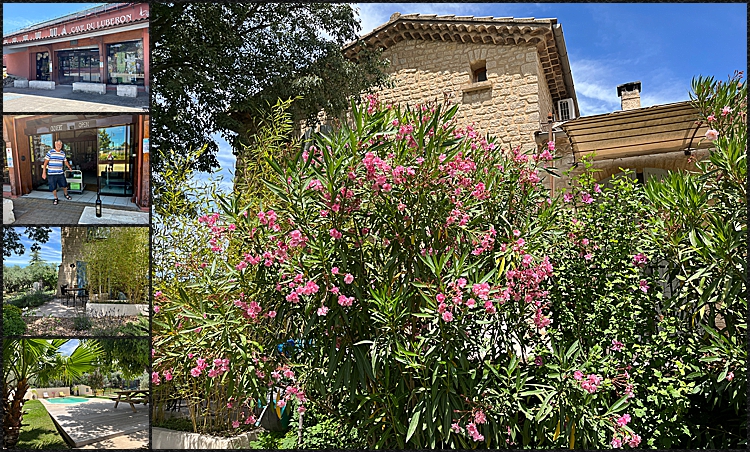
And now we were heading to Provence and our gîte for the week in the village of Lagnes. We’d stayed in this charming Provencal village the year before and it had suited us so well that we decided to go back again. Aurelie and Fabien, the owners are very welcoming and the rooms in the gîte are quite spacious. Although it’s part of the house, the accommodation is self-contained with a private patio leading off from the bedroom. Another reason that we like this gîte is we can use the pool at any time and bbq when we like and there’s no problem with parking.

Lagnes is very unspoilt and has many narrow paths and covered walkways between the old houses. The XIIIth century chateau which is perched on the rock overlooks the village. We walked up there one evening as you get a magnificent panoramic view from the top. The bakery is a short walk from the gîte as is the pub but nearer still is the excellent pizza place. Just one meal there is not enough, le Monde à Sa Porte does great pizzas. We went twice and had a thoroughly good meal on both occasions.

The gite at Lagnes, also the Cave du Luberon which we visit (note the trolley). It’s a necessary part of the holiday.

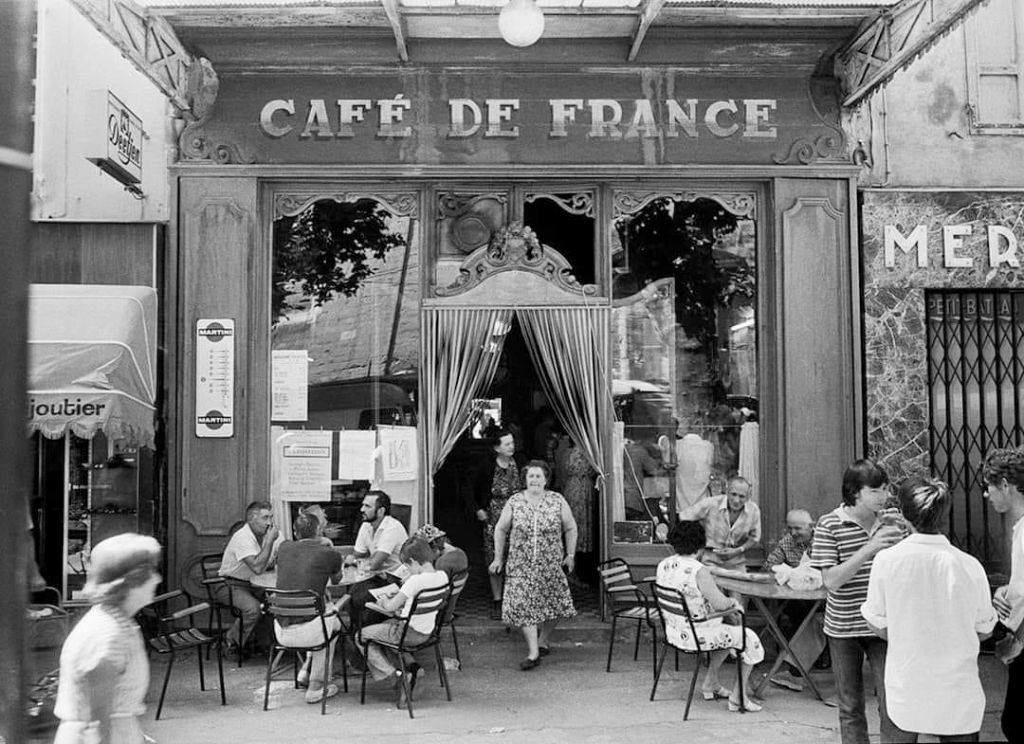
I can’t speak highly enough of Provence and particularly the south east of the region. It’s our favourite part of France and because we’ve been going there for many years we know the area pretty well. We always go into L’Isle-sur-la-Sorgue which is the nearest main town to where we stay but avoid Sundays when the Brocante (Bric & Brac) market is on. It’s impossible to park that day and where once it was somewhere you could pick up a reasonably priced antique and wander easily around the stalls, it’s not like that anymore. We like to go into the town mid-week on a Thursday to the locals’ market and sit in the square outside the Cafe de France with a beer and watch the world go by. I’ve copied this picture from their website. Not sure how long ago it was taken but the cafe itself has been going since 1903. Incidentally, this is not me in the picture!

The famous Café de France in the centre of L’Isle-sur-la-Sorgue.

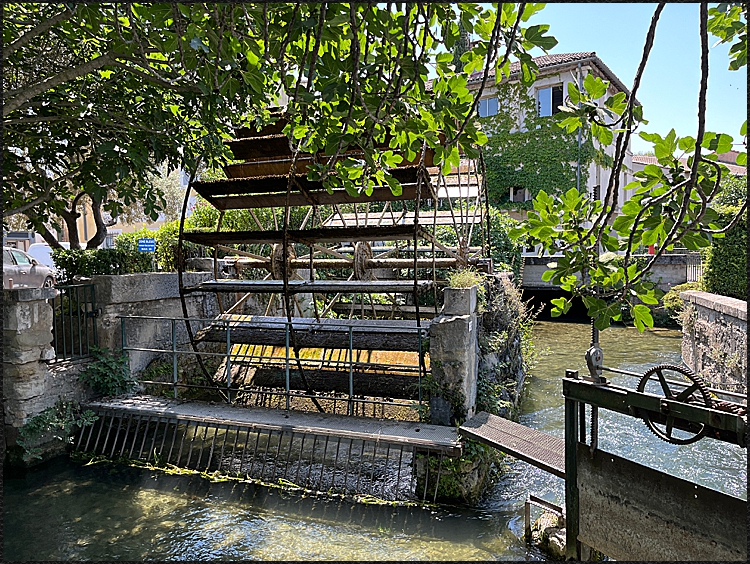
We have the TV chef Keith Floyd to thank for introducing us to this part of France and to L’Isle (as the locals call it). We watched a programme, probably thirty-five years ago now, where the chef had set up his grill on a bridge and was cooking, glass of wine in hand of course. He was waxing lyrical about the town and when the camera swung round you could see why. This ‘Island city’ is very picturesque with its canals of clear, blue water, little bridges, flowers spilling over the tops of the railings and giant waterwheels turning in the Sorgue river. Fortunately although the town is much busier than it used to be it still has lots of charm and we always enjoy walking around and popping into some of the more bohemian, independent shops.

Thursday market in L’Isle-sur-la-Sorgue followed by a beer.
One of the waterwheels along the canal in L’Isle-sur-la-Sorgue.

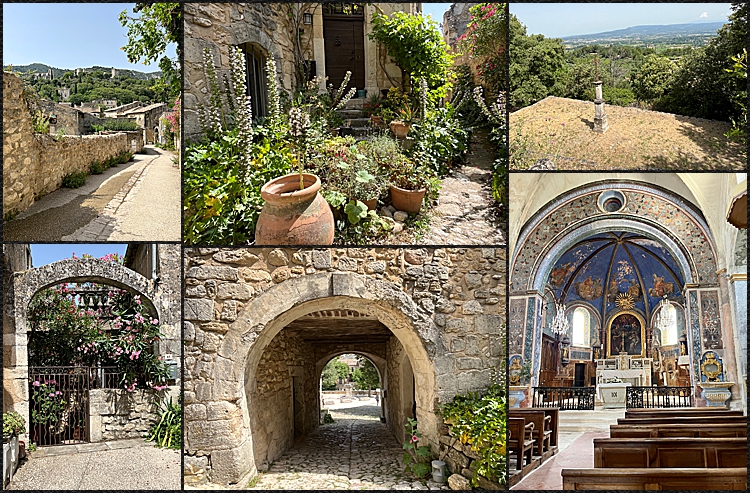
Whilst we’re in Provence we travel around enjoying the countryside, the villages and soaking up the history and the atmosphere. It’s only recently that we’ve discovered the village of Oppéde-le-Vieux. This medieval village is off the main tourist route and is quite remote. You can park a little way outside and pay a small amount or there’s free parking in Oppéde village and enjoy the 30-minute walk to the old village. There’s a well laid out botanic garden at the start to the village which is full of plants and shrubs including ‘garrigue’, which enjoys this dry, Mediterranean climate. Further along the path towards the village is the graveyard which we had a wander round before arriving at the cobblestoned ‘Place de la Croix’, the centre of the village. We were tempted to get a drink at one of the two cafes in the square but decided to wait as we wanted to head up to the Chapel. It’s quite a climb but worth it.

The medieval village of Oppéde le Vieux.

At the start of WWII there were around ten people living there. After the war, the interesting ruins attracted artists and students studying architecture and gradually a community grew. Thanks to them the houses, churches and castle ruins were protected and today the village is well preserved. I imagine it’s a heritage site since grants have been procured enabling the ruined castle to be saved from further decay.

The beauty of this village is that it is remote and is more or less unchanged from medieval times. There’s a tea shop in the Place de la Croix where you can sit in the small courtyard and enjoy one of the owner’s refreshing drinks. Perfect to revive you after a steep climb up to the church and a scramble over cobbles on the way down. It’s worth having a look in the boutique shop there where I always find something to buy.

During our week this time we went to several places and rather than a blow-by-blow account I’ll finish this Blog by mentioning a few towns and villages and add a couple more pictures.

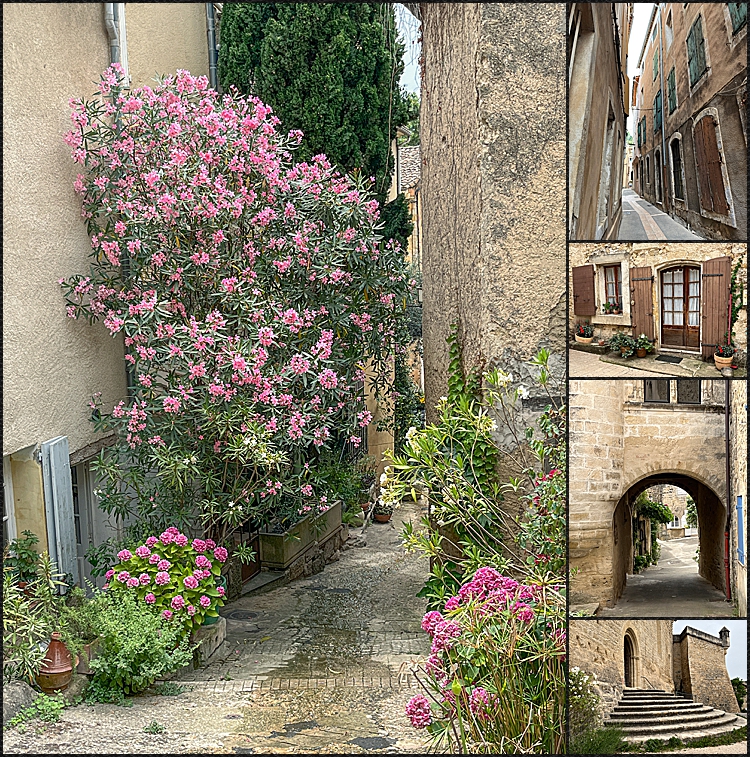
The small Provencal villages of Cucuron & Ansouis

We’d spent a pleasant morning wandering around Apt which is the main town of the Luberon. It has a distinct Arabic feel to part of it with several spice stalls and Moroccan carpets on sale in the Saturday morning market. We found a good wine shop where we bought a couple of bottles of wine to take to our friends who live near L’Isle-sur-la-Sorgue. It was important to buy ‘good’ wine from a vintner rather than a supermarket for this special lunch. On the way back from Apt we meandered over the Luberon Hills and explored the medieval villages of Cucuron & Ansouis. In the latter, we came across a cafe and had a very reasonably-priced lunch sat under a large Plane tree. The castle is well preserved but then it is privately owned. There’s also a beautiful little church in the village with a wonderful set of steps in the shape of a fan.

Le Verger des Papes restaurant at Châteauneuf du Pape

I want to mention the village of Châteauneuf du Pape which is, like many settlements in the area, perched on top of a hill surrounded by fields of grapevines, (you have probably heard of this famous, full, red-bodies wine). At its summit is the ruined castle which was built in the 14th century by the popes as a summer residence. There’s not much left of the castle so it’s easy to walk round. The adjacent car park is free too. It was quite a drive there but we like the restaurant which is just a few steps down from the car park. The food at Le Verger des Papes is excellent but not cheap. Sitting in the garden you look across the Rhone valley to Avignon which on a clear day you can see the famous Palais des Papes.

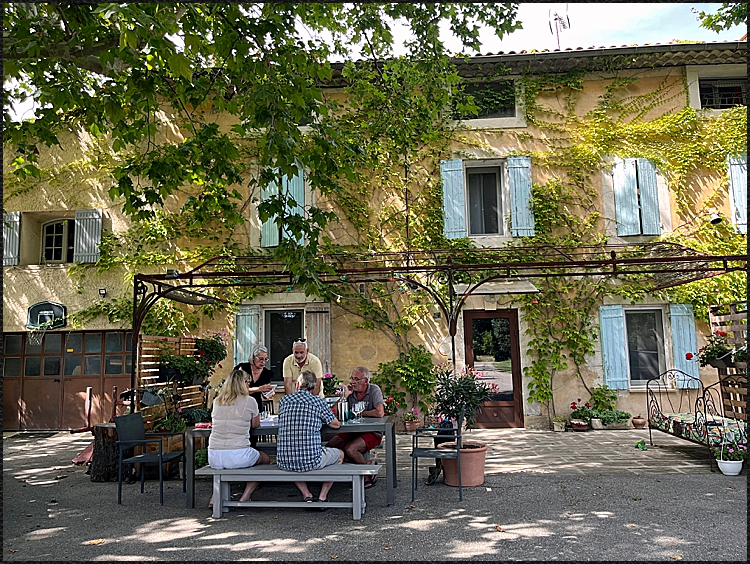
A typical Provencal Mas (Farmhouse). We are enjoying the company of friends over an unhurried lunch in typical French style.

Just a couple more places to mention which we always make time to visit. Venasque is one, famous for its cherries also the lovely little chapel there and wonderful views from the ramparts and St Didier, where you must head for the nougaterie shop run by familie Silvain. Oh and I almost forgot Lacoste which is one of our favourite villages. There are so many worth visiting.

I hope my tale of our week in Provence has inspired you to travel that way and explore the countryside and the villages and the markets and all the thing that make this such a wonderful area. Thank you for reading this rather lengthy account. I could have written more …

Travelling to the Bernese Oberland.

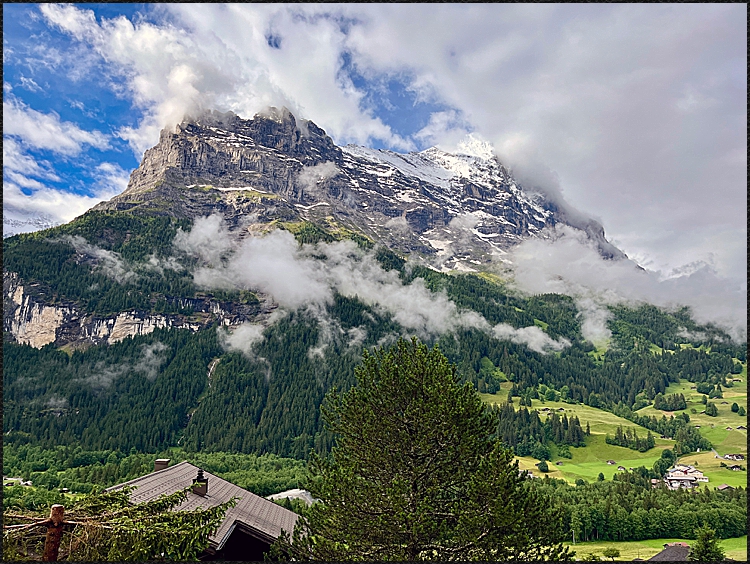
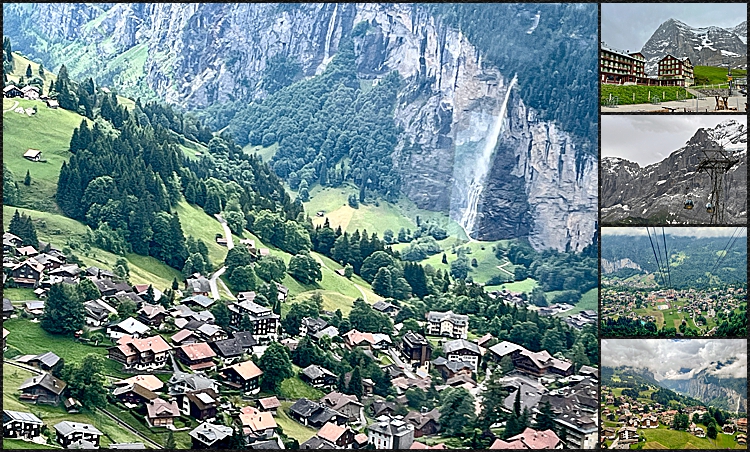
Breathtaking view from our balcony at Hotel Tschuggen, Grindlewald.

Most years, for our summer holiday, we head over to Provence however last year we decided to go to Switzerland via Alsace as well.

It’s a bit of a drive from Calais so we often stop for lunch in Laon; an interesting old, hill-top town with a beautiful cathedral and a good cafe nearby. It’s a steep climb between the high and low parts of the town but we’ve now found a car park just by the medieval gateway.

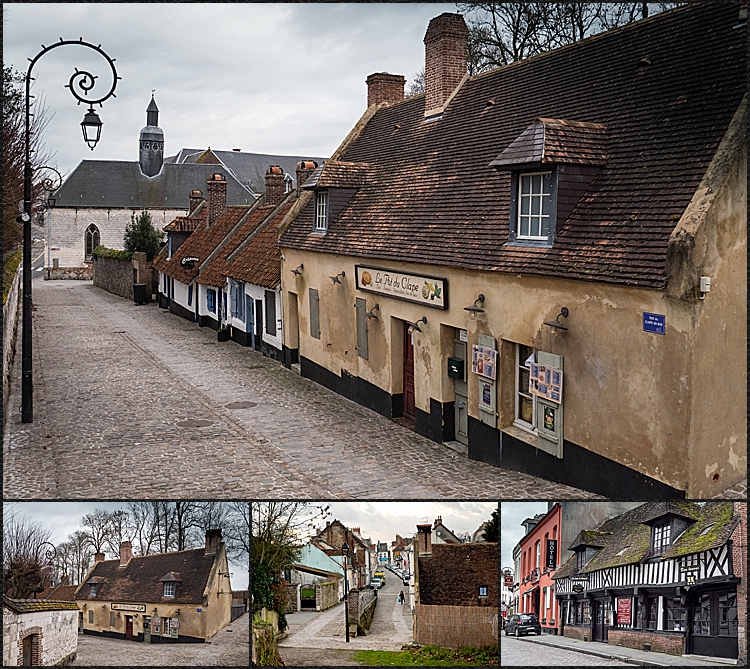
Medieval gateway into the town of Laon. The colourful main street and the interior of the magnificent Gothic Cathedral.

Fed and watered we stopped off at a Logis for the night at a ‘one horse’ town, south-east of Rheims. It was a reasonably priced hotel, good sized room with a restaurant with absolutely ziltch atmosphere. You would have thought someone had just died in there …

Moving on we headed towards Alsace stopping off at the major tourist site of Chateau Haut-Koenigsbourg near the city of Sélestat. The castle sits on top of a large rock, ideal for spotting the arrival of your enemies. Its strategic position however didn’t stop the Swedish artillery who burnt the chateau to the ground in the Middle Ages which was then abandoned for two hundred years. It wasn’t until Alsace was annexed to Germany in 1899 and given to Kaiser Wilhelm II that the castle was rebuilt back in the style of a 15th century fortress. It’s an impressive castle with three storeys, great views all around and plenty to see and do.

Chateau du Haut-Koenigsbourg.

Before going to our friends in Sélestat we had a walk around a couple of the villages nearby. It was early afternoon and very quiet. The architecture in Alsace is Germanic in style with frontages clad in wide half-timbered panels and most buildings have steeply pitched roofs. The patterns seen on these houses stem from local symbols and traditional decorations. Even though Alsace is part of France, long periods were spent under German influence. The region was finally returned to France in 1945. Many of the street names are Germanic rather than French.

Traditional Alsace houses, also the entrance to the main square in Sélestat and its cathedral.

After a very pleasant stay with our friends we finally tore ourselves away from their wonderful hospitality and headed for the Swiss border and the town of Thun. I first visited this town over fifty years ago and it’s still as charming now as it was then. Yes it’s very touristy but it has a lovely feel about it. The Old Town is worth walking through and climbing up the steps to the medieval castle is a must. We didn’t go inside Schloss Thun purely due to lack of time but from the website it sounds as though its worth a visit. Its four distinctive 12th century white towers are a famous landmark – a real fairy tale castle. We did go inside the city church (Stadtkirche) which is just along from the Schloss. It was built in 1330 and has a striking tower which complements the architectural style of the nearby Schloss.

The weather that day was glorious and the town was buzzing. We sat at one of the cafes of which there are several along the banks of the river Aare. This is the longest wholly Swiss river and originates from the Oberaar glacier. I love the bluey-green waters of the river and with the backdrop of the old wooden bridge with flowers along it, you just know you’re in Switzerland.

The beautiful town of Thun.

By late afternoon we’d arrived in the mountain village of Grindelwald where we were staying for four nights. We always stay in the family-run, Hotel Tschuggen; Monica & Robert are so welcoming. We book one of the rooms at the back of the hotel as the view is, (in our view) one of the best in the world. There’s nothing better than relaxing on the balcony with a glass of wine whilst taking in the breathtaking scenery. The breakfast there is excellent and their yogurt …well you’d be hard pushed to find a more delicious yogurt anywhere – those Swiss cows enjoy a good life in the lush Swiss meadows.

View from our balcony at Hotel Tschuggen.

As we were staying in the area for a few days and had planned various excursions and walks along some of the mountain trails we bought the Swiss Travel Pass. It appears quite pricey but when you’re using the transport system within the Bernese Oberland and going on several excursions, you do save money.

On our first morning the plan was to take the 25 minute Gondola ride from the village up to First and then walk to Lake Bachalpsee which takes about an hour. There’s a new Cliff Walk at First also a 800 metre ‘First Flyer’ zipline and a high-octane scooter ride down to the next Gondolbahn station so we watched all the action for a while before starting our walk. None of these new attractions are included in the Travel Pass.

Station at First with the new Cliff Walk.

We hadn’t walked very far before one of the rangers stopped us to say the trail to the Lake was closed due to recent snowfall so we changed our plan and decided to walk straight to Grosse Scheidegg. We were thwarted there too as the pass was also closed. Nothing we could do but to go back down to Grindelwald where we caught the bus to the new Terminal. It’s all very grand in there with lots of shops so we grabbed a baguette from the Co-op before going on another Gondolbahn up to Mannlichen.

Walking from Mannlichen to Kleine Scheidegg

I do a fair bit of walking and I remember some walks more than others; this one I’m unlikely to forget. Once again, the trail we intended to take was closed due to snow so we looked at the signpost showing the distance to Alpiglen station and as we thought it wasn’t too far we decided to head that way. Unfortunately we had misread the sign, it was a great deal further than we thought. From time to time we could see the station but it never seemed to get any closer. The trail at times wasn’t easy and the clouds kept coming in over the mountain tops which was a little worrying. In the end, having stopped to eat our baguette we decided to head towards Kleine Sheidegg.

What a climb that was! The wind was in our faces, we were tired and the trail was really steep. We almost fell into the cafe, ordered two beers and plomped ourselves down on the nearest seats. Thankfully the weather had improved a little but it didn’t lift our spirits. We caught the train down to Grindelwald and bought some chocolate in the town to sweeten us up, which it did …that and a glass of wine on the balcony, followed by a steaming hot bath.

That evening we walked along to Oncle Tom’s which is a superb pizza place only to find it was full. The day did end well though as we went to another pizza place, Pizzeria da Salvi and had a very good pizza there.

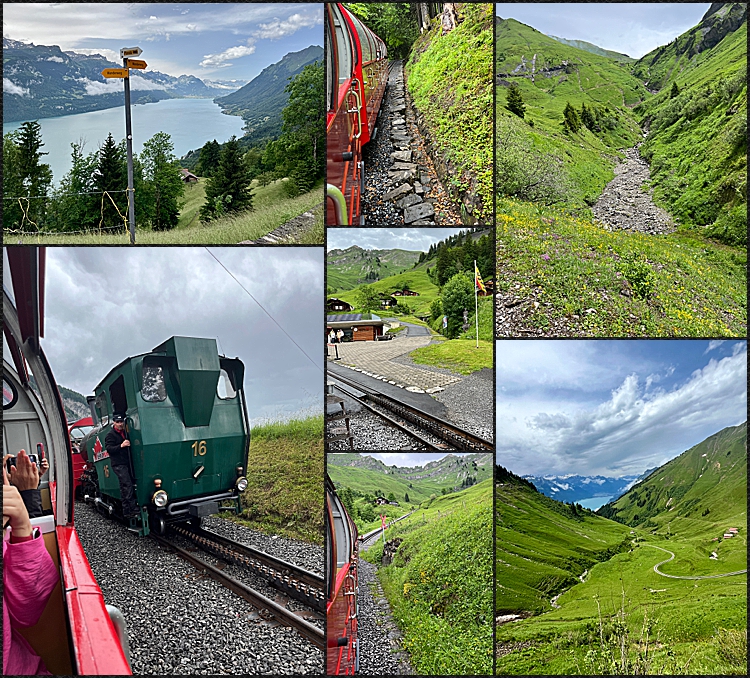
The next day we caught the train to Interlaken and then a second train going to Brienz. Bearing in mind that we had a Swiss Travel Pass it should have been easy to go straight onto the train, the Brienz Rothorn Bahn but no, the tickets didn’t work with the turnstile. We weren’t the only ones realising this and so there was quite a queue to get an actual ticket. Thankfully we squeezed into one of the carriages before the train chugged off. There’s not much room in the carriages what with people and backpacks but don’t be put off going as it’s a good journey, very interesting with some great views. The train takes an hour to get to the Rothorn Kulm with a stop at Planalp middle station to wait for the other train to come down from the summit as it’s a single track cogwheel railroad. They also refuel the steam locomotives with water there.

Going up to the summit – Rothorn Kulm.

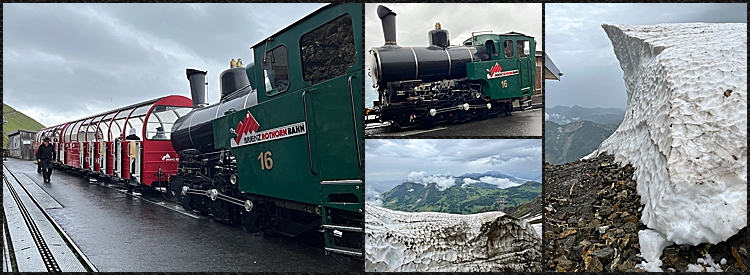
I seem to be mentioning the weather a little too much in this Blog but unfortunately it was very unsettled most of the time we were in the Bernese Oberland. This day was no exception; lots of cloud at the summit and bitterly cold but there is a good, spacious restaurant where we got a snack and were able to warm up. We did have a quick walk around the top but as soon as the sleet started we caught the next train down. This one was a steam locomotive and was more fun than the diesel one we’d travelled on to get up there.

A steam-powered locomotive on the Brienz Rothorn Bahn.

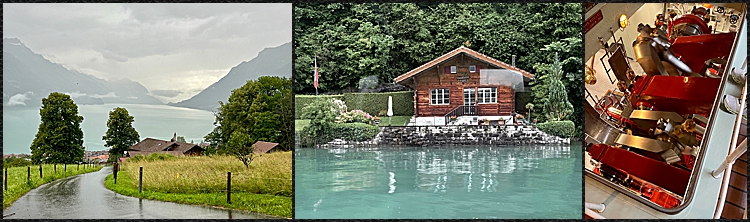
There were limited views on the way down because of the low cloud and rain which might be the reason why the train was late getting in. If you know anything about the Swiss transport system you’ll know that all modes of transport synchronise with one another, in otherwords you hardly ever have to wait long for a connection. Looking at our watches we knew the paddle steamer would be leaving on time which meant we were in danger of missing it.

Lake Brienz in the rain, a lakeside cottage and the highly polished engine powering the boat.

With a couple of minutes to spare we ran across from the train to the dock and boarded the steam boat which was just about to leave. We went up to the top deck not realising that it was first class. The waitress told us and said (for whatever the extra cost was), we could stay up there but we said we were happy to go downstairs. Actually it was just as enchanting. The design of the decor was early 20th century with bevelled mirrors, wooden panelling and solid wooden tables like you’d imagine something Agatha Christie would write about. No murders here or shady characters; passengers came and went, everyone shared tables and that way we met some interesting people. These boats are lovingly maintained, it was fascinating to see the engine from the viewing area and we both agreed it had been an interesting experience.

We rounded off the day with an excellent meal at the Hotel Pinte having escaped the rain and being rewarded by a beautiful rainbow as we walked along the Main Street of Grindelwald.

Rainbow’s End.

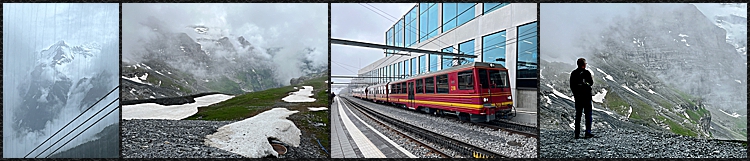
Our last day and wanting to get the most out of our Travel Pass we walked down to the Bus station to get the bus to The Terminal. In this building are several television screens showing what the conditions are like at Kleine Scheidegg or First or the top of the Eiger and other places. Most were pretty cloudy but we decided to get the Eiger Express up to the Eiger Glacier station which takes about fifteen minutes.

Cloud at the Eiger Gletcher station.

The weather wasn’t good as we’d seen on the TV screen so after having a warm drink at the top we caught the train down to Kleine Scheidegg and then a train to Wengen. I’m sure this pretty Swiss village is a lot busier than this in the winter but when we were there the main street was virtually deserted and no cars. There didn’t seem much to do so after wandering into a few touristy shops so we headed to the local bar for a couple of glasses of wine and snack.

View travelling down from Wengen.

Not feeling like walking round anymore we headed for the Wengen-Männlichen cable car This is a superb ride in a large cable car with an impressive view of the Lauterbrunnen valley and its iconic waterfalls. The trip is less than five minutes and has an open air balcony which would be great I’m sure in good weather. We then got the gondolbahn down to Grindelwald. It was an ‘interesting’ ride down as we had got on the Karaoke car! Our granddaughters would have loved it but after trying to sing a couple of songs we gave up and were content to enjoy the view.

That evening we did manage to get a table at Oncle Tom’s and thoroughly enjoyed a pizza and their excellent beer. If you’re ever in Grindelwald this is the place to go – reasonable prices, good food and beer and a great atmosphere. It was a perfect way to spend our last evening in the town.

After another excellent breakfast at the hotel we got on our way hoping to escape the rain which had dogged us for a few days and headed out of Switzerland towards France.

This Blog is quite long enough so I’ll write about the rest of our holiday in Part II. Hope its given you a taste for the Bernese Oberland and maybe you’ll be tempted to visit sometime.

A week in sunny Kos.

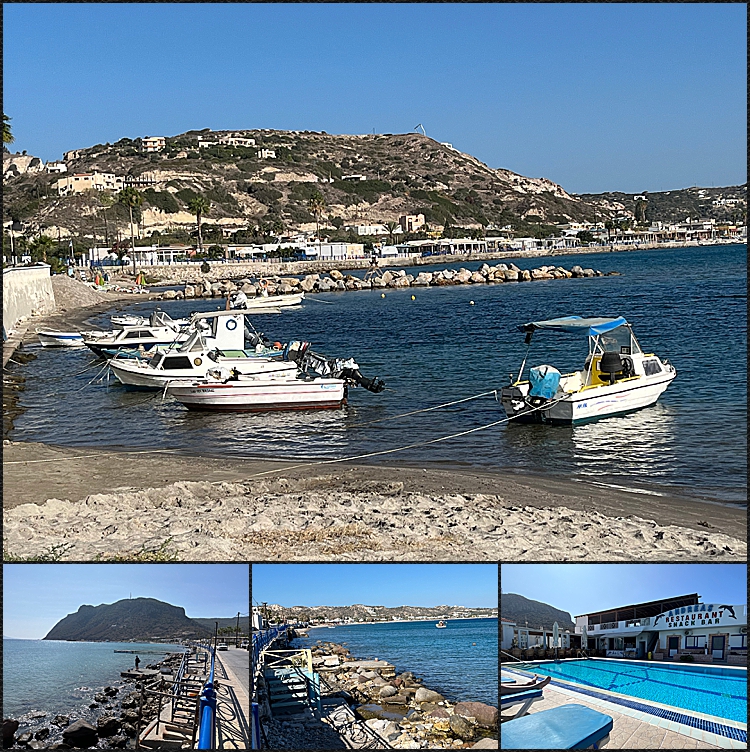
Near Kefalos and our apartment at Andreas Studios with its fab. swimming pool.

We needed a week’s holiday, somewhere that wouldn’t cost the earth and preferably with some good weather. Mentioning this to our neighbour he told us about apartments on the island of Kos run by friends which has reasonably priced rooms, a lovely swimming pool and a good restauarant. It wasn’t long before we had booked a room at Andreas & Rita’s Studios,near the town of Kefalos. https://www.self-catering-apartments-kos.co.uk/

As you can see from the pictures, the coastline is beautiful and was just down the road from the apartment. Andreas & Rita were so welcoming and after leaving the cases in our very spacious apartment we enjoyed an excellent meal in their restaurant washed down with a few pints of lager. This was defintely the right place for us and we couldn’t wait to explore the area the next day.

It was tempting to have a swim in the pool first but we decided to walk down to the shops of which there were just a few including a very good supermarket which had all the things we needed – fresh fruit, warm croissant, jam and yogurt. After a very slow breakfast we did hit the pool and lazed there for much of the rest of the day. That evening we had a meal at one of the many local restaurants along the seafront. ‘Tanipota’ is a relatively new tapas-style restaurant in Kamari Bay a five minute walk from our apartment and is very popular.

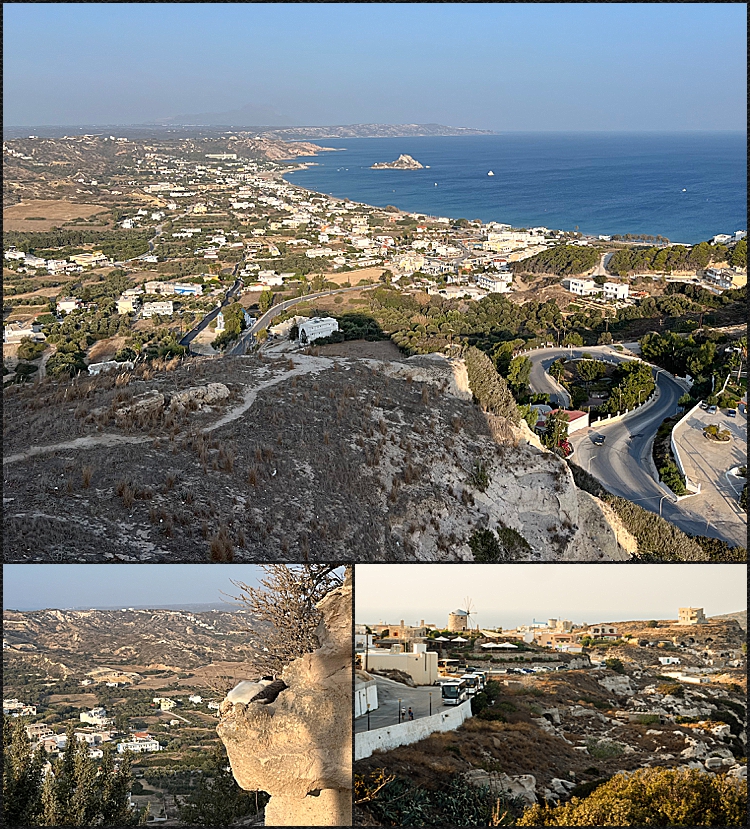
The next day a car came to collect us to take us to the car hire place. We’d booked a car for five days so we could look around the island. Kos is only a small island but having said that, there’s lots to see and do. Sandy beaches (although not all), stunning views, hilly outcrops to explore, a varied countryside with picturesque villages of typical Greek whitewashed houses, full of flowers and taverns offering tasty local food, and the quaint capital of Kos Town. Here’s a selection of pictures taken during our trips round:-

Traditional windmill of Antimachia

This 205 year old windmill is well worth a visit and the only windmill still in use on the island. There’s no charge to go inside where a guide tells you about the workings but you are expected to pay for your refreshments by buying some of the delicious biscuits made from the flour. A good gift shop too.

Peacocks in Plaka Forest

Driving around we stopped at one of the tourist spots to look at all the peacocks. There were lots of cats too and a chap selling food to give to the tame peacocks. There’s probably a story as to why they’re at this particular spot in the forest but we didn’t find out what it was.

The church of Agios Dimitri

There are Greek churches dotted everywhere around and often like this one, nowhere near a town or village. I like photographing churches and was very pleased this one was open. It was just down the road from the peacock place. The painted murals inside were beautiful and I also liked the simplicity of the interior. Not always the case as you’ll see towards the end of this Blog.

Views from the ruined castle at Kefalos

That evening we drove up to Kefalos town to a restauarant which had had a very good write-up. We could see why. We had an excellent meal at Maistrali and would recommend it. This is a hillside town with great views but to get a full panorama you need to walk slightly out of the town to the ruined castle. There’s hardly anything left but it’s worth the climb up for the views. I found it quite tricky getting back down to the road but I wasn’t wearing the right shoes! Can you spot the two cats lounging on the edge of the cliff enjoying the evening sun?

Entrance into Kos Town. The Harbour front, Hippocrates statue and the new town area

Like most people visiting the island for the first time we spent a day in Kos Town. What a great place. I expect at the height of the summer it would be packed with tourists but out of season it wasn’t. We were impressed with the harbour and all the well-maintained gardens and flower beds. We had a snack at one of the cafes on the harbour front and weren’t charged a ridiculous amount. We both thought that the architecture had a moorish feel about it. I thoroughly enjoyed browsing the little shops in the narrow streets away from the front and bought a couple of things. That called for lunch and we were spoilt for choice. In the end we ate at ‘Zorbas Eat Greek’ in the Old Town and very much enjoyed it.

Odeon Roman Ampitheatre

Walking back out of town on the way to the large, free car park we spotted a sign for the Odeon Roman ampitheatre. It’s quite something and well preserved with restored marble seating & galleries. The catacombs underneath are interesting too.

Views from the terrace at Jenny Camel bistro.

After our trip to Kos Town we decided to spend a lazy morning the next day by the pool and then to check out a couple of beaches. Camel Beach is very popular and has two restaurants, which are only a few meters apart: Jenny Camel, we were told offers more of a personal service and that was borne out by the very warm welcome. The home made bread was delicious but we turned down the kind offer of taking another loaf away with us as a gift. They were cetainly lovely, generous people.

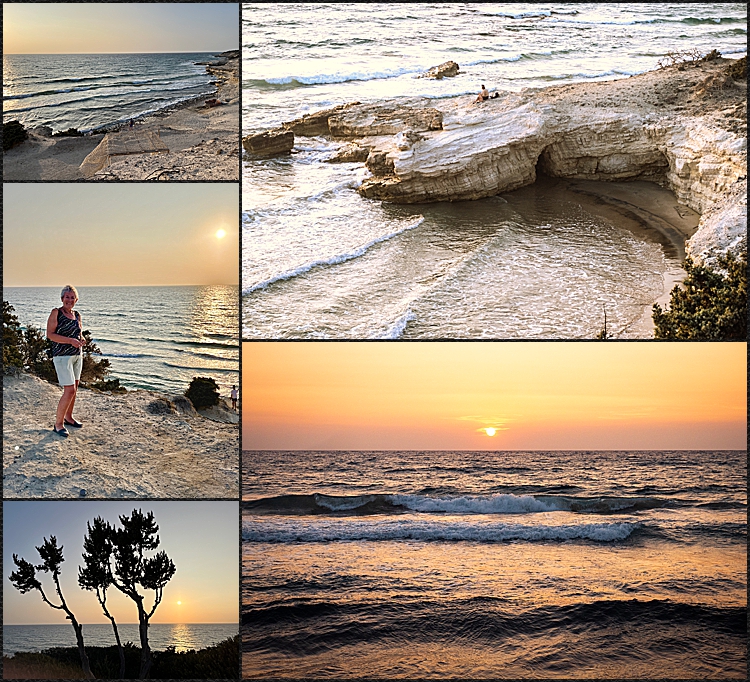
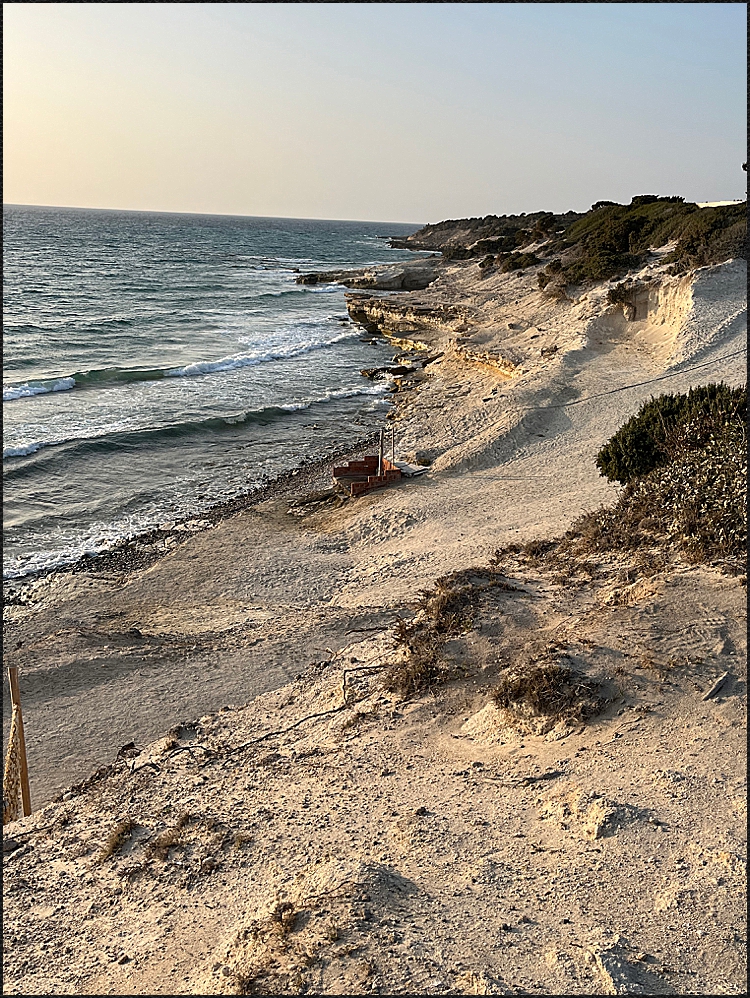
‘Agios Theologos Beach’ (ignore the wonky skyline!)

We then spent a couple of hours on another beach chilling out before driving over to ‘Agios Theologos Beach’ known appropriately as ‘Sunset Beach’. Tourists flock to the west coast of the island to watch the flame-coloured sunsets from this beach and see the chiselled cliffs and coves.

‘Sunset Beach’

When we were there it was really quiet, just a few people and it wasn’t the best of sunsets but the coastline is impressive. A decent pair of shoes is useful when you’re scrabbling around as the sand is very gritty.

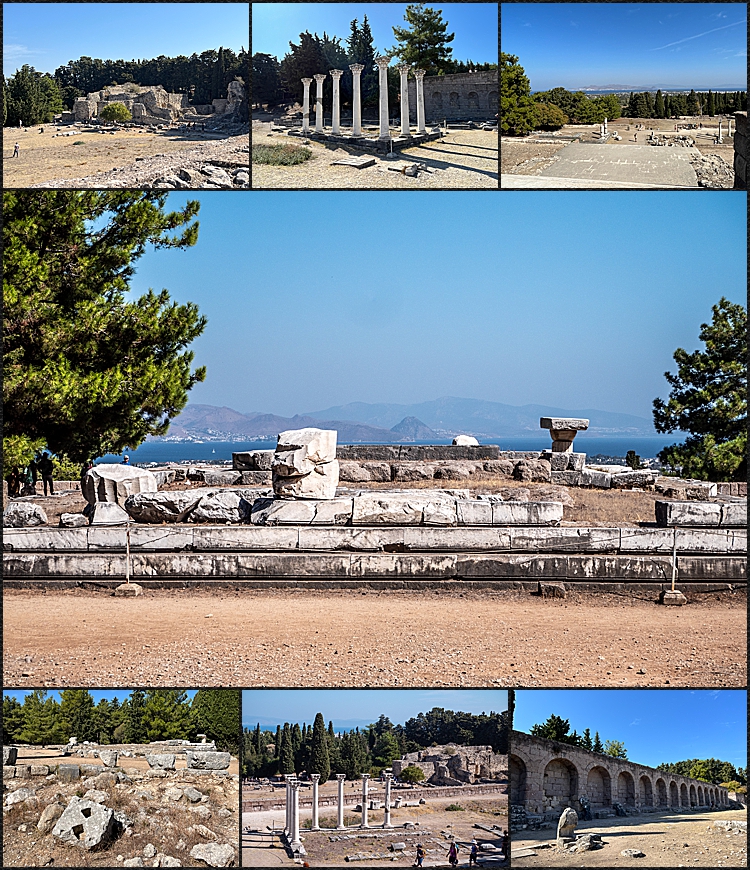
Asklipieio

It was our penultimate day so we wanted to do some more exploring. First stop was the ruins of an ancient healing temple & medical school where Hippocrates once practiced. Asklipieio is about 4km from Kos town and is the site of a historic hospital. The ruins date from the first half of the 3rd century BC and are extensive. Great for photography particularly on a beautiful, sunny day. The entrance charge is €8.00 which is well worth it. You also get great views from the site down to Kos and across to the Turkish coast.

After wandering around the Greek ruins we were in need of something to eat …and drink. We had planned to stop at the village of Lagoudi Zia which is a small mountain village. Zia is a popular place to visit and is known for ‘its charming cobbled lanes lined with tavernas, shops for handmade crafts, and traditional blue-and-white houses. Domed Orthodox churches dot the village, and there sweeping views extend to the coast’. Having said all this which I’ve ‘lifted’ from a guide book I have to confess that we drove through it and didn’t stop. Even out of season the streets were teeming with tourists and all we could see was shop after shop of Greek ‘tat’. Not for us so we carried on to the next village and had lunch in a small family-run cafe with just a few locals and a couple of other visitors. Much more enjoyable and peaceful too.

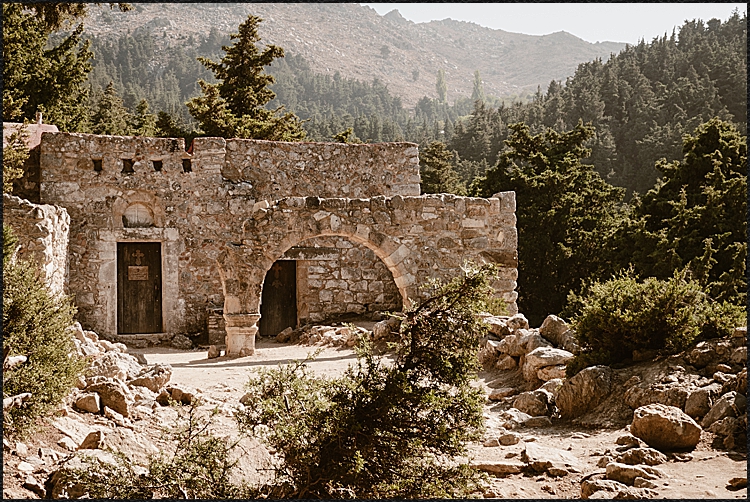
Ruins of the castle and settlement of Palaio Pyli

The drive round after lunch was quite something with narrow winding roads and stunning views, we seemed to be climbing up forever. I can’t remember whether we had already decided to walk up to this ruined castle or whether we saw it and thought we’d give it a try. The ruins and settlement of Palaio Castle tower above the village of Pylie and is reached by going up a forest path about three kilometres or so. Along the way you come across ruined churches and other signs of the settlement which dates back to the 11th century. The view of the castle remains was tantalising and although the path up there was very uneven, mostly cobbles, we didn’t think about giving up until we got near the top. It was tough and even though we don’t like to be beaten we looked at the final stage and knew we had to turn back. It was disppointing but I did get some shots of the ruins and the terrain and the resident goats.
Palaio Pyli
Ruins of one of the three churches in the Pyli settlement

This had been quite an active day to say the least so that evening we decided to go back to the fish restaurant, Cavos Taverna which was just around the corner from our apartment. Not only is the fish cooked beautifully but Mama’s home made honey cake is delicious. Everyone is given this to round off the meal. I was tempted to go round the plates on other tables where people had left some and hoover it up. I should have asked for the recipe.
Church of Panagia in Kefalos

The other restaurant we visited twice was Maistrali in Kefalos which we would also recommend. Just before we went for our meal we wandered around the town and looked inside the main church. This church is nothing like the one we’d been to earlier in the week; the inside of this one is decorated …everywhere. There’s not a square inch left uncovered as you can see.

I hope this Blog has given you a flavour of the island of Kos. We thoroughly enjoyed our week and wouldn’t hesitate to say that if you decide to visit do get in touch with Andreas & Rita’s Studios, https://www.self-catering-apartments-kos.co.uk/ Lovely people, spacious apartment, good food and a great location.