Travelling around Puglia.

This was the first time we’d been to this part of Italy which is known in the UK and maybe elsewhere as ‘The Heel’.
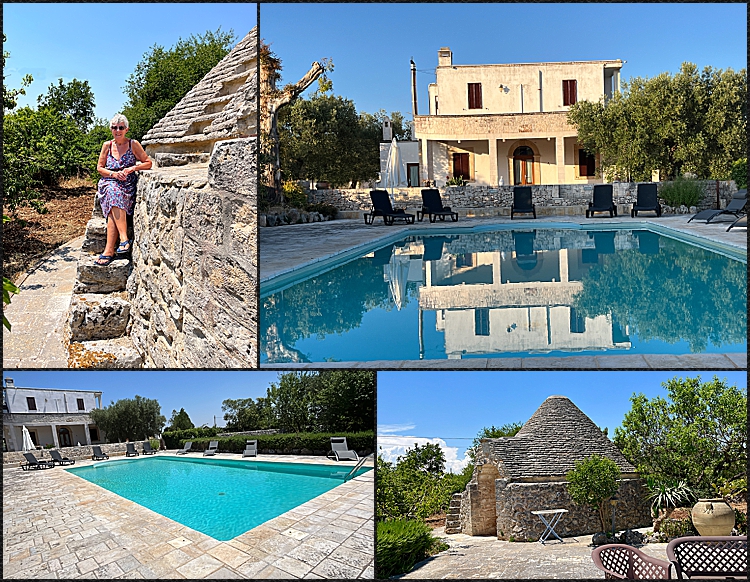
Airbnb Contrado Caprio, near Noci.

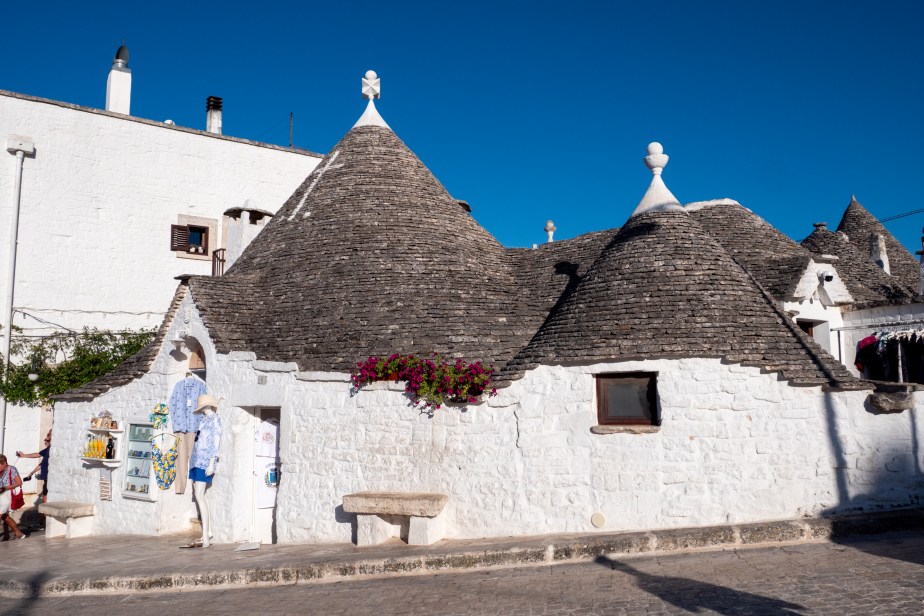
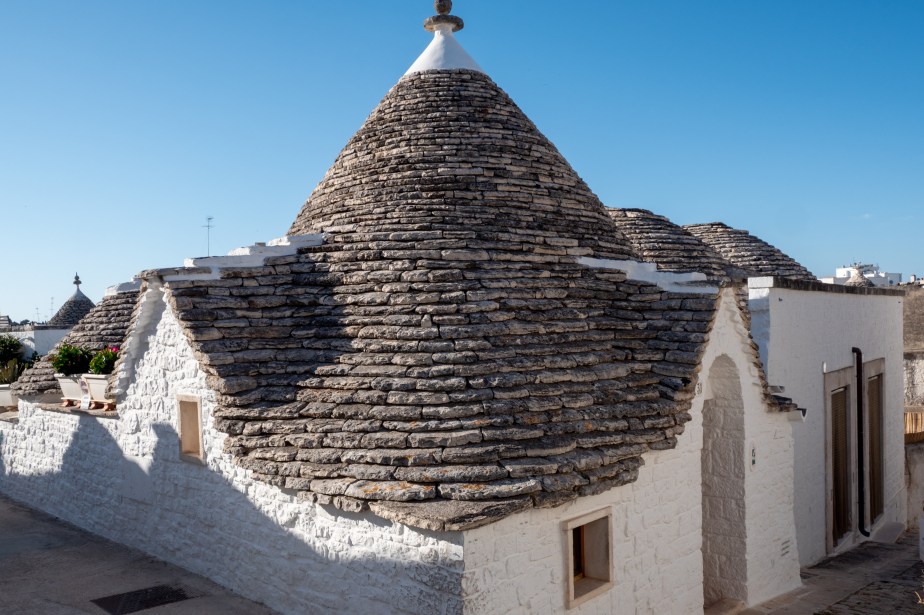
We eventually found our ‘contrada’ after several wrong turns in the Puglian countryside, in the dark. Despite feeling tired we weren’t disappointed with our Trulli which would be our accommodation for the week. These conical traditional buildings are a feature of this part of Puglia and were built by hand using local limestone without any mortar. There’s a whole village full of Trulli which we did visit, but more on that later.

As well as our delightful accommodation which is much roomier than it looks, we had a splendid swimming pool all to ourselves. With the daytime temperature in the high 30’s we made good use of the pool and took time-out for a daily siesta …like the locals do.

The nearest town was Noci which was just a short drive away. Not sure why I didn’t take any pictures as it’s a nice town, quite compact and we really liked it there. The place has a great atmosphere with families strolling around the narrow streets and the main square. The restaurants were full of life and lots of good food so we didn’t feel the need to search out anywhere bigger.

One evening we had a wander around the olive grove which was still maintained by the host family. We saw the owner’s father from time to time who would wave to us but our lack of Italian was somewhat of a barrier, however we could contact Nunzia, the owner of our Trulli, if we needed to. We also wanted to explore a little as we’d read there was another Trulli nearby.
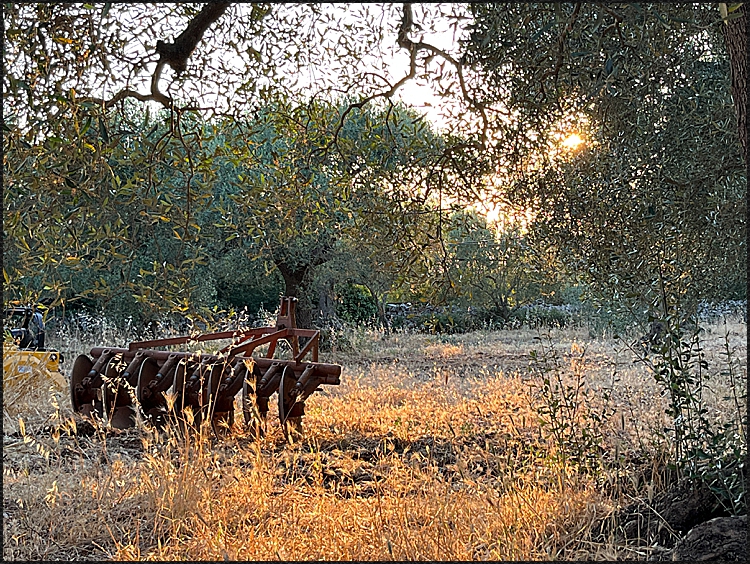
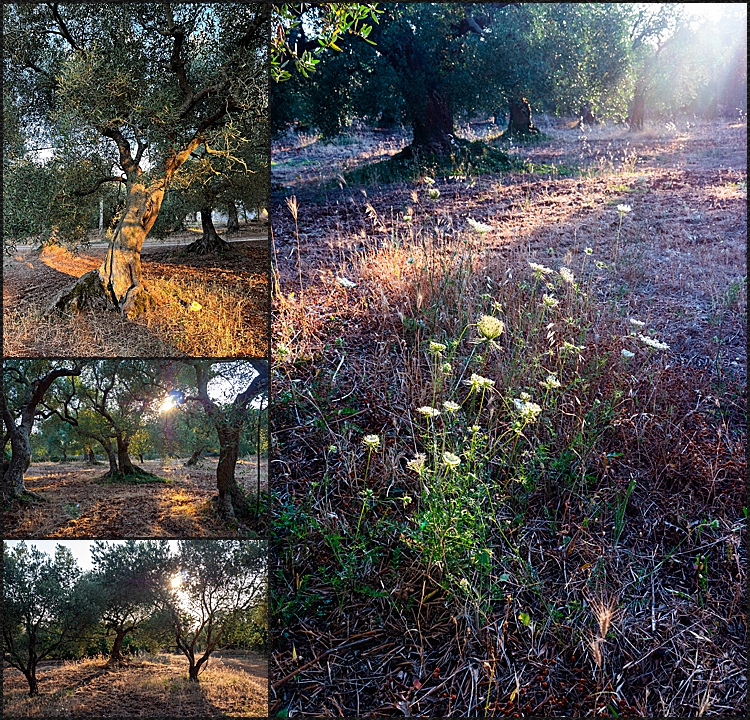
The Olive grove
The delightful Olive grove

As you can see the light was stunning that night and yes, I did take several pictures. Not only did we come across the second Trulli, which looked as though it hadn’t been used for a while but along the track we came across a small pig sty with, a rather sweet little pig. We had a feeling that it wasn’t kept as a pet …

The land mass at this point of Italy is very narrow and is bordered by the Adriatic Sea to the east and the Ionian Sea to the south and west. The coastline of the Adriatic is known for its dramatic limestone cliffs, clean waters and historic port cities. Principal towns are Monopoli, Brindisi and Lecce although there are lots of towns dotted along the coast . Some have sandy beaches, some are pebbly and some are very rocky. We’re not really beach people although we did visit both coastlines. and tested the temperature of the water at one beach used by the locals.
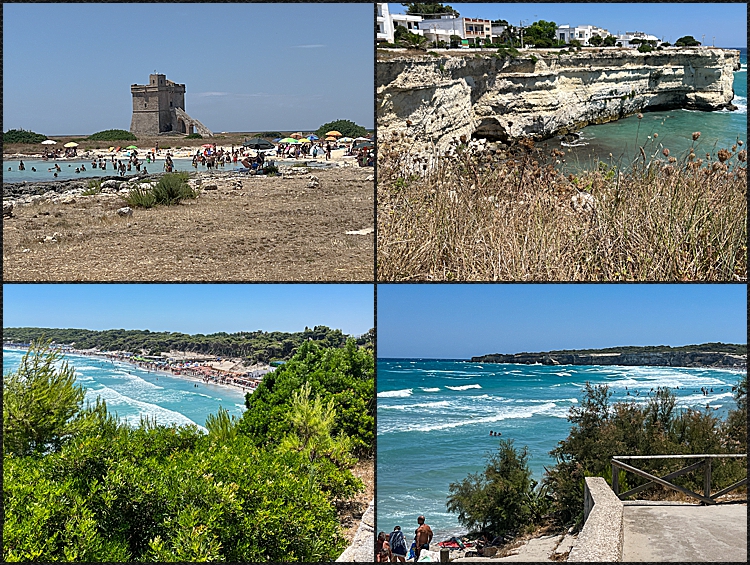
Ionian sea (top left) and a resort on the Adriatic Sea.
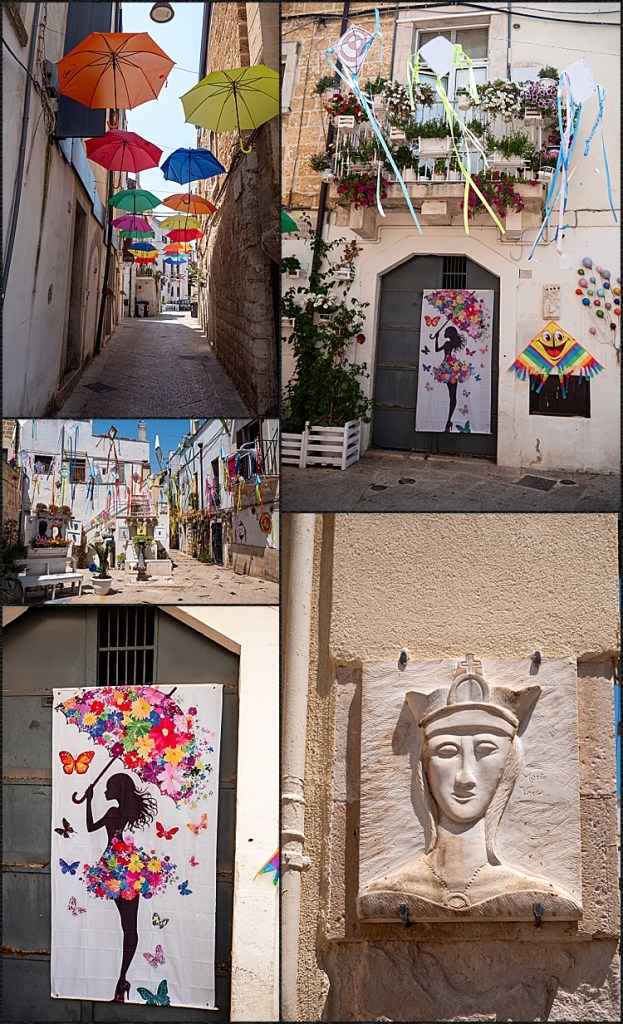
The delightful back streets of Gioia del Colle

I almost forgot to mention this pretty village which we visited in our first week. Gioia del Colle is famous for its castle, its historic centre and medieval quarter and producing fresh mozzarella. The dairy shops open from early morning so villagers can buy the cheese warm. Maybe it has more taste that way …? There are many local wineries offering guided tours and tastings but we settled for a glass with our meal after walking around the pretty decorated streets with lots of murals, interesting artwork and sculptures.. Would definitely recommend visiting Gioia del Colle

Inland is the hill top town of Locorotonda, a name which rolls of the tongue. It is pretty with great views but also very touristy as you would expect. I can imagine that in the ‘High Season’ the narrow, white alleys of the old town are rammed with tourists.
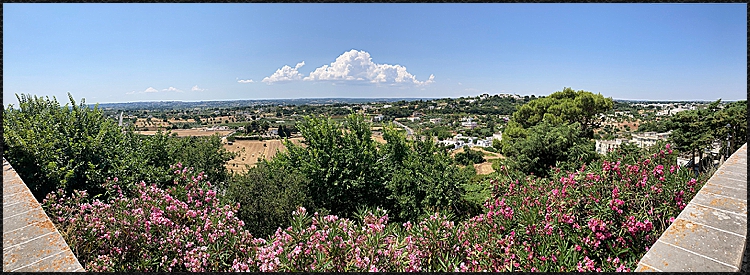
A panoramic view from the park in Locorotondo.
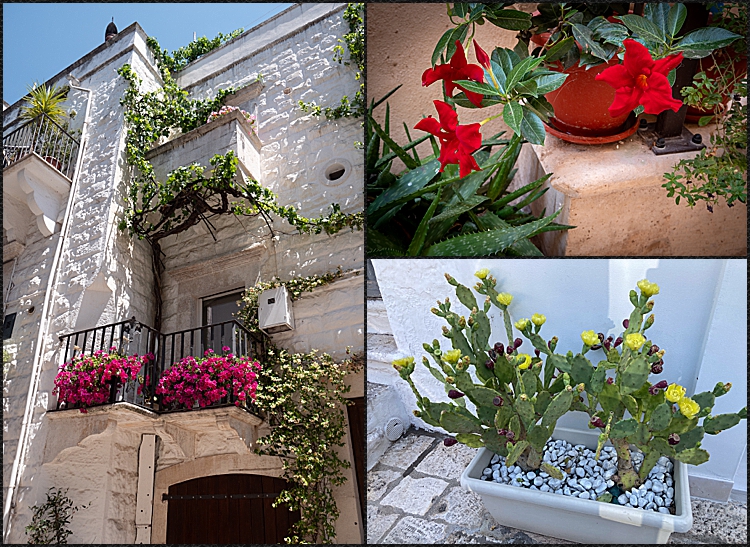
Flowers everywhere in Locorotondo

We also visited Martina Franca, another hilltop town which we liked very much, particularly its wonderful Baroque architecture and cathedral. It seemed more spacious than some of the hilltop towns. The large Piazza Plebiscito is a great place to sit, to have a cool glass of wine and watch locals and tourists walk by. The narrow streets of the historic centre are charming too. Apparently there are at least 15 churches in the town and although we did pop into a few, we certainly didn’t do them all. The Basilica di San Martin is however well worth a visit and is free to go inside.
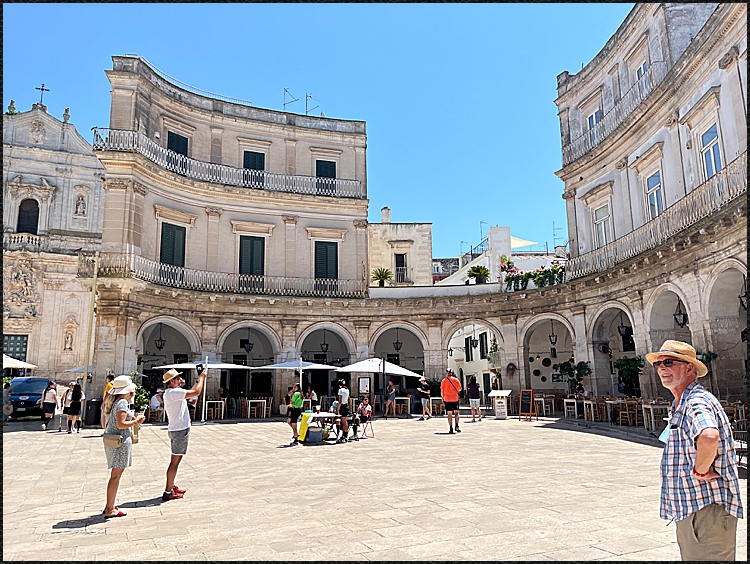
Piazza Plebiscito – Martina Franca

No-one should visit Puglia without going to this UNESCO World Heritage site – it’s a town full of Trulli, those distinctive dry-stone conical pyramids. They have been counted of course and although there may be some dispute about this, the town of Alberobello has over 1500 of them! It’s quite a sight as you arrive in the town. We parked a little way from the centre and walked in along the narrow streets with Trulli on either side. It felt like we were the only tourists around until we arrived in the main part which was very busy.
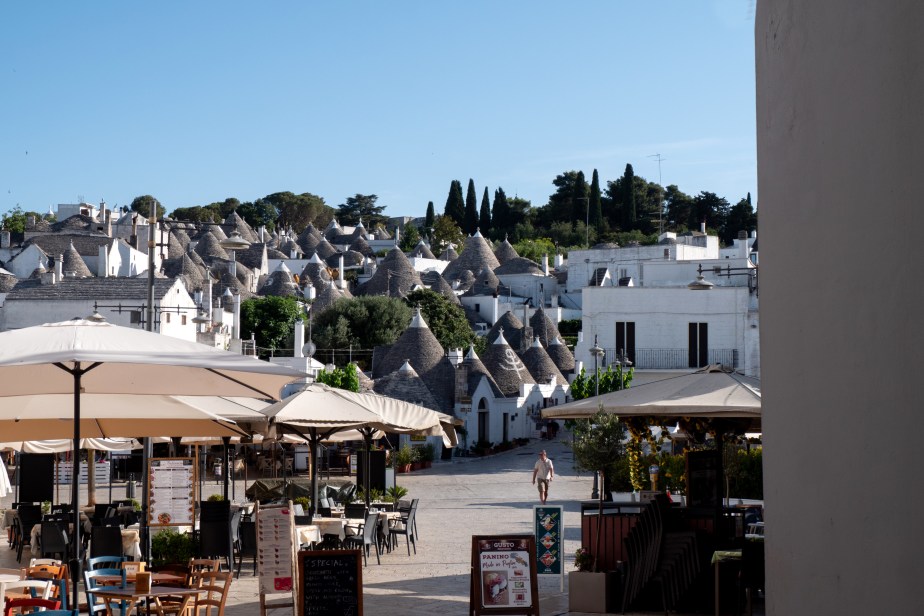
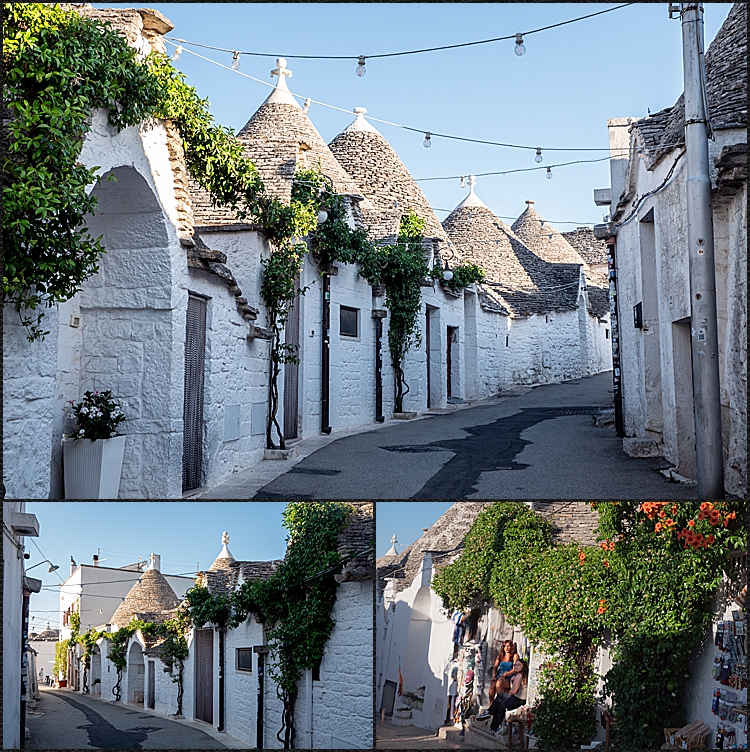
The sight of all these Trullis when you arrive in the centre of Alberobello is quite something.
The town of Trulli houses.
Many Trulli in Alberobello are now tourist shops.
It is a mannequin leant outside not a tourist overcome by the heat!
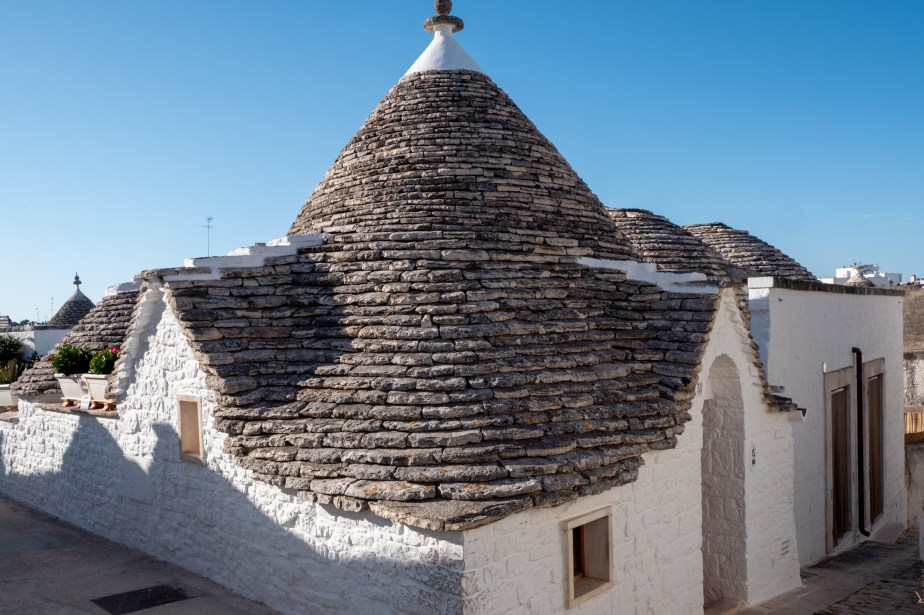
A perfect conical roof.

If you would like to know more, here is a link to a Blog by ‘The Thinking Traveller’ which is a full account of the fascinating history of Trulli Houses and their construction. We visited in the afternoon and thoroughly enjoyed wandering around but the best time to be there (apparently) is just before the sun is setting to get that golden glow on the Trullis and then you wait until the narrow streets are slowly lit by street lights to experience a unique fairytale setting.

At the end of our first week we drove south-east to the province of Lecce in the region of Apulia and onto the town of Lequile. The Airbnb was down a narrow, dusty track about 1km from the town. Pressing the bell at the side of an impressive pair of gates, we didn’t quite know what to expect, certainly not a mini-arboretum; the palazzio, swimming pool and grounds were fabulous. Our hosts Veronique & Mark were very welcoming and so was the wine offered to us once we’d settled into our accommodation which adjoined the main building.
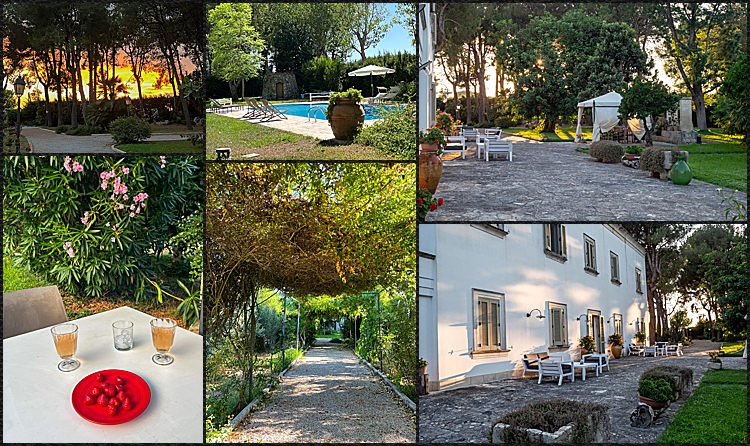
Via Capograsso near Lequile

It’s always helpful to chat to the owners who can suggest places to visit, not necessarily places where all the tourists go and also suggestions for local restaurants. Veronique did use the swimming pool but not in the afternoons when we were very happy to dive in after a dusty day’s sightseeing. The fruit in the garden was ours to pick, all grown organically and if we’d had the energy there was a tennis court we could use too. After the previous week on our own we were pleased the owners were nearby and spoke very good English.

There’s a lot to do in this area so we drove to Lecce first of all which is the main city. It’s described as the Florence of the south and is steeped in history with wonderful Baroque architecture. We parked outside the historical centre and walked through one of the gates, (apparently there are four). We did this walk a few times marvelling at the intricate facades of the buildings. Heading straight to the heart of the city we came directly to The Roman Theatre. It was built, as the name suggests, by the Romans during the 2nd century. It was buried for centuries and re-discovered by accident in 1901 by workers building a bank. You can see the horse-shoe shaped arena which could hold 15,000 spectators, but currently you can’t go beyond the perimeter fence. Perhaps it’s open for festivals?
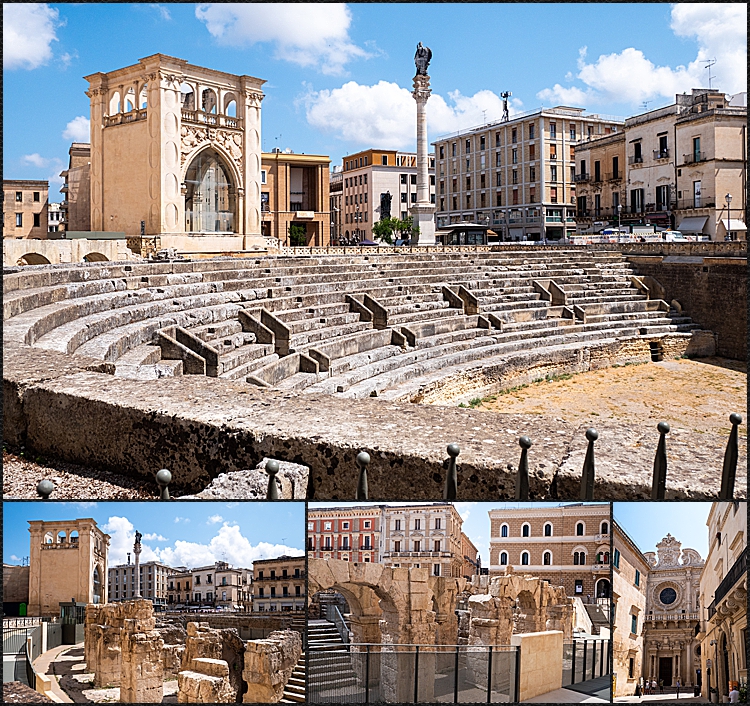
The Roman Ampitheatre Theatre.

As well as taking in the ornate architecture of the city buildings we enjoyed wandering around the narrow streets which predictably has lots of shops full of souvenirs interspersed with cafes and fine-dining restaurants. We did come across an excellent wine bar and thoroughly enjoyed a glass of wine in a quiet area in one of the side streets. Feeling refreshed we headed for the Cathedral.
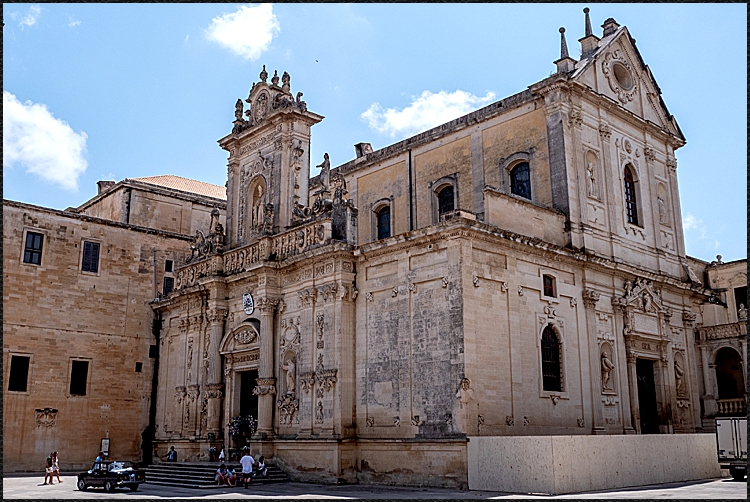
The Cathedral of of Santa Maria Assunta.

It was no surprise that a wedding was taking place. I used to be a wedding photographer before I retired and ironically on almost every one of our holidays we’ll come across a wedding. I own up, that along with several other tourists, I did take a few pictures as the party came out. I smiled when the official photographer turned round and asked if ‘The Paparazzi’ would get out of her way …people taking ‘snaps’ are a real nuisance!
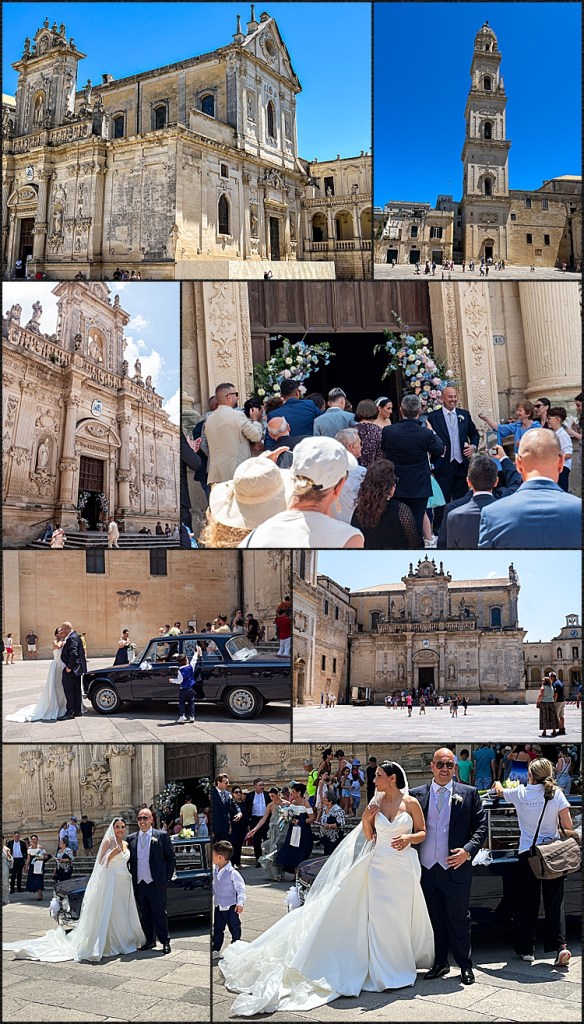
Wedding party outside the Cathedral.
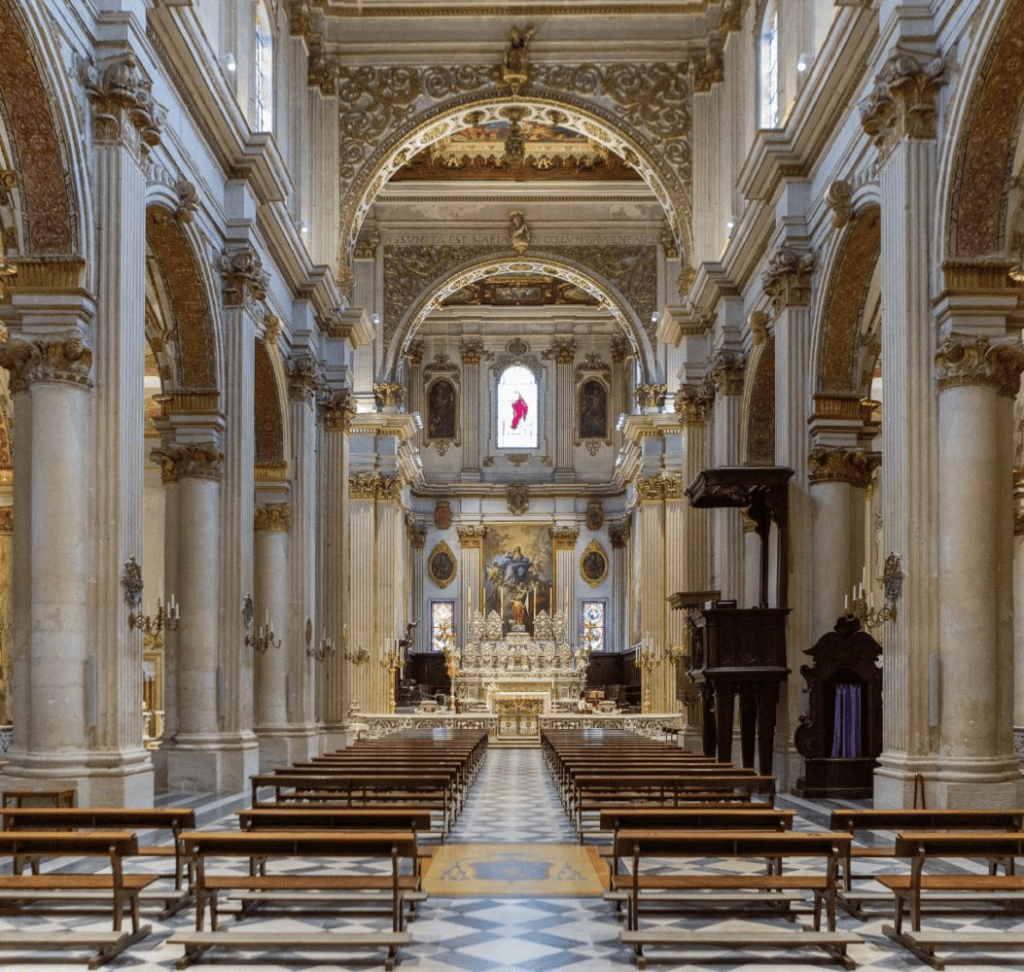
The Nave in the Cathedral of Santa Maria Assunta.

The Cathedral is a fine example of the Baroque style with its (heavy) decorations in Lecce stone, majestic columns and ornate sculptures. What a beautiful place in which to get married!

We went back to Lecce a couple of times as there was so much to see. .. churches, historic buildings and interesting alleyways are everywhere within the city walls. Parking can be difficult so we drove to a large car park outside the walls and walked in. Veronique suggested we go to Lecce in the evening when the Roman ruins are lit but we didn’t get round to that.
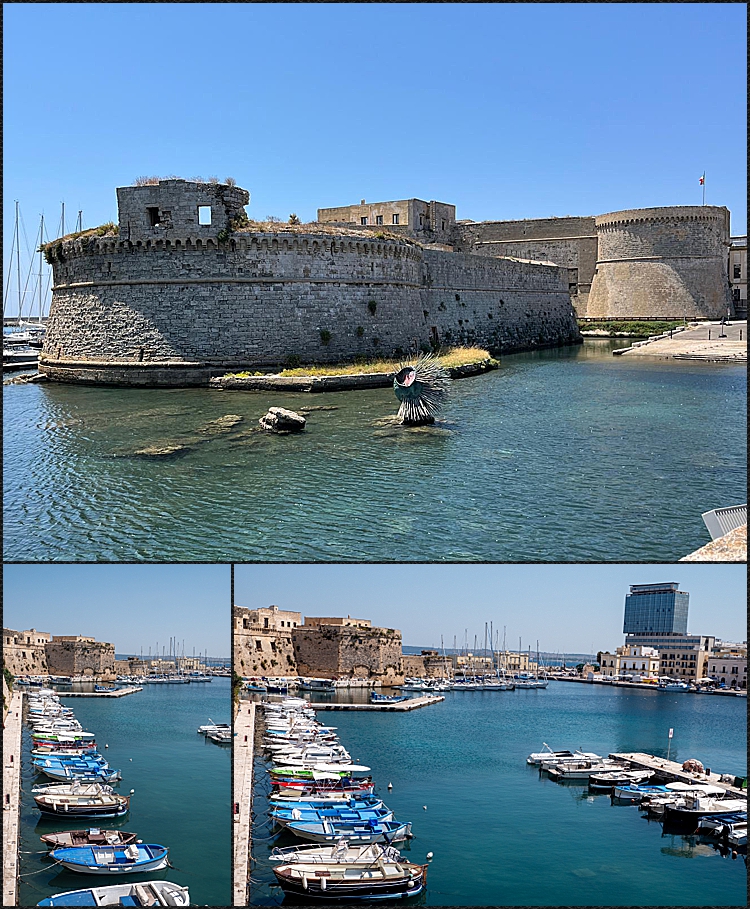
The port of Gallipoli.

On one day in our second week we drove to the port of Gallipoli which is located on Puglia’s Ionian coast. (There is also a place in Turkey called Gallipoli which was the site of a major World War 1 offensive known as The Gallipoli Campaign).

Gallipoli’s old town is perched on a limestone island. The first thing that hits you as you walk into the town is the castle. Described accurately as a fortress it was built in the 13th-centrury to protect the harbour from invaders, it is open to visitors. For us we enjoyed walking along the maze of narrow alley ways and along the harbour side. Yes there were of course lots of touristy shops but there were some more interesting ones too. Gallipoli is a busy place in the summer, not just for its character and its history but for the beaches with long stretches of white sand and crystal-clear water. As in all Italian towns in this area there were numerous Baroque churches, we did go inside a few but after a while we were happy sitting in one of the Piazzas enjoying an excellent lunch whilst watching the world go by.
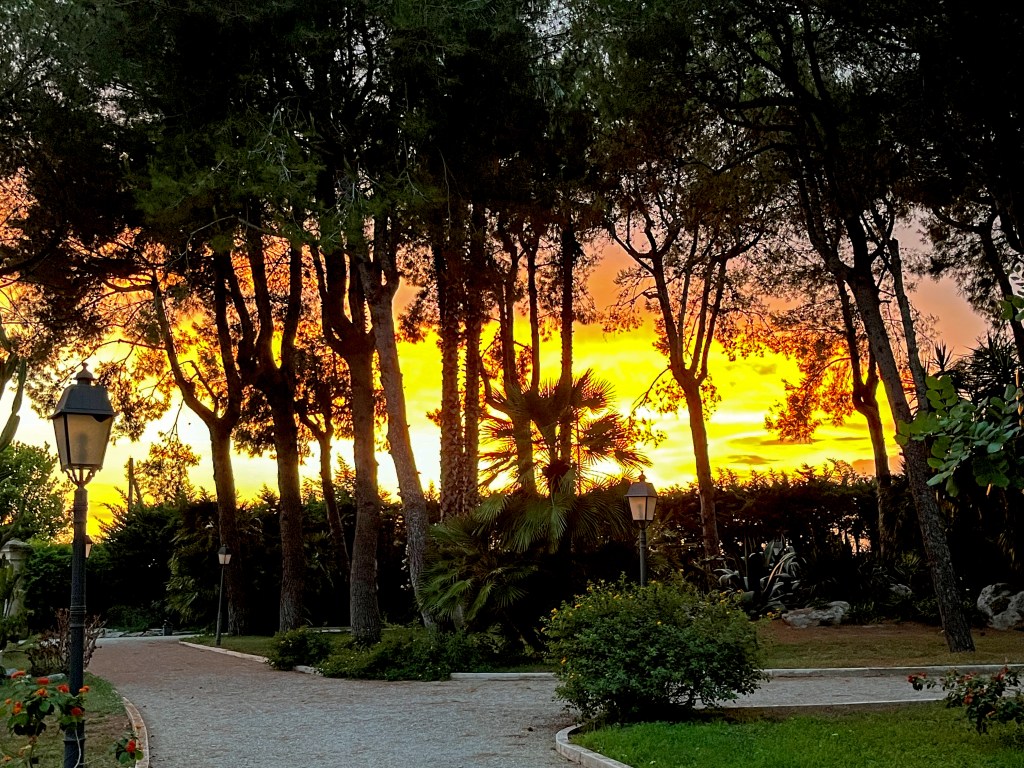
A stunning sunset for our last evening at Via Capograsso, Lequile.

Our last evening in Via Capograsso. We shared a couple of drinks with our hosts before heading off to ‘La Tana Del Lupo Giuseppe’ where we had eaten earlier in the week. Veronique & Mark had recommended it to us and we enjoyed it so much we decided this was where we wanted to eat on the last night of our holiday. It was the right choice.
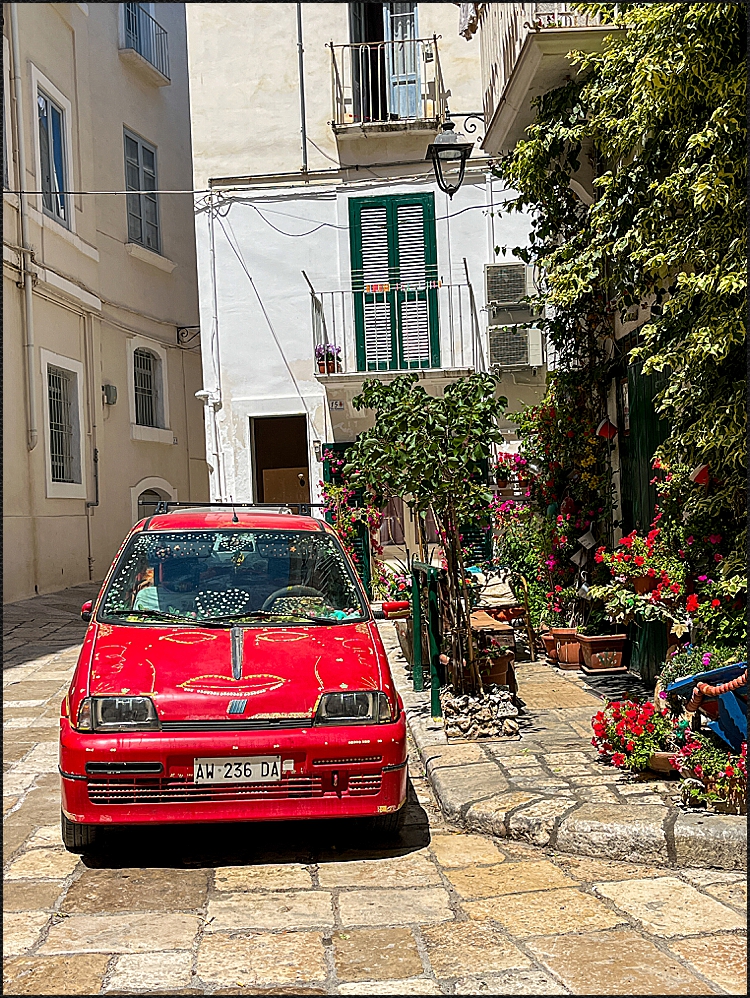
A corner which caught my eye in the pretty town of Monopoli.

Fortunately we didn’t have too far the next day to drive to Bari International airport and as our flight was late afternoon we stopped off at a couple of places en route.
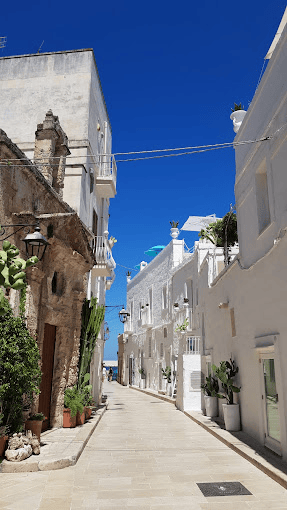
A typical street in Monopoli.

Monopoli is a popular tourist destination. The old town has narrow winding alleys which we enjoyed wandering along. Most houses are whitewashed and have green shutters which is typical of the region. Despite not being the height of the summer season, the main square was packed; hate to think what it would be like in August. We were happier avoiding the centre and enjoyed wandering around the Baroque Cathedral which was lovely and cool and afterwards found a cafe off the main thoroughfare where we enjoyed a sandwich and a beer.
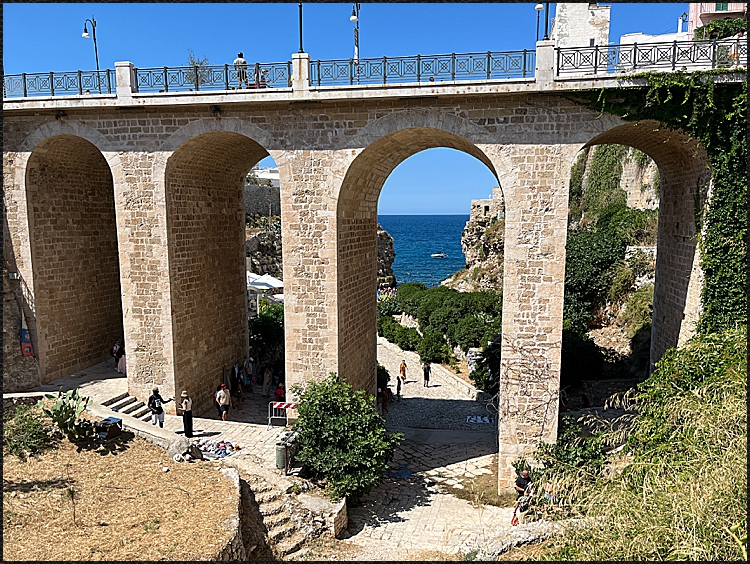
The impressive viaduct at Polignano a Mare

Our last stop before the airport was Polignano a Mare. This is another Puglian town perched on top of a high limestone cliff. As we knew parking might be difficult we parked a little outside of the town and walked in. As you can see, the viaduct is impressive and glimpsing the sea through one of its arches made, I think, this picture. ‘Blue Flag Beach’ is a popular spot with locals and tourists alike who apart from swimming in the crystal clear waters love to dive from the cliffs into the Adriatic Sea. Taking a boat trip is also on the tourist itinerary as from here there are trips to Monopoli and Capitolo, neither of which is far.

As for us we walked along the waterfront stopping at one of the panoramic terraces where you get a fabulous view of the sea and the coastline. The town was even busier than Monopoli so after grabbing a cold drink we walked back up the hill to our car and headed to nearby Bari to drop off the hire car and head for the Terminal.

We had enjoyed our two weeks in Puglia. The town of Alberobello with it’s funny little houses (Trulli); Lecce for its Baroque architecture and Roman ruins, the food, the wine, the coastline, the splendid pools at both Airbnb’s but the place we liked the most was Noci. A great little town where the locals know how to enjoy themselves. Every time we drove in for our evening meal there were families everywhere having a good time. It’s a friendly place with a great atmosphere and loads of places to eat. It’s not particularly touristy and maybe we liked it because of that or maybe it was just seeing all these Italian families and people of all ages just having a real good time.

I hope you enjoy reading about our two weeks in this part of Italy.
Exploring Tuscany: Highlights of Perugia and Beyond

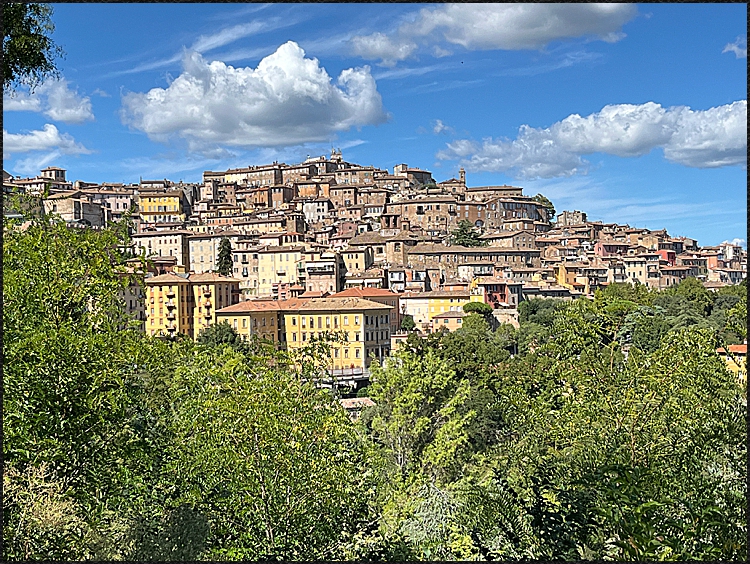
The hilltop city of Perugia.

Exploring Perugia.

These pictures have been ‘burning a hole’ in my Hard Drive since 2024 – that’s how long it is since we went on a week’s break to Italy. I knew I wanted to write a Blog on that holiday but for various reasons, I didn’t get round to it. Now I’m taking you back to September of that year when we flew to Perugia, picked up a hire car and headed for the city.

We found a car park outide the walls to avoid driving into the middle. The only snag was that we coldn’t get the pay machine to work however a local person came to our aid and gave us a Euro …such kindness. The picture above was taken from that car park.

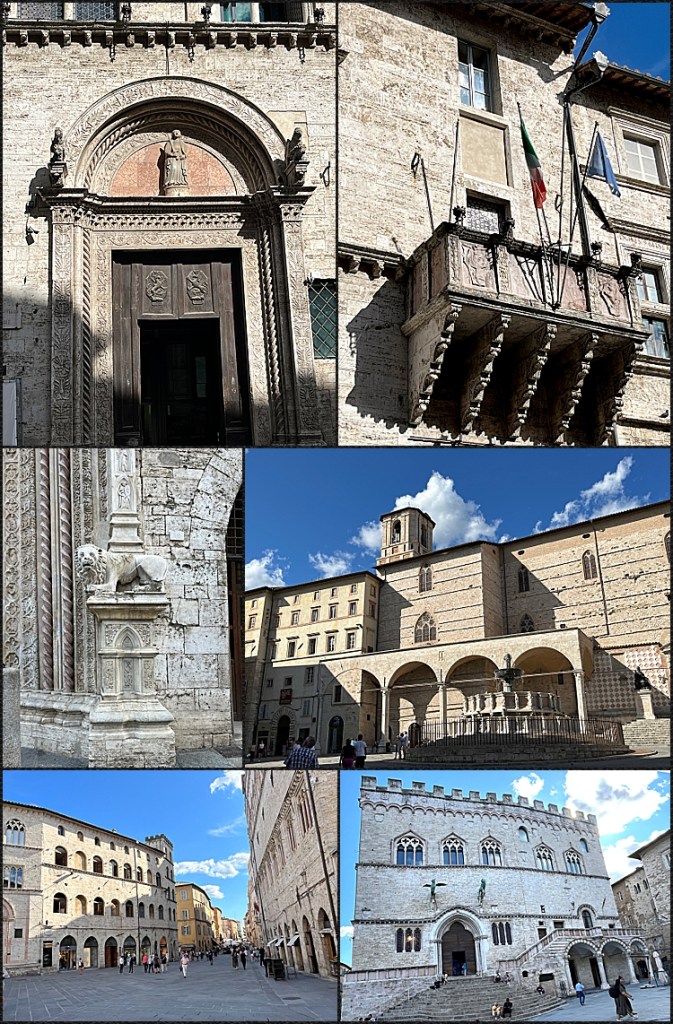
The historic centre of Perugia is described as a 14th century village, famed for its architecture, culture, cathedral and chocolate. Although this is a mediaeval city perched on a hillside it’s very easy to get to the centre by using lifts and escalators which take you right into the city centre – it’s a brilliant system.

Central Perugia.

After we’d got our bearings we sat at a cafe in one of the piazzas and ordered a glass of wine.This turned into a tasty lunch as the waitress told us quite firmly that we needed to eat otherwise the wine would go to our heads! Some time later we headed back to the car driving out of the city looking for our bed for the night at the Agriturismo La Ginestrella which took some finding! The accommodation there was very good however both the meal in the evening and the breakfast was disappointing. I’m afraid the description of their meals as shown on the website didn’t live up to expectations but possibly the standard of the cuisine has improved since we stayed there.

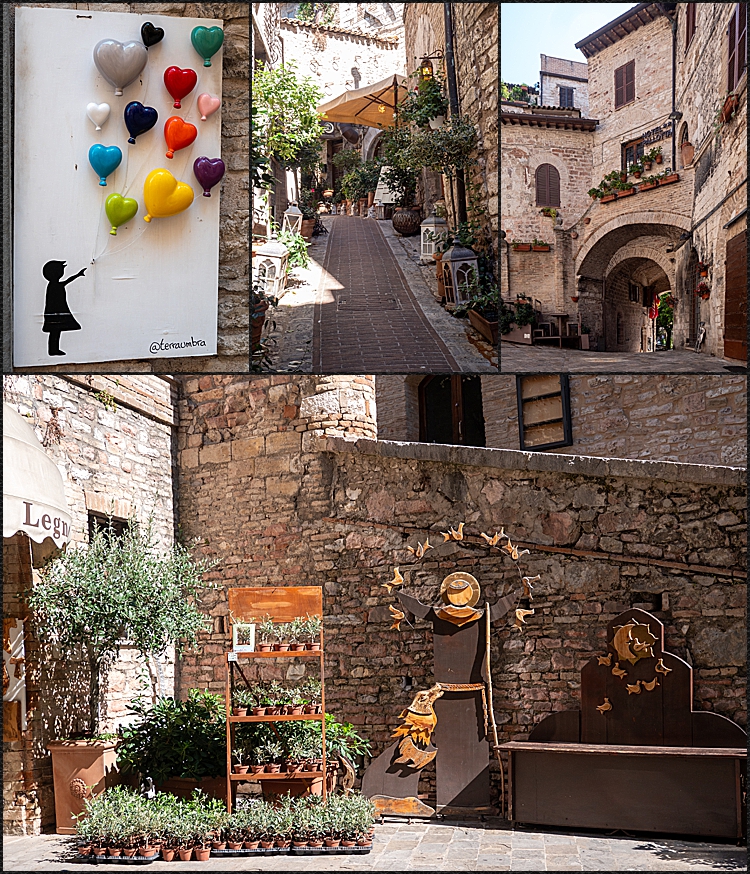
Assisi

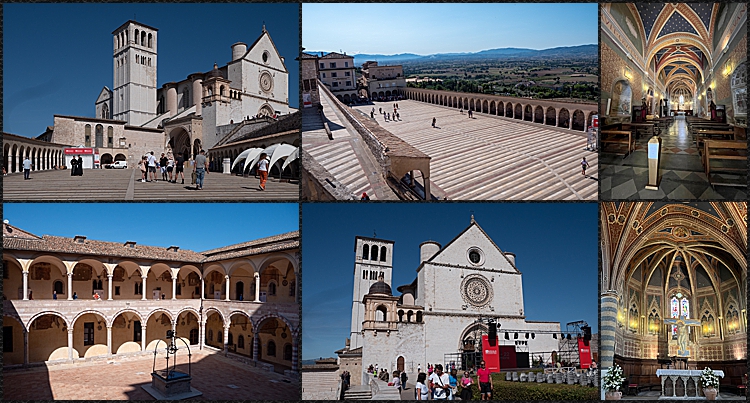
After a mediocre breakfast we drove to Assisi. This hilltop town attracts visitors from all over the world and is best known as the birthplace of St Francis. It’s a special pilgrimage place for worshippers who flock there along with other tourists to visit the Papal Basilica and view the tomb of St Francis. The Basilica is enormous and is on two levels with fabulous views of the countryside when you get to the top. Down in the crypt is the stone sarcophagus of St Francis. We were surprised that there was no charge to go in this splendid building …the church could make a fortune!

The Basilica of St Francis.
Assisi town.

Assisi has always been a special place of pilgimage but since the 17year-old Carlo Acutis was canonized there on 7th September 2025 the town has attracted even more Catholic followers. His tomb is in the Shrine of the Renunciation which we didn’t visit. The town itself is steeped in history and was well worth dodging the crowds to look around. Small shops, many of them selling souvenirs line the narrow cobbled streets. After a while we decided to head out of town and find a quieter place for lunch. The small village of Spello was perfect. We sat on a sunny corner, enjoying a delightful lunch washed down with a carafe of wine. Spello is known as the ‘city of flowers’ and many of the streets and balconies are filled with plants and flowers. It’s a popular destination, known for its Roman and mediaeval architecture (along with other hilltop towns), but the annual Flower Festival in late spring attracts hundreds.

In the evening:

Rather than eat at the Agriturismo we researched local restaurants and discovered Taverna dell’Orso which was just down the road. We hadn’t booked thinking it would be quiet but we were wrong …this restaurant is on everyone’s radar and no wonder, it’s excellent. There were no tables left inside but the outdoor seating area was fine and that quickly filled up too. We thoroughly recomend this Taverna if you’re in the area, it’s very hard to beat.

Exploring Perugia:

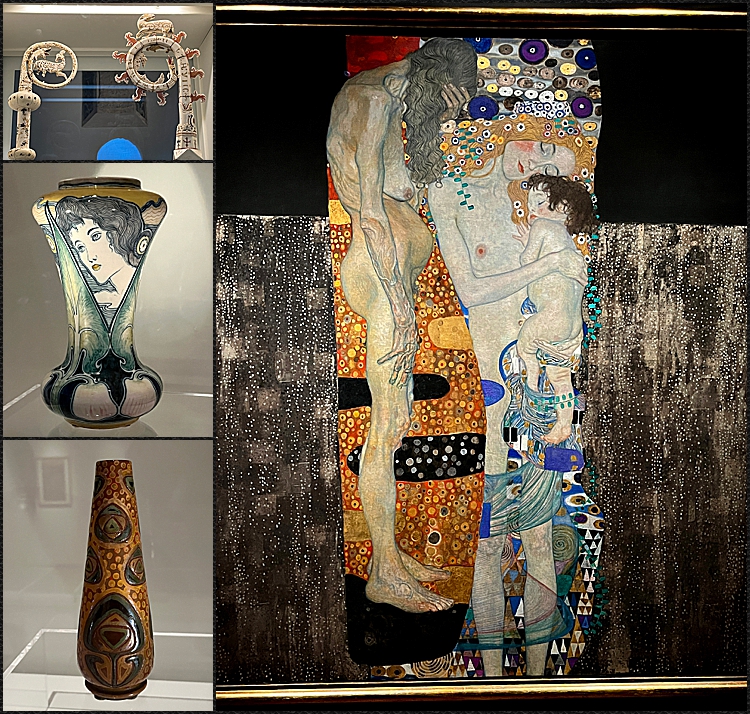
Next day we thanked our hosts at the Agroturismo as everyone had been very friendly and drove to Perugia. We were looking forward to exploring the city as there’s so much to see. Our first stop was to the Galleria Nazionale dell Umbria. The building itself is remarkable with about four floors, each one as interesting as the last and the views out of the windows to the hills are stunning too. I particularly wanted to visit the museum to see the temporary exhibition of paintings by Klimt. The museum houses many Art deco exhibits too. We spent quite a while in the Galleria and thoroughly enjoyed walking around this huge mediaeval building.

Some of the exhibits in the Galleria, also one of Klimt’s well known paintings,
‘The Three Ages of Woman’.

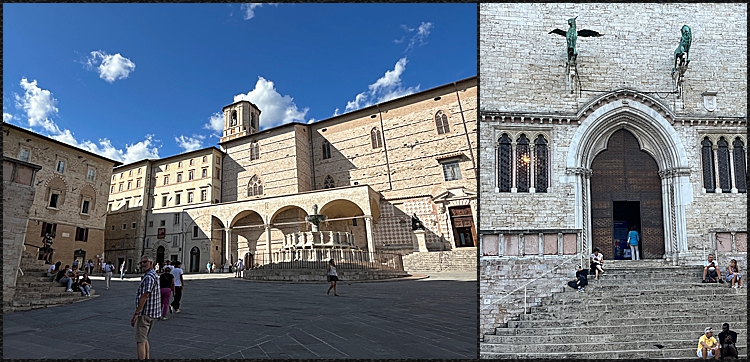
The museum is on the famous square, Piazza 1V Novembre with the fountain, Fontana Maggiore in the centre. In the Middle Ages the square was the starting point for the five main streets of the city. The area is a popular meeting place in Perugia not only to sit and watch the world go by on the steps of the Cathedral but also to gaze at the fountain in the centre of the Piazza which is considered a masterpiece of medieval sculpture.

Piazza 1V Novembre.

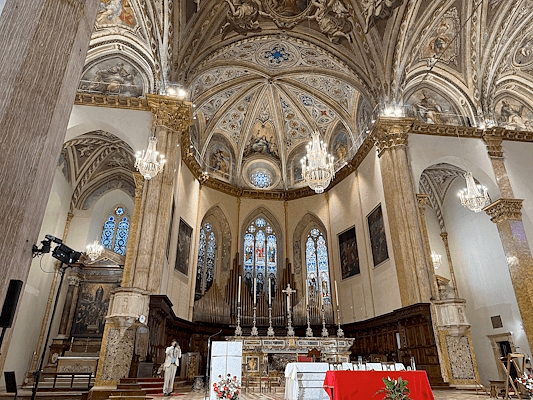
The Cathedral of San Lorenzo was our next stop whci is next to the Galleria. The exterior with its pink marble looks as though the building isn’t finished which in fact it wasn’t as in 1587 work stopped, they did finish the interior of the cathedral though. Inside there are three naves separated by massive pillars but the most notable feature is the intricately decorated ceiling. I don’t think we did justice to the Cathedral but we had to get on and we had one more thing to do.

I’m guessing that few people visit Perugia without visiting at least one of their famous chocolate shops. Chocostore is in the square and calls itself the Temple of Chocolate. It was so popular when it opened in 2012 that there are now three Eurochocolate stores in Perugia. The Italians love chocolate as much as they love ice cream so in November each year, since 1993, nearly a million people come to Perugia for the annual chocolate festival where there is live sculpting and massive chocolate art. Sounds amazing! You can also visit the factory where the chocolate is produced by the company, ‘Baci’, (the Italian word for kisses).

On to Montepulciano:

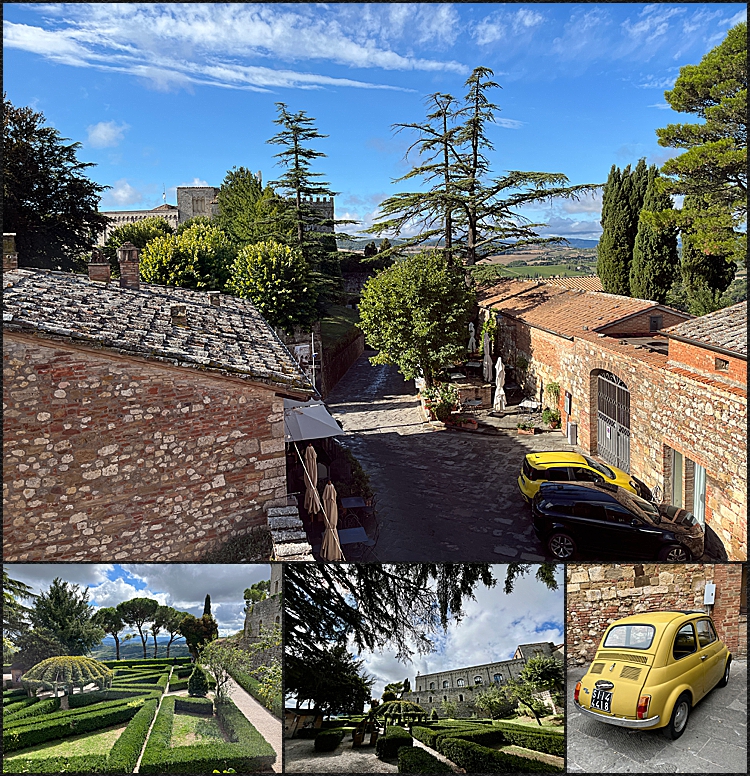
I love the name of this place, it rolls off the tongue. We had booked a hotel in the town but when we were met by one of the owner’s staff we were told that we could stay in this appartment at the very top of the town. Everything in the apartment was brand new so maybe the owber used us as ‘guinea pigs’? It was fine by us but parking in this area is difficult although that goes for most of the town. We did like the location and once settled we walked to the the Fortress – Fortezza Medicea di Montepulciano. The views of the Tuscan Hills are stunning and the grounds are well-maintained although very manicured.

The view from our appartment, also the grounds of the Fortress.
The iconic italian car parked nearby deserved a picture.

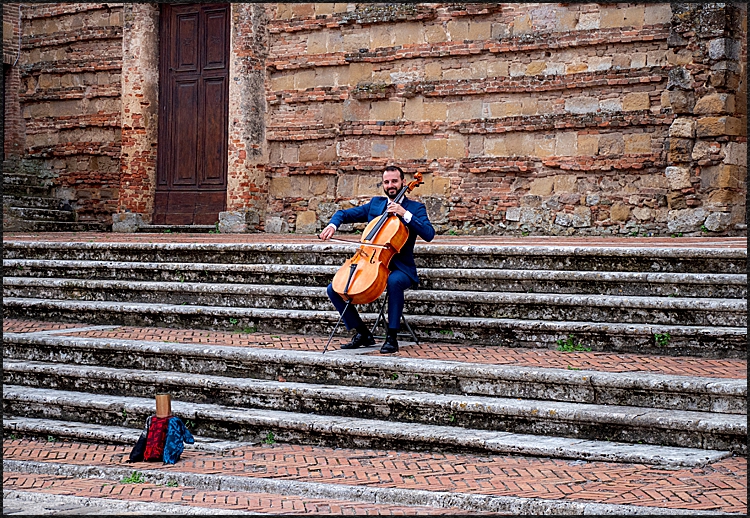
It was quite a steep walk down into Montepulciano but all very interesting. As we got nearer to the centre we could hear music being played and there on the steps of a large ancient building was this chap playing his cello. The sound bouncing around the walls of the piazza attracted quite a crowd and was the perfect setting for his music.

A happy musician.

After a short walk round I spotted a tea shop and decided it was time for tea. Unfortunately although the building looked interesting and it didn’t disappoint inside but the attitude of the staff wasn’t good! The ‘little demigods’ of waiters were miserable looking down their noses at the customers and there was a definite hierachy amongst the staff which meant the lowly junior was treated appallingly. We didn’t linger long on our hot drinks and said there was no way we would go there for breakfast. Fortunately the restaurant we had chosen that evening was excellent. Osteria del Borgo has a good reputation so you need to book. The menu is extensive as is their wine list. The whole of one wall in the restaurant is lined with bottles! We rounded off the evening with a leisurely walk back up to our apartment remarking on how lovely the town looks with each pathway and piazza carefully lit.

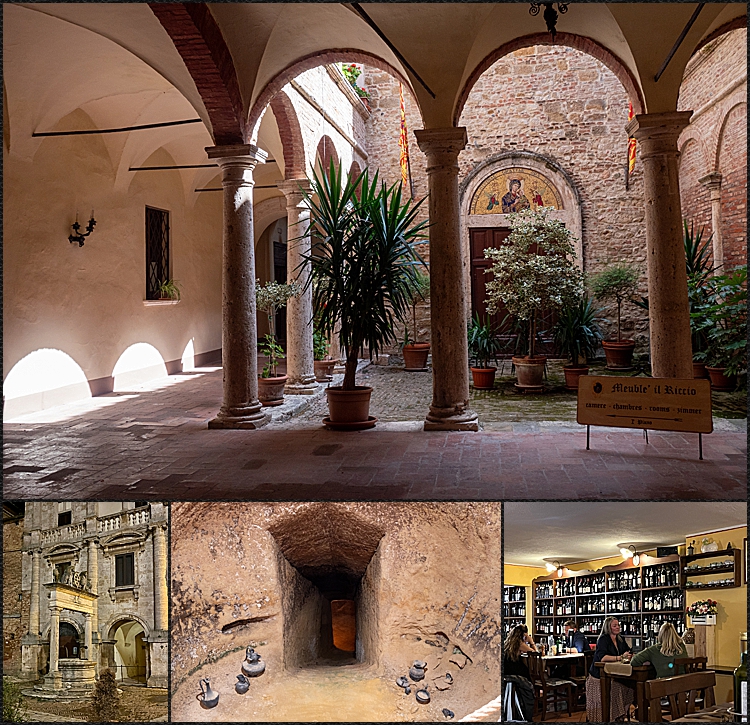
Some of the features of Montepulciano including a deep cave inside one of the shops
and a very well-stocked wine store with apparetly over 600 labels!

A little research and we found the perfect place for breakfast just down the hill from where we were staying. There were people queuing outside Alma cafe and not surprising it was probably the best cafe in the area. Afterwards we wandered into the grounds of the Fortress again and found an exhibition was being set up. There were lots of paintings and sculptures but although I tried to chat to some of the artists my Italian wasn’t up to it.

There are quite a few touristy shops in the town which you would expect but there were a few selling local crafts. I spent some time in a delightful studio run by a local artist and bought a painting there for a friend. Another shop we went into had a deep cave at the back of the building which obviously had a lot of history attached to it. Looking at how deep it was suggests that many of the shops along that street had cellars underneath them.

Walking to the Temple of Saint Biagio:

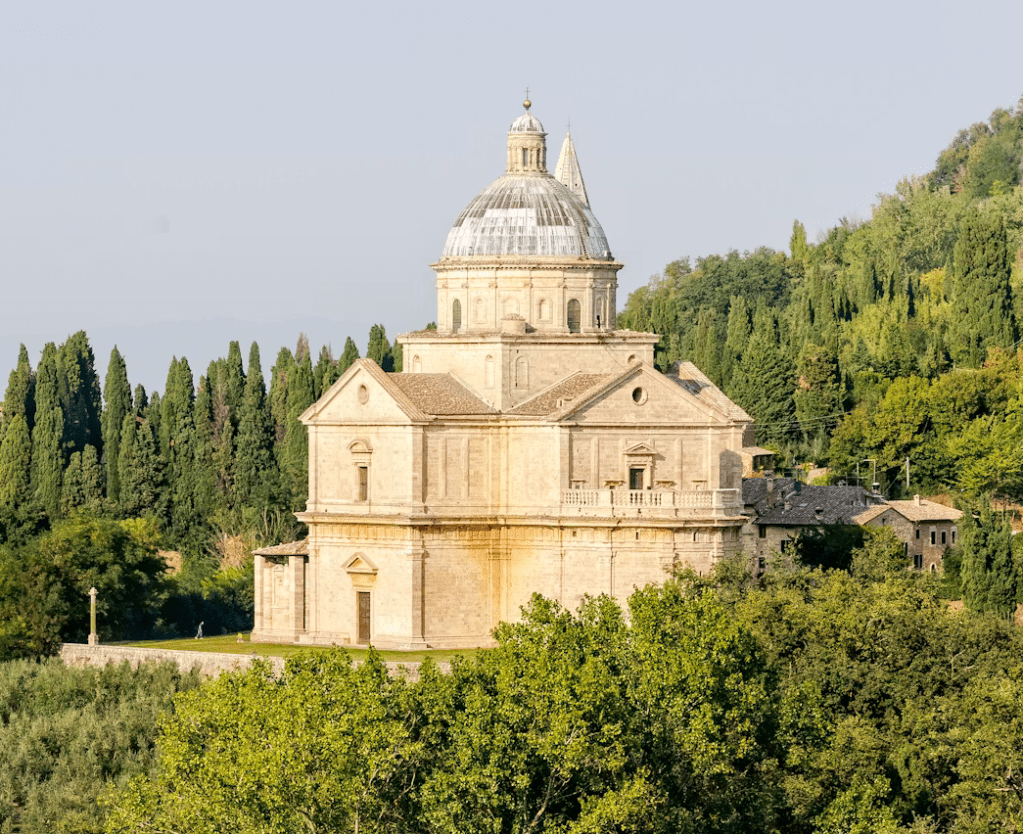
In the afternoon we walked down the hill to have a look at the large church which is located on a flat meadow some way from the centre of town. The Tempio di San Biagio was built in the sixteenth century and is very impressive with its central dome and tall tower. Unfortunately as we walked down the heavens opened and we got thoroughly soaked! The Basilica is a rather dour place inside but that might have been something to do with the rain hammering down outside and us being quite wet. We waited until the rain stopped and made our way up the steep path back to our appartment to dry out.

Leaving Montepulciano and heading for Sienna. First stop of the day – Pienza:

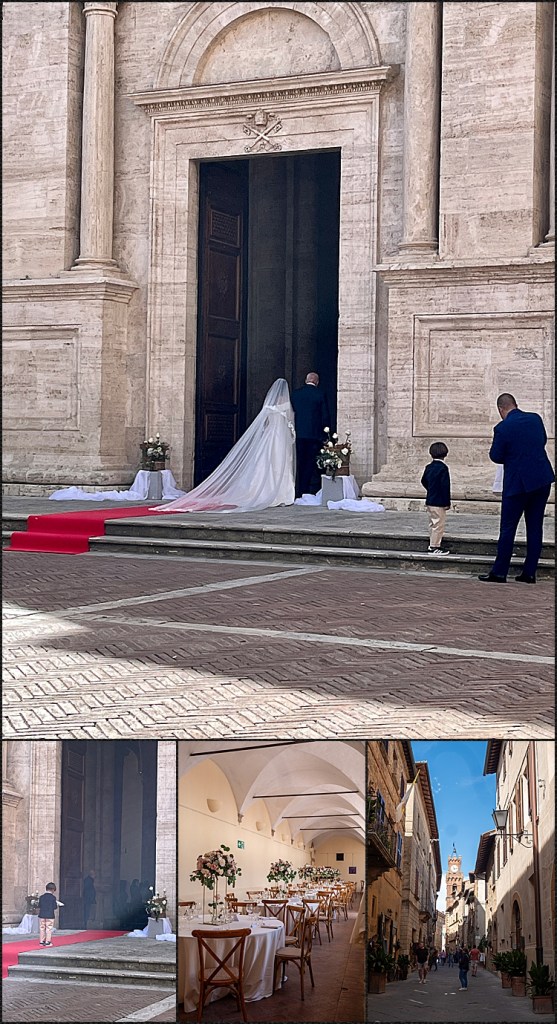
Breakfast again at the excellent Alma Cafe before leaving Montepulciano and moving on to Siena. It was a Saturday morning and true to form on our holidays, we came across a wedding. Sometimes I think it’s because I was a wedding photographer and although I’m retired, I can’t escape them. We stopped to look round Pienza, another interesting town in Tuscany with a large cathedral and buildings in the Renaissance style. It’s a compact town with some great local shops and beautiful views. The wedding was at the town’s very impressive Cathedral and of course the wedding attracted quite a crowd. Once the bride had gone inside, the doors closed and for a short while the young page boy stood outside on his own. I wonder if he was nervous? Those doors look very big even to an adult. We crept in through the side entrance and watched for a while and then started walking back to the car where we saw where the wedding breakfast was being set up with tables beautifully decorated. It was a perfect setting, and yes, I had to take a picture!

A wedding in Pienza

The hamlet of Bagno Vignoni:

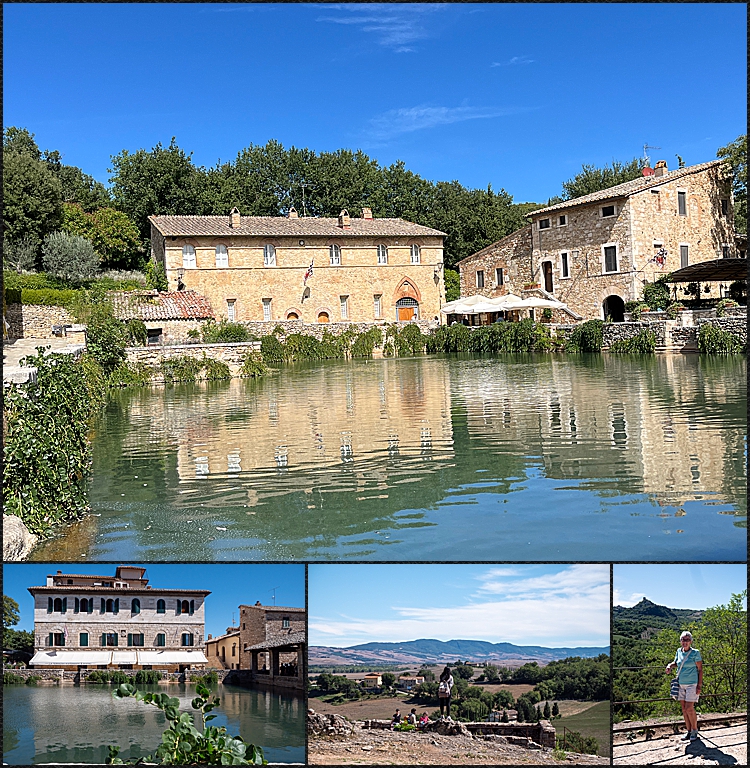
Our next stop was at the famous village of Bagno Vignoni just eight miles down the road. It’s a small, hillside settlement which attracts many tourists. Where you might expect a village square, instead there’s a large expanse of water; a tank full of hot, thermal water which bubbles to the surface. Locals used to bathe in there. Legend has it that St. Catherine dipped her toes in ther water but now it’s just a great photo opportunity. We ate lunch outside at one of the cafes but we were plagued with flies which I guess is the down side of having all that water around.

Bagno Vignoni and the ruins of a water course alongside the village.

To the Abbey Abbazia di Monte Oliveto Maggiore:

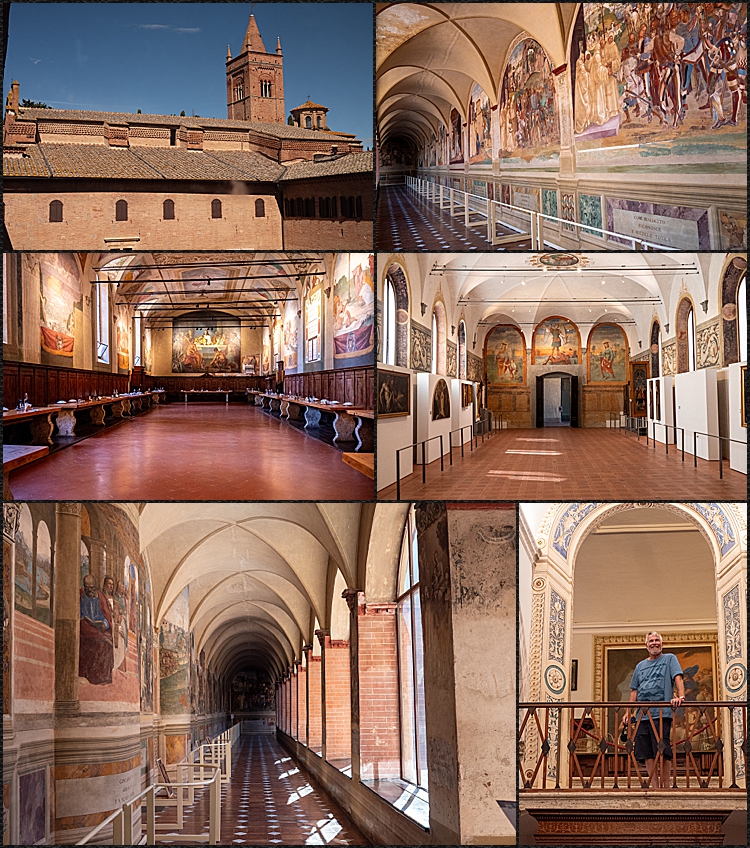
Our last stop before arriving in Siena was to the Abbey, Abbazia di Monte Oliveto Maggiore. An interesting drive into the hills and a lovely walk to the Monastery building along a woodland path. The Abbey iteslf is a complex of several buildings some of which visitors could access. The entrance was €7 for each of us. I think we had to pay for parking too – these places need the money!

Abbazia Di Monte Oliveto Maggiore.

We enjoyed walking around but both if us felt the place lacked any atmosphere, religious or otherwise. Perhaps we expected to see more, even bumping into one of the monks would have done it. The Refectory which is still used, the 15th centrury frescoes along the Cloisters and the library were the highlights. Some areas were mentioned in the leaflet but we asumed they weren’t open that day.

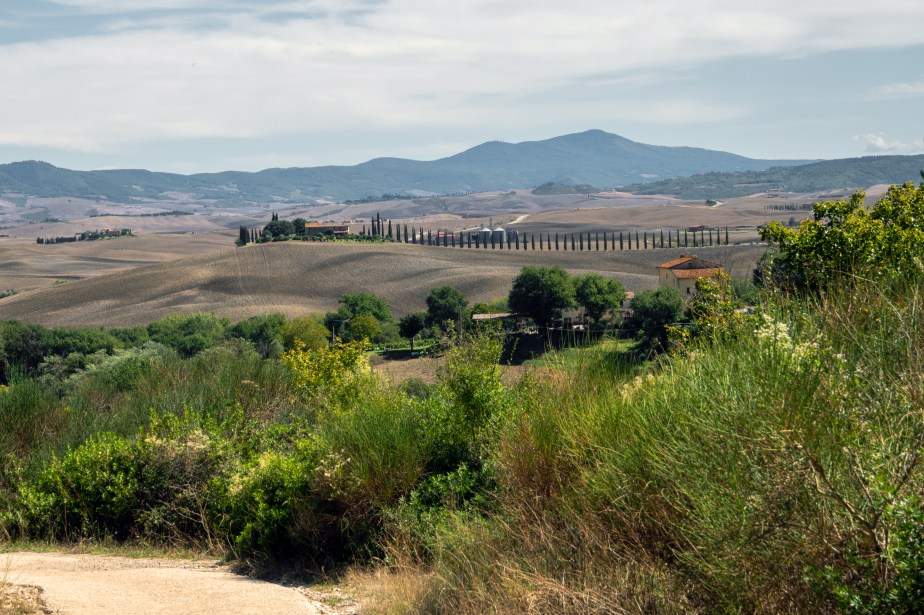
From the Tuscan hills across the the Plains towards Siena is a beautiful drive with superb views.

Tuscan landscape

Arriving in Siena:

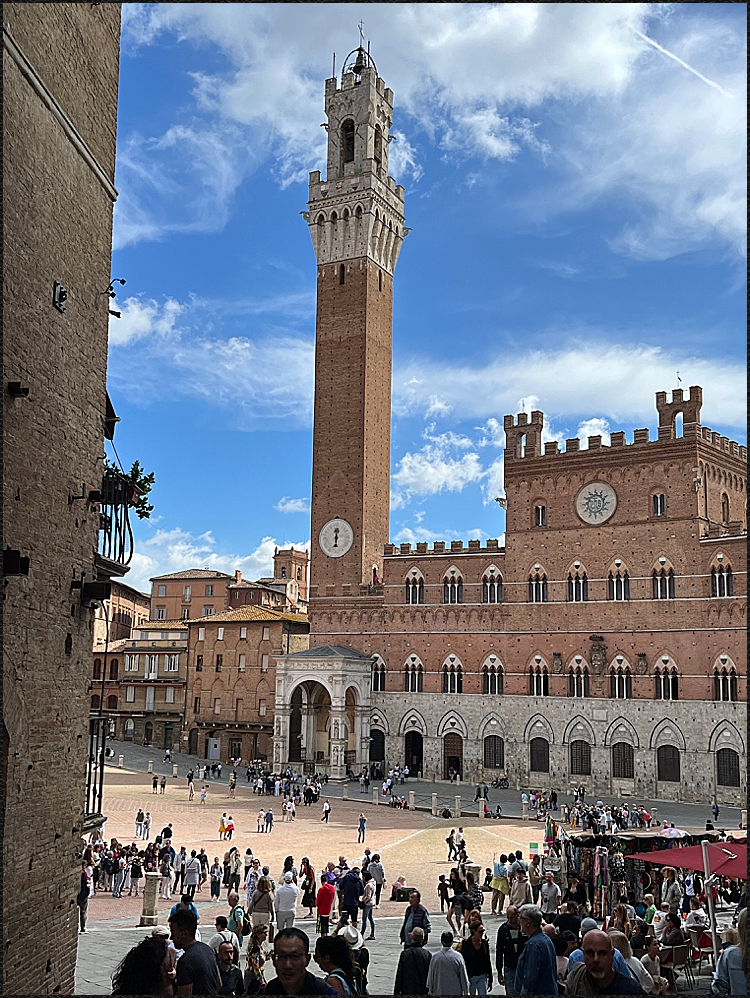
We arrived at our hotel, Il Giardino late afternoon and it wasn’t long before we headed into the city which we know so well. It was good to be back.We were pleased with the hotel as this was the first time we’d stayed there. It’s just outside the historic walls, has good views over the city and a great swimming pool. Siena is one of our favourite places, one city we will never tire of. Just sitting in the Piazza del Campo, the main square, watching people sat in this revered public space is fascinating. The shell-shaped ‘square’ is divided into nine sections, representing the ‘Government of Nine’ who ruled Siena in the 14th century. It’s not unusual on a hot, summer’s day to see people moving around the Campo to stay in the shade.

Enjoying a drink at one of the many cafes around Le Campo.

Walking along the medieval streets at night time is a different experience to during the day. These narrow, cobbled streets are lit with lamps fashioned to look medieval so together with the historic nooks and crannies you see along the walls of the ancient buildings and the flags of the Contrade of Siena hanging overhead, this is an experience you don’t find anywhere else. The cobbles can be tricky if you’ve had one too many glasses of vino though as you stroll back to the hotel!

There’s lots of places to eat so on our first night, spoilt for choice, we headed for the family-run Antica Tratorria Papei It’s very popular but they did manage to fit us in. We thoroughly enjoyed this friendly restaurant with great food and lots of atmosphere so we went back there on our last night in the city. More about that later …

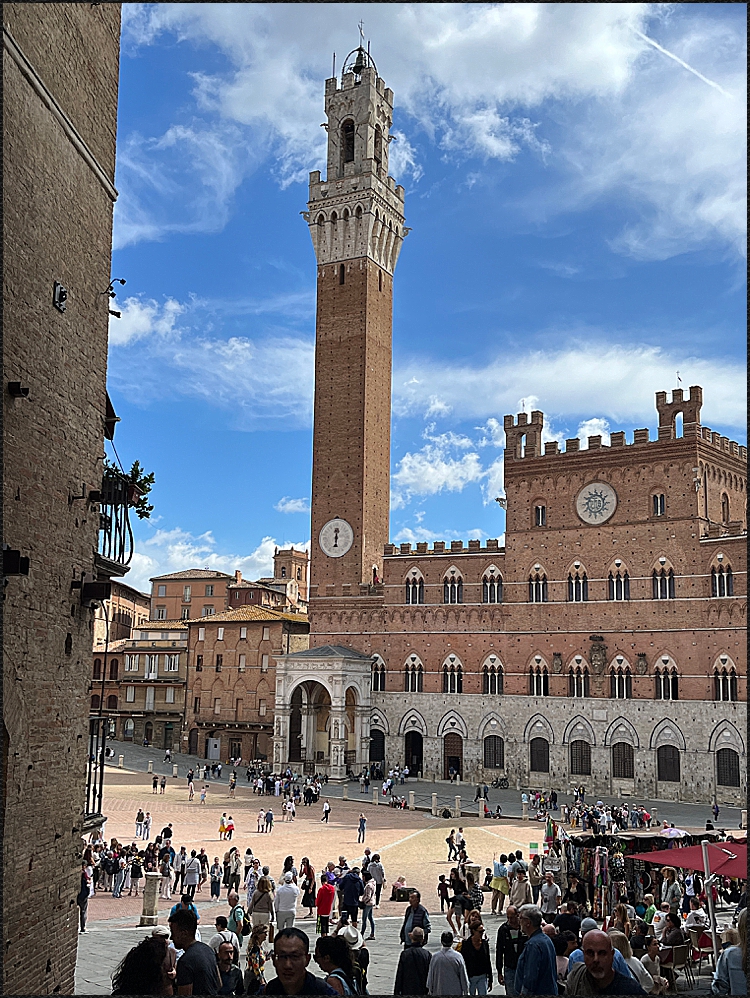
Even though we’ve been to Siena several times it was a while since we’d been into the Museum which is in Siena’s City Hall, the Palazzo Pubblica. Construction began in 1297 and with a few breaks was completed in 1331. The building is considered to be the most significant example of civic Gothic architecture. Together with the tower, La Torre Del Mangia, this iconic building dominates the Campo. The paintings and artifacts in the museum, Museo Civico, are well worth the entrance price of €10 and if you have a head for heights, the Tower gives a superb view of the city and surrounding countryside.

The Palazzo Publica & The Tower.

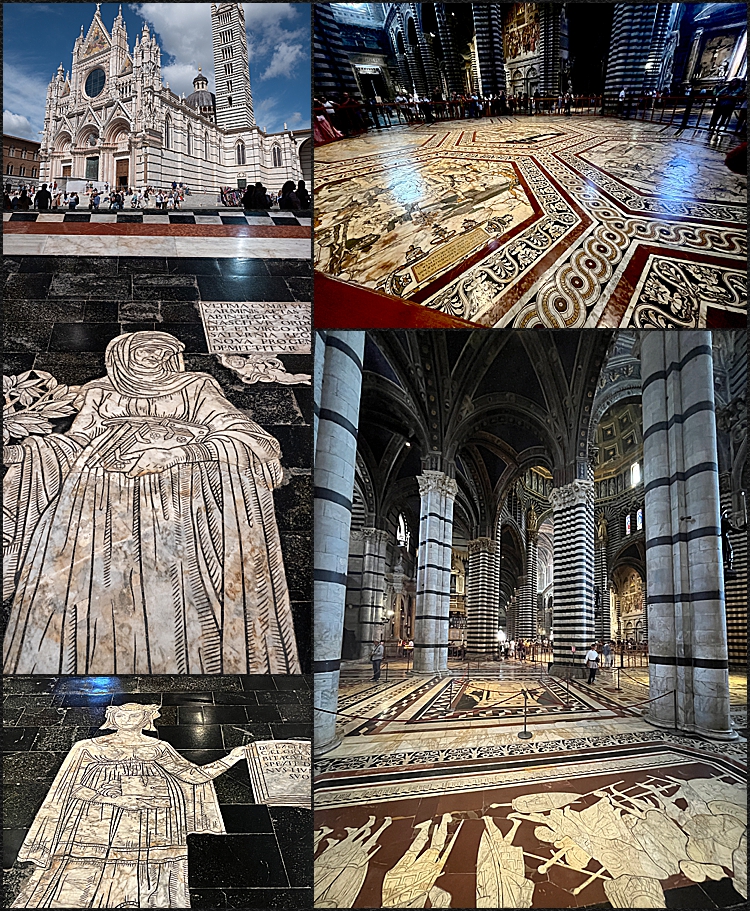
Afterwards we walked up the steep street to the Cathedral, the Duomo di Siena. It’s another Gothic masterpiece and is most famous for its marble mosaic floor with images of saints etc, with this 14th century work known as ‘graffito’ – the detail is truly stunning.

The Magnificent Cathedral of Siena.

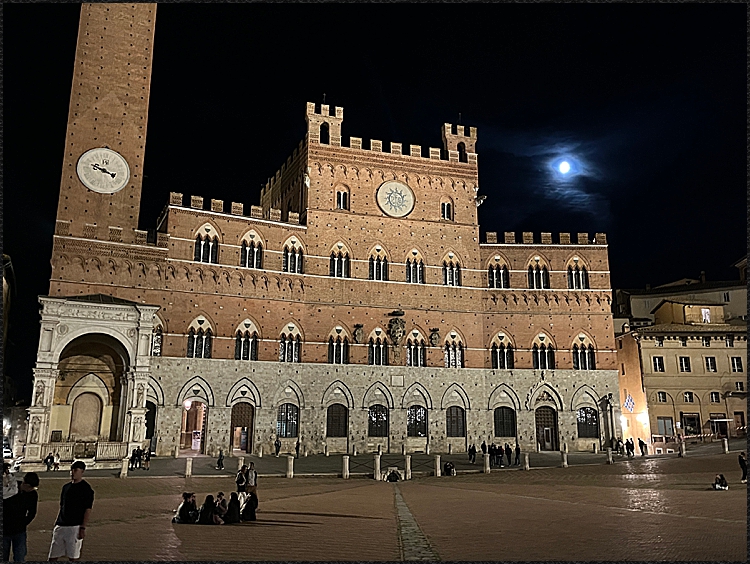
After lunch and another wander round in the heat we sauntered back to our hotel to take advantage of the swimming pool and catch up on some reading. Had a couple of wines in the evening at one of the cafes which line the Campo enjoying looking at the people going by and tracing the moon going across the sky behind the Palazzo Publico. This is a magical place whatever the time of day or night.

Palazzo Pubblico also the Torre del Mangia and on the far left the Cappella di Piazza.

A visit to San Gimignano:

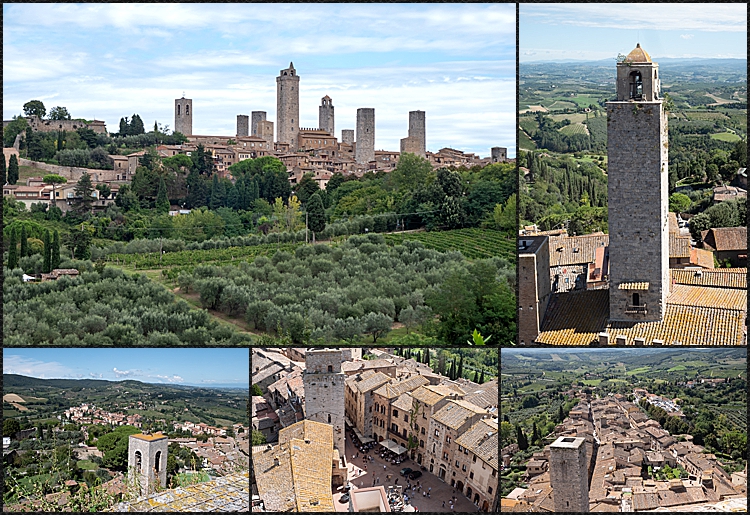
Another hot day in Tuscany and the last full day of our holiday. We decided to drive over to San Gimignano to have a look round. This is one of the most popular towns in Tuscany and famous for its medieval architecture including many tall towers. The story behind all these towers is quite interesing …there was rivalry between two powerful families who thought by building a tower would indicate their power and wealth. By the end of the Medieval period, this trend had caught on, with every wealthy family building their own tower, resulting in 72 towers in total in San Giminano. Although many towers were cut down or destroyed during World War II, 14 remain. The tallest is 54 metres, built in 1311 and is the one tourists aim for, which we did too. Going up the 218 steps of Torre Grossa is well worth the climb as the views from the top are fantastic. There’s a small ladder at the top and people are ‘controlled’ so not too many stand on the tower at any one time.

The skyline of San Gimignano and views from the top.

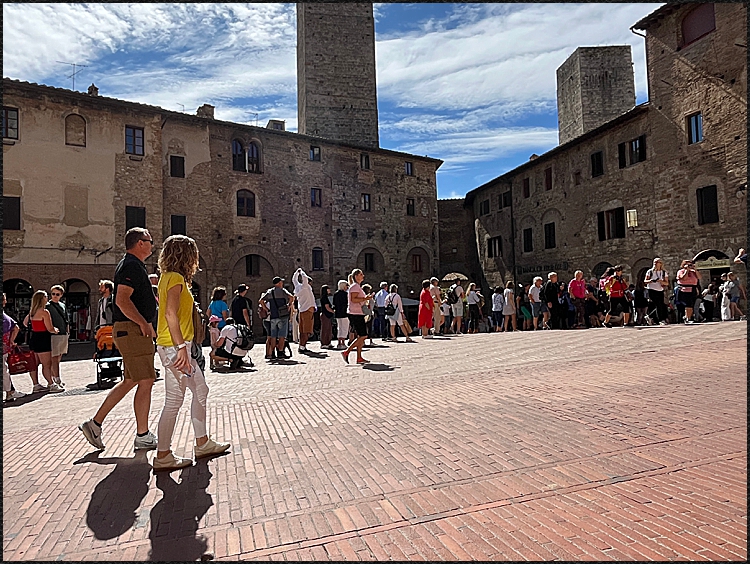
After our exertion up and down the tower we headed for a cafe in the central Piazza della Cisterna and enjoyed a beer and a pleasant lunch. The square is also home to the Gelagteria Dondoli which they claim is the ‘World’s Most famous Ice Cream’. Whether that’s true or not it’s fame is well known going by the enormous queue which went right across the Square from the tiny doorway of the Ice Cream Shop. It was a hot day but I imagine that every day during most of the year there is a long queue outside.

The Piazza and queue for The Ice Cream Shop

Not sure what the temperature had soared to, but after walking around the town we headed back to our hotel to cool off in the pool.

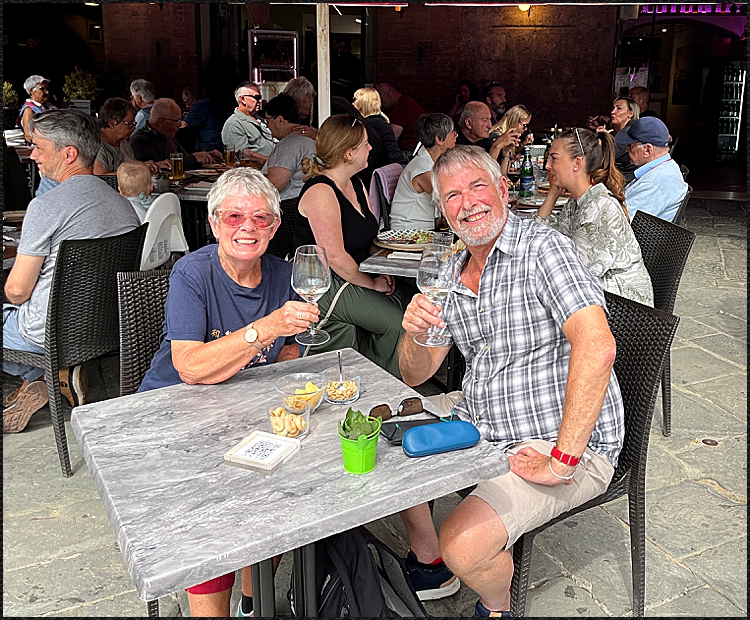
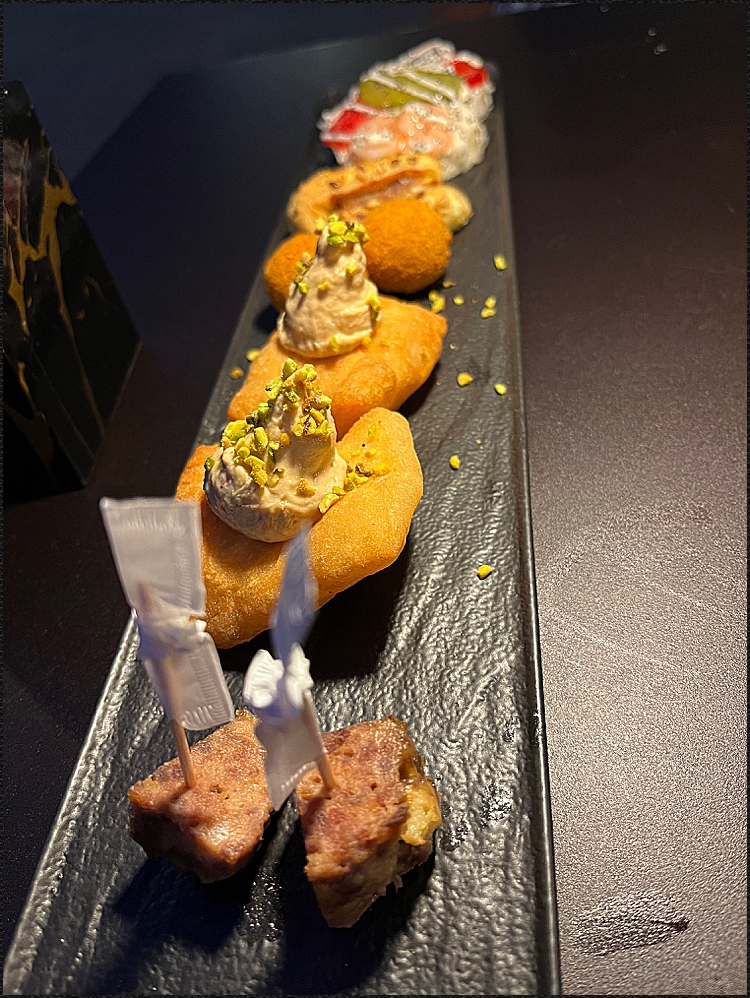
As it was our last evening and as we’d enjoyed our meal so much we booked a table back at the Antica Tratorria Papei We walked first to The Campo and decided to have a drink at one of the cafes. Unbeknown to us, Bar Restaurant Caffe Fonte Gaia are very generous when it comes to serving ‘nibbles’ with their drinks. We probably should have stopped at the first glass of wine but we had plenty of time before our meal so we orderered a second glass wine which came with even more ‘nibbles’ than before! They were delicious but now we were full …

Substantial ‘nibbles’

We did go along to the resaurant after that and were welcomed with open arms as though we were regulars. We made a brave attempt at eating the meal but it was a struggle. We laughed about it all the way back to the hotel. It had been a fun night and one to remember as we bade farewell to Siena and headed back home the next day. Adieu Siena, we will be back.